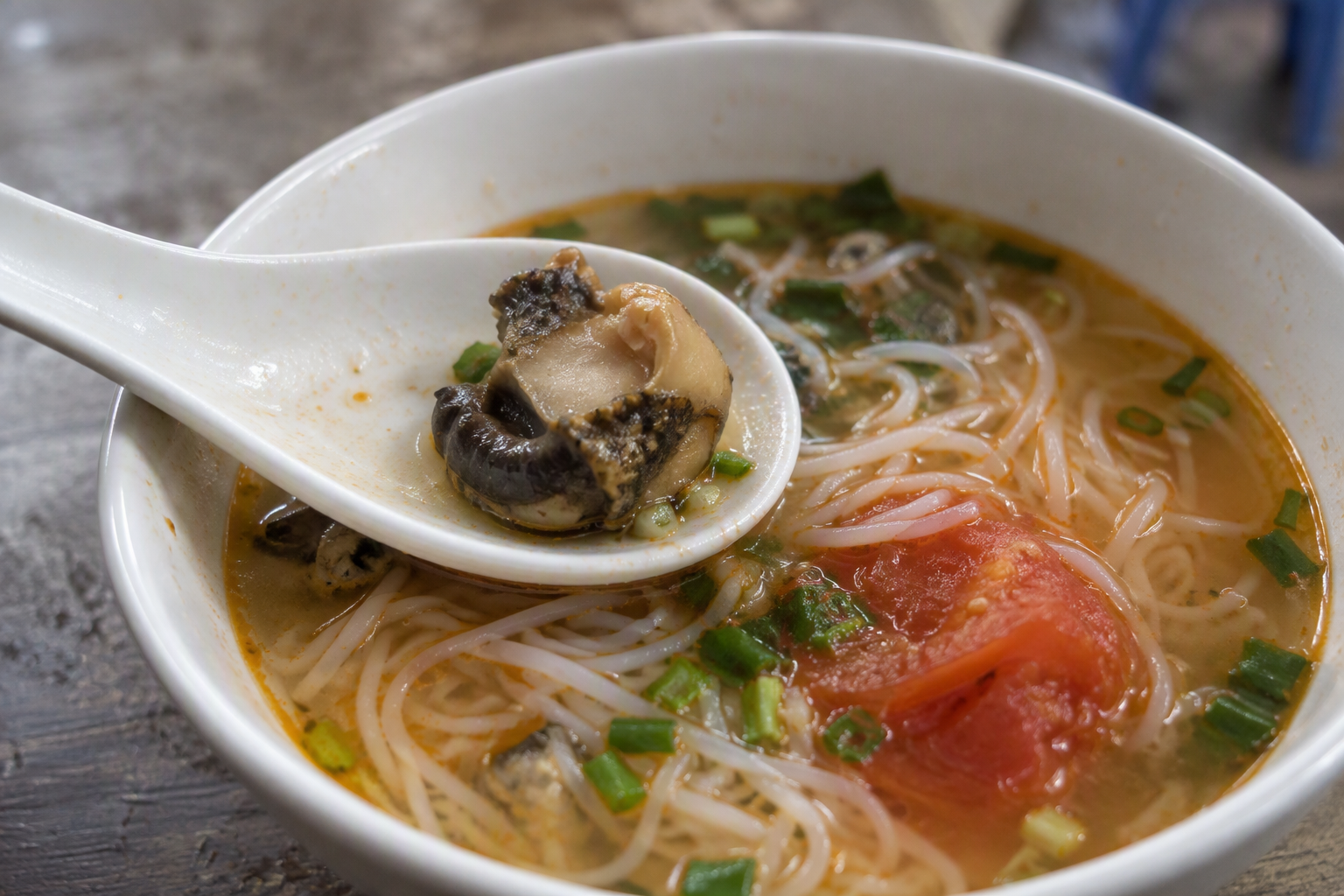

Snail noodle soup in Hanoi combines thin rice vermicelli, cooked freshwater snail meat and a broth sharpened with tomato and fermented rice acidity. On menus, the dish appears as bún ốc. The most useful preparation is not memorizing a famous stall: it is knowing what your order includes. Hot or cold service, snail size, extra toppings and seasoning can change the meal substantially. Treat the annotated ticket below as a compact ordering brief, with each field explaining what to specify and what to leave to the kitchen.
Dish field: identify snail noodle soup precisely
Ticket entry: Hanoi-style rice vermicelli with freshwater snails.
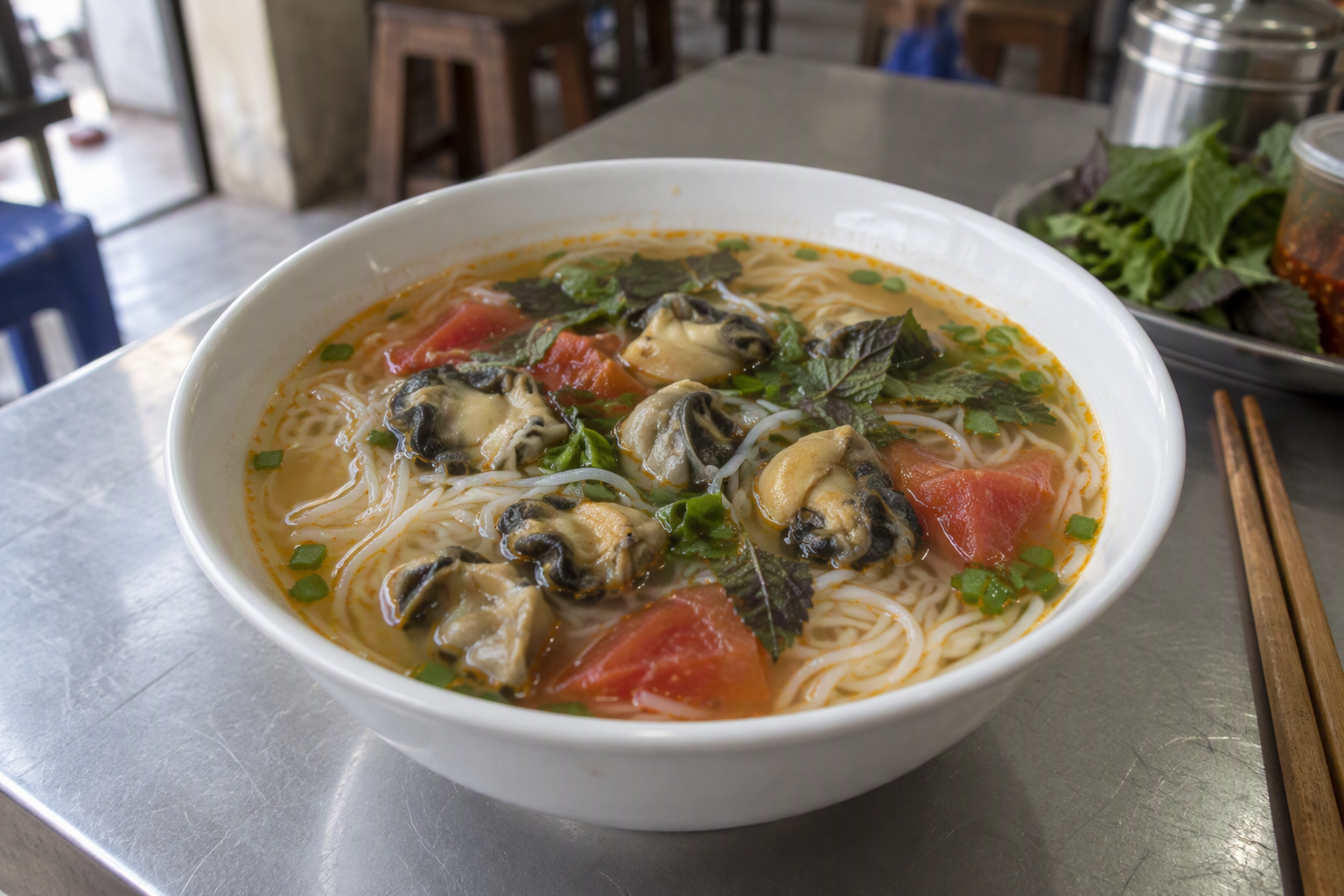
The identifying combination is snail meat, fine white rice noodles and a lightly sour broth. Tomato supplies color and sweetness; fermented rice vinegar or lees supplies a different, aromatic acidity. Chopped spring onion and perilla add freshness. The result should not be confused with a thick sauce or a bowl of whole snails to extract at the table.
Vietnam News Agency’s description of Hanoi’s traditional snail vermicelli identifies tomatoes and rice wine residue as essential to the characteristic broth. Its account also emphasizes cooked snail meat, fresh vermicelli, green onion and perilla. Individual kitchens still differ in stock, herbs and additions; those details are not standardized by the dish name.
This is a freshwater-snail dish, not a generic seafood noodle order. The English description on Wikipedia’s overview of the dish also distinguishes the hot bowl from noodles served separately for dipping. Both belong within this narrowly defined dish family.
Save the Vietnamese menu name on your phone for identification. A translated menu may use “snail noodles,” “snail vermicelli” or “snail soup.” Before ordering the latter, confirm that rice noodles are included. Ask whether the bowl shown on the menu is the basic serving or an upgraded combination; a photograph alone does not establish the price.
Service field: choose your snail noodle soup temperature
Ticket entry: hot broth over noodles, or cooled broth with noodles separately.
For the familiar hot version, broth is ladled over the vermicelli and snail meat. The noodles sit in the soup, so chopsticks and a spoon are the practical tools. Start with a spoonful of broth before adding anything; the souring ingredient may already make the bowl sufficiently sharp.
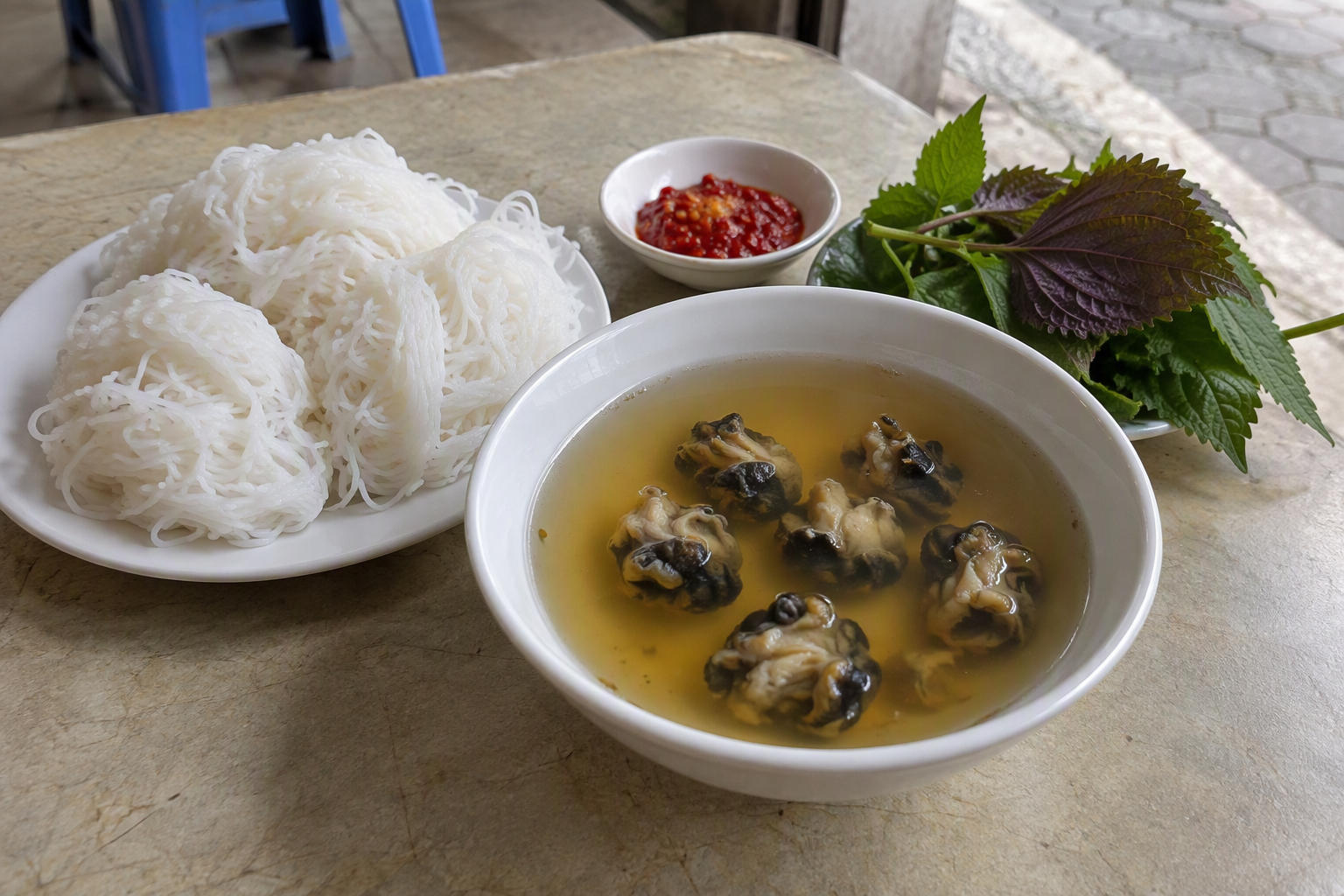
The cooled version, identified on menus as bún ốc nguội, normally keeps the noodles on a separate plate. Pick up a small bundle, dip it into the snail broth and eat it with a piece of cooked snail. Do not immediately empty the whole noodle plate into the bowl: keeping portions separate preserves the serving’s intended dipping rhythm.
“Cold” describes the service, not raw snail meat. It also does not promise refrigerator-cold broth or a bowl filled with ice. Ask how that kitchen serves it rather than requesting ice, which is not part of the standard order. In hot weather, the unheated serving offers a different eating temperature without becoming a different dish.
You can order snail noodle soup either way when both are available, but availability is shop-specific. A first order in hot broth makes the balance of acidity, stock and herbs easy to assess. Choose the cooled serving because you want that style, not because it is automatically safer or more traditional than every hot bowl.
Protein field: specify your snail noodle soup portion
Ticket entry: basic snail serving; confirm large or small meat if offered.
Some specialists offer larger, chunkier snail pieces as well as smaller ones. Large pieces give you a more substantial bite; small pieces distribute differently among the noodles. Neither size alone proves freshness, quality or value. Ask which is included in the quoted serving rather than assuming that the largest visible pieces come with every bowl.
The cooked meat should offer a firm, springy chew. It is not expected to dissolve like slow-cooked beef, but grit is not a desirable texture. A spoon helps lift a piece without chasing it through the vermicelli. There should be no need to remove a shell from each mouthful in the finished noodle serving.
Additional beef, fried tofu, ribs or pork sausage appear at some shops, but they are not universal. If your aim is to understand snail noodle soup, a basic bowl leaves the snail texture and sour broth easiest to recognize. Extra noodles can increase the meal’s size without changing the protein selection; confirm the separate charge first.
Published accounts of individual businesses can disagree about toppings. A Travellive report about Cô Huệ describes snail patties, yet its English text later calls an accompanying cake “fish cake.” Do not use that inconsistency to make an allergy decision. Ask the current kitchen what the patty contains, or leave it out if staff cannot explain it clearly.
Seasoning field: keep the first spoonful unchanged
Ticket entry: chili and fermented shrimp paste separately, if available.
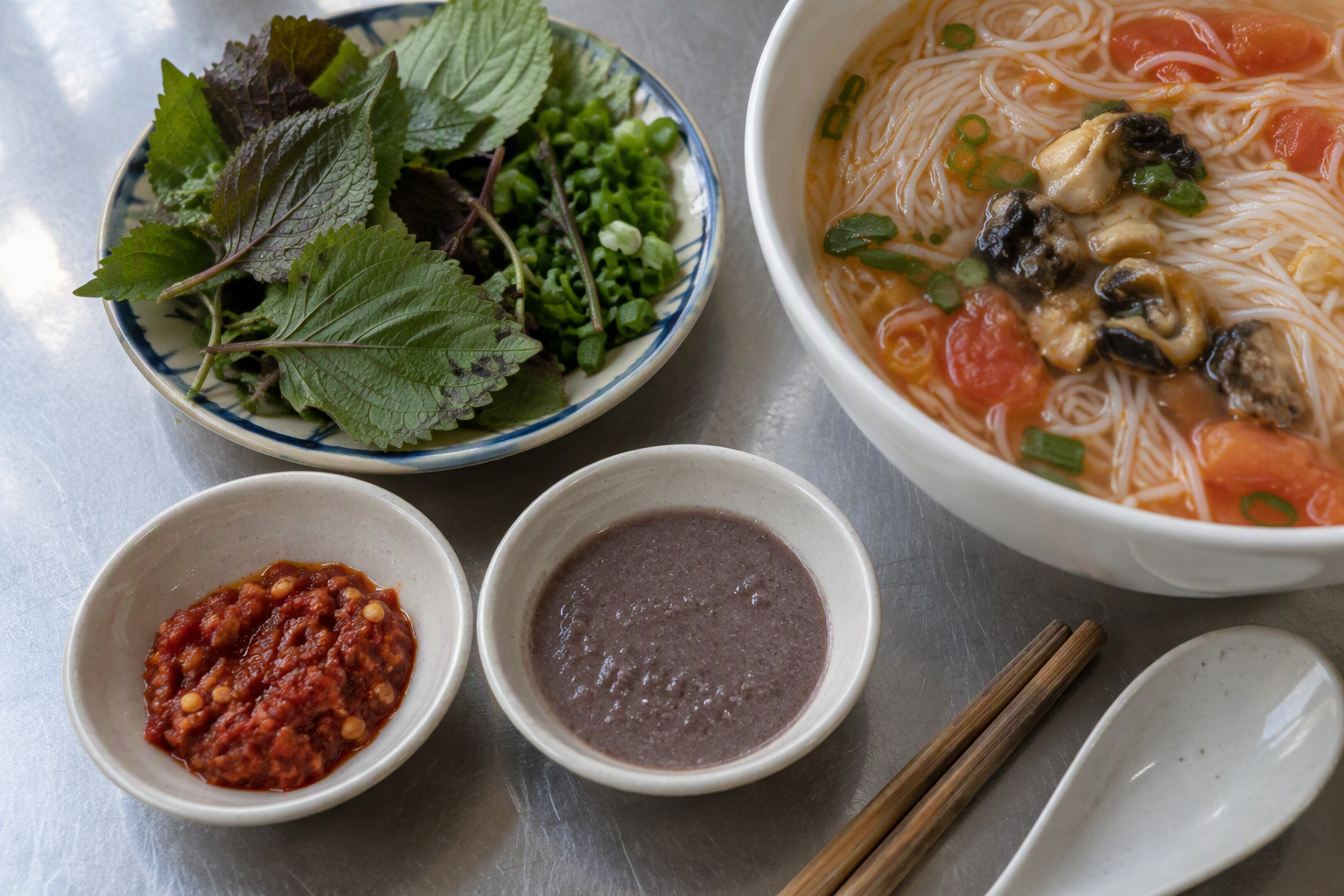
Chili adds heat; fermented shrimp paste adds salt and a strong marine aroma. They solve different problems. Adding both immediately can bury the fermented rice note that makes this soup distinctive. Taste first, then add a small amount of only the condiment you actually want. Ask whether chili has already entered the broth if you need a mild serving.
Perilla’s green-and-purple leaves provide a recognizable herbal aroma. Other leaves, sprouts or cut vegetables may accompany the order, depending on the shop. Ask for raw accompaniments separately when you prefer to control them. Dipping raw herbs briefly into hot soup is not the same as having the kitchen cook them thoroughly.
Snail noodle soup is not vegetarian, and omitting shrimp paste does not necessarily make it suitable for a shrimp allergy. Stock, fish sauce and prepared patties can introduce additional ingredients. Snails themselves are mollusks; anyone with a relevant allergy needs ingredient and cross-contact information, not reassurance based on the English menu heading.
For a serious restriction, show staff a reliable translation of the specific allergen and ask before the order is assembled. A busy single-dish kitchen may be unable to separate stock, utensils or condiments. Choose another meal if it cannot accommodate the restriction. For ordinary table manners, the site’s Vietnamese dining etiquette guide explains shared condiments and considerate chopstick handling without requiring a special ritual for this bowl.
Address field: use a street number, not a reputation
Ticket entry: a confirmed specialist address near your existing plans.
Cô Huệ is documented at 43 Nguyen Sieu in Hanoi’s Old Quarter. Saigoneer’s 2018 report on the Nguyen Sieu specialist gives that address and describes both noodles in soup and separate service. Travellive’s May 2025 coverage reports premises on opposite sides of the street. Use the street number as an initial navigation point, then check the current sign and serving counter.
From the northern edge of Hoan Kiem Lake, allow roughly 1 km of walking and 15–25 minutes to the Nguyen Sieu area. These are planning estimates, not a measured turn-by-turn route: your starting corner, crossings, crowds and stops change the total. Check a current map rather than interpreting “Old Quarter” as an exact location.
The site’s Hanoi Old Quarter guide provides broader orientation. Keep the food stop within the part of the city you already intend to explore; a taxi across Hanoi is unnecessary if your accommodation is within comfortable walking distance of the lake’s northern streets.
For a useful nearby activity, C Vietnam Tours’ Old Quarter architecture walk focuses on Hang Gai, Hang Bac and Ma May. Those merchant streets give context to the neighborhood around your meal. The page presents an independent planning idea, not guaranteed entry to every building or a promise that this particular food stop is included.
Time field: confirm service, not preparation hours
Ticket entry: morning or early lunch, with same-day hours checked.
The older Saigoneer account lists Cô Huệ’s service as 7 am–2 pm. Treat that as dated reporting, not confirmed October 2026 opening hours. Travellive’s 2025 report describes preparations beginning at 4 am, but kitchen preparation does not establish when customers can order. Its reported busiest period is noon–1 pm, with mornings less crowded.
If you need a low-risk scheduling choice, aim for a morning meal after confirming opening locally. Leave enough time to find the counter and ask about the serving instead of arriving minutes before a presumed closing time. Sellouts, holidays and changes in premises can matter more than the broad hours displayed by a directory.
CTour’s Hanoi street-food timing guide places snail noodles in its evening section. That is a citywide suggestion, not evidence that the Nguyen Sieu specialist opens at night. Use it to plan other food stops, but verify the hours of the exact business you choose for snail noodle soup.
The dish is available beyond a single season. Cooled service is especially associated with summer, while a hot bowl can suit cooler days. Hanoi’s warm, rainy summer and generally milder autumn affect walking comfort, not a guaranteed change in the recipe. Check the day’s forecast; covered seating and a shorter approach may matter more than chasing an allegedly perfect season.
Price field: separate snail noodle soup prices from directory ranges
Ticket entry: confirm today’s basic serving price and every extra.
Travellive’s May 2025 account of Cô Huệ’s snail noodles reports a full bowl at 50,000 VND, approximately US$2.00. That is an attributed historical price, not a verified current menu or a promise about today’s included patty. Confirm the current amount before ordering.
The Haron hotel’s Old Quarter snail-noodle directory gives a broader reference range of 30,000–50,000 VND for basic bowls, approximately US$1.20–2.00. It also quotes 30,000–100,000 VND for Cô Huệ with additions, approximately US$1.20–4.00. Those are directory ranges, not independently verified business prices; its topping description differs from other reporting.
For practical planning, carry enough for a bowl and any separately confirmed extras rather than treating the directory’s lowest figure as your entitlement. Ask whether the number refers to one bowl, a separate noodle portion or an upgraded serving. A quoted range does not reveal which option staff are about to prepare.
All dollar figures here use a simple planning conversion of 25,000 VND per US$1, not a live exchange quote. The site’s Vietnam cash and payment guide explains useful note denominations. Keep payment ready without assuming that a small shop accepts an overseas card.