

Landing in Vietnam without a working data connection turns simple things into small problems: no map, no translation app, no way to confirm a hotel booking or call a Grab driver. The country has three main mobile networks — Viettel, MobiFone, and Vinaphone — plus a growing list of eSIM resellers aimed at tourists. Every option gets you online, but they differ enough on price and coverage that picking the wrong one wastes money or time on day one.
This guide lines up the real options: physical SIMs bought at the airport, physical SIMs bought in the city, and eSIM plans bought online before departure. It covers costs in VND and USD, the paperwork involved, how coverage holds up outside the big cities, and how to keep a connection running for a two-week or month-long trip without overpaying on top-ups.
Quick Comparison: Airport SIM vs. City SIM vs. eSIM
| Option | Typical Cost | Setup Time | Coverage | Best For |
|---|---|---|---|---|
| Airport SIM counter | 150,000–350,000 VND (~$6–$14) | 10–20 minutes, ID checked | Good in cities, patchy in remote mountains | Travelers who want to land and go, no pre-planning |
| City phone shop | 60,000–200,000 VND (~$2.50–$8) | 15–30 minutes, ID/passport needed | Same network, same coverage as airport | Budget travelers already settled near a hotel |
| eSIM bought online (Airalo, Klook, Holafly, carrier eSIM) | $4–$25 depending on data volume and days | 5–10 minutes, done before landing | Depends on host network (usually Viettel) | Travelers who want data live the moment they land, no physical card to lose |
The three options run on the same underlying infrastructure — an eSIM from a reseller is still riding on Viettel’s, MobiFone’s, or Vinaphone’s towers. The differences are in price, how fast you’re connected, and whether you keep a spare phone slot free.
Stage 1: Decide Physical SIM or eSIM
Start here, because it determines everything else.
Go with a physical SIM if:
- Your phone is older than an iPhone XS or a Galaxy S20 equivalent and doesn’t support eSIM.
- You want a second working number for the trip (useful for booking sites and delivery apps that expect a Vietnamese number).
- You’re comfortable dealing with paperwork at a counter and don’t mind removing your home SIM.
Go with an eSIM if:
- Your phone is eSIM-capable (most flagship phones since 2020) and you want to keep your home SIM active for calls and 2FA texts.
- You want data working the second you land, without hunting for a kiosk.
- You’re only in the country 7–14 days and don’t need a local phone number for anything besides data.
Dual-SIM phones with an eSIM slot let you run both at once: home SIM for calls, Vietnamese eSIM for data. That combination avoids the classic problem of missing a bank’s one-time verification code because the number it’s texting sits in a drawer at home.
Stage 2: If You’re Buying a Physical SIM
At the airport
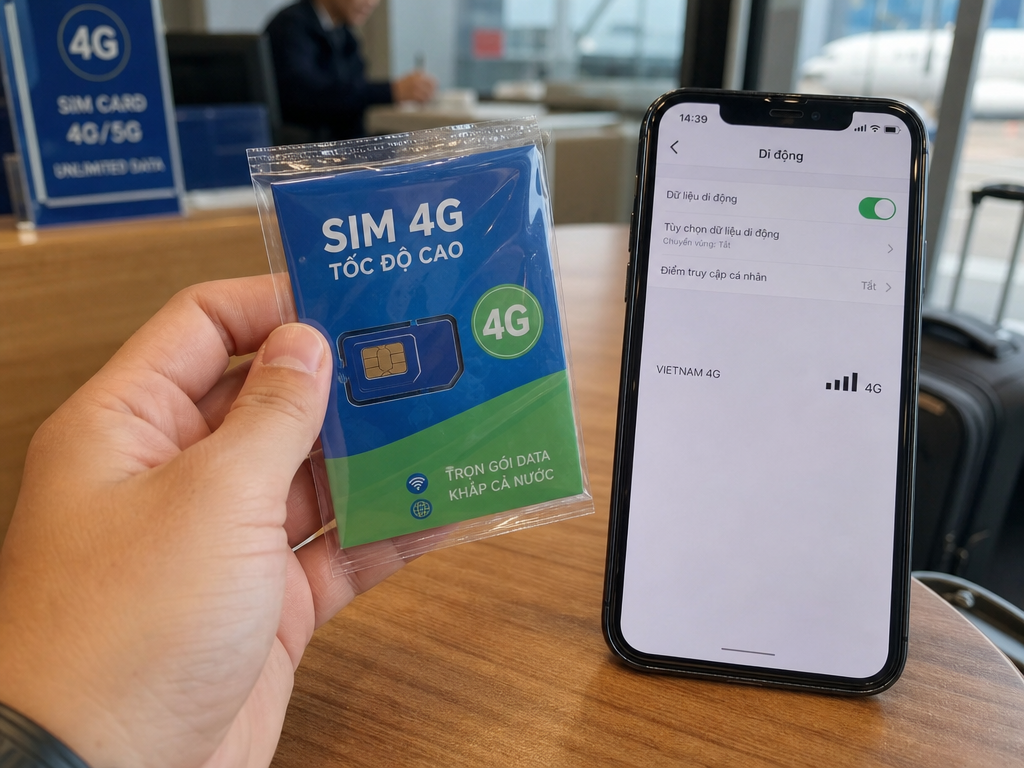
Both Noi Bai International Airport (Hanoi) and Tan Son Nhat International Airport (Ho Chi Minh City) have telecom counters in the arrivals hall, past immigration and baggage claim, before the exit doors. Staff speak enough English to sell tourist packages and register the SIM to your passport on the spot — Vietnamese law requires SIM registration with valid ID, so bring the passport itself, not a photo of it.
Airport pricing runs higher than the same SIM bought in the city: roughly 150,000–350,000 VND (about $6–$14) for a package with 1–5GB of data per day, valid for 7–30 days. The premium buys convenience — walking out already connected instead of hunting for a shop with luggage in tow.
In the city
The same Viettel, MobiFone, or Vinaphone SIM costs less from a branded store in any city center — often 60,000–200,000 VND (about $2.50–$8) for a comparable data package. Shops cluster on main streets in Hanoi’s Old Quarter, along Saigon’s Pham Ngu Lao backpacker area, and near any market in Da Nang or Hoi An. Bring a passport; the shop enters details into the network’s registration system before activating the SIM, adding a few minutes compared to a straight sale.
Convenience stores like Circle K sell prepaid SIMs too, but registration and top-up support are less reliable — a phone shop with staff who install the SIM and confirm it works before you leave is the safer bet.
Which network to pick
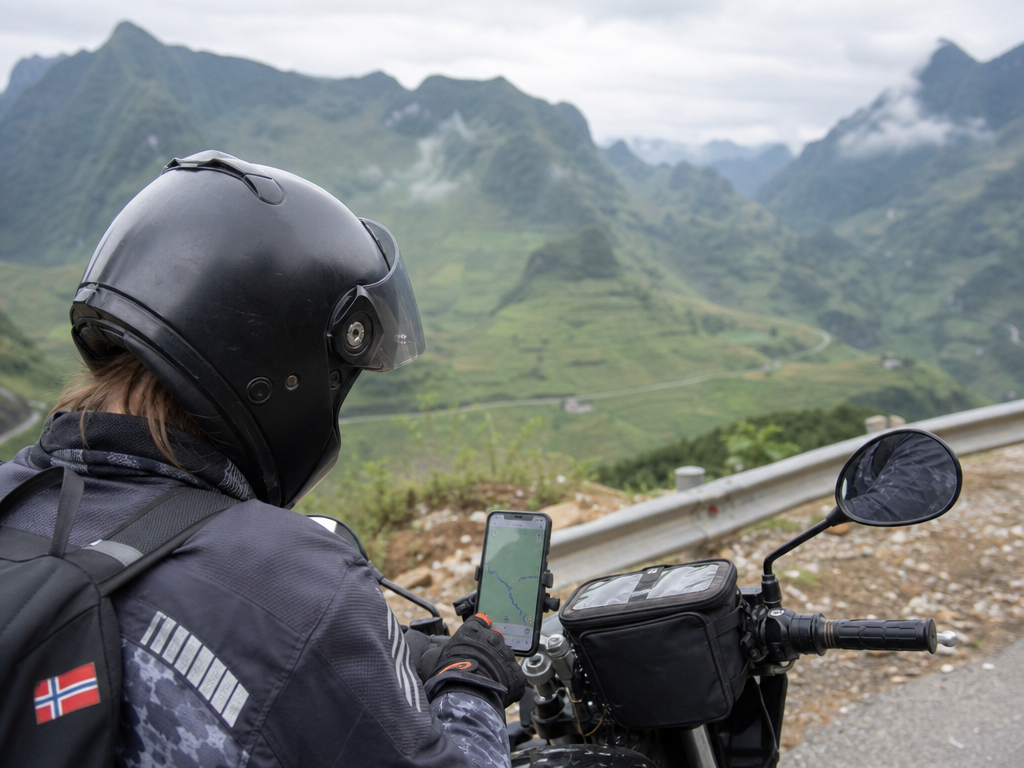
Viettel has the largest network by coverage, including the best signal in remote areas like the Ha Giang Loop, Cao Bang, and parts of the Mekong Delta. It holds roughly half the domestic mobile market and is the default pick for anyone leaving the main cities. MobiFone and Vinaphone perform similarly to each other in cities and along the coast (Hoi An, Nha Trang, Phu Quoc) but drop off faster in mountainous or rural stretches.

Stage 3: If You’re Buying an eSIM
Options available
Three categories of eSIM cover most tourist needs:
- Third-party marketplaces (Airalo, Holafly, Klook, Traveloka) sell prepaid data-only eSIM plans, typically starting around $4–$5 for a small data pack and running to $20–$25 for unlimited-with-fair-use plans over two to four weeks.
- Regional/multi-country eSIMs cover Vietnam plus neighboring countries (Thailand, Cambodia, Laos) on one plan — useful for a Southeast Asia loop, usually a few dollars more than a Vietnam-only plan.
- Carrier-branded tourist eSIMs, such as Viettel’s own tourist eSIM, sold directly or through Viettel’s site and select resellers, often starting near 60,000 VND (about $2.50) for a week of data.
Installing before you fly
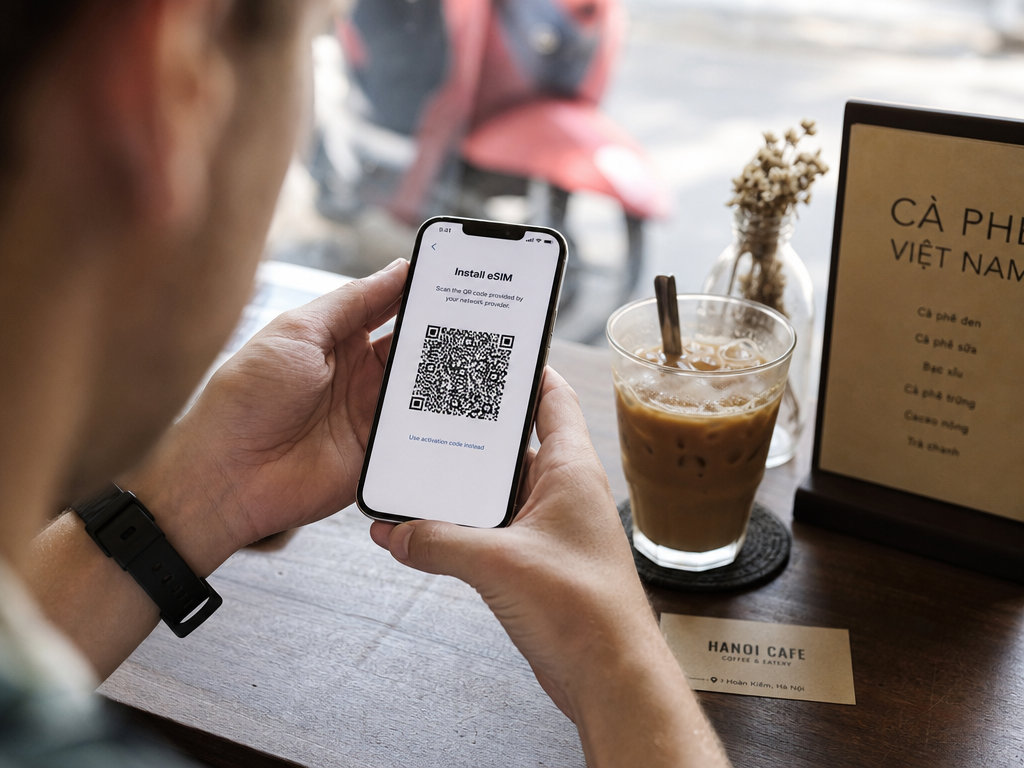
Every provider sends a QR code by email or through its app after purchase. Installation takes about five minutes: Settings → Cellular/Mobile Data → Add eSIM → scan the QR code, done on home Wi-Fi before departure. The eSIM typically doesn’t start burning through its validity window until it detects a Vietnamese tower, so installing it a day early to confirm it scanned correctly is safe.
Data-only eSIMs won’t carry a home phone number for calls or texts. Keep the primary SIM in its slot — most phones still receive SMS two-factor codes over Wi-Fi calling in some cases, though this isn’t guaranteed, so check with the home carrier first.
What eSIMs are less good at
Because most tourist eSIMs are data-only and run on a single host network, they inherit that network’s coverage gaps. A cheap eSIM riding on MobiFone’s infrastructure will struggle in the same rural pockets where a MobiFone physical SIM struggles. Check which network a given eSIM plan uses before buying if the itinerary includes remote regions — Viettel-hosted eSIMs handle the Ha Giang Loop and similar routes noticeably better.
Stage 4: Data Packages and Real-World Usage
Package sizes are usually quoted as GB per day rather than a flat monthly total, which changes how far the same headline number stretches:
- 1–2GB/day covers maps, messaging apps, and light browsing — enough for someone who relies on hotel or cafe Wi-Fi for anything heavier.
- 4–5GB/day covers Google Maps navigation while riding a motorbike, streaming music, and occasional video calls without hunting for Wi-Fi.
- Unlimited with fair-use throttling (common on 30-day plans, around 300,000–600,000 VND or $12–$24) covers constant navigation and video calls until a daily cap (often 4–15GB) is hit, after which speed drops to a slower tier rather than cutting off.
For context: streaming an hour of standard-definition video uses roughly 500MB–1GB, and a full day of Google Maps navigation typically uses 50–150MB. A 3–4GB/day plan comfortably covers a full day of sightseeing with maps, photos, and messaging.
Topping up
Physical SIMs are topped up two ways: buying a scratch card (recharge card) from any phone shop or convenience store and dialing a short USSD code printed on it, or using the carrier’s app (Viettel’s official app is widely used) if it’s in English. Shops that sold the SIM will usually top it up for a customer on request for a small convenience fee if the USSD code process feels unfamiliar.
eSIMs bought through third-party apps top up inside that same app — buying another data pack that stacks onto or replaces the current one, no code needed.
Coverage Outside the Cities
Coverage is strong across Hanoi, Ho Chi Minh City, Da Nang, Hoi An, Hue, and most coastal towns on all three networks — 4G and increasingly 5G in dense areas. It gets patchier in:
- Mountainous border regions — Ha Giang, Cao Bang, parts of Sapa’s back roads — where Viettel’s tower density gives it a real edge.
- Remote islands — smaller islands beyond Phu Quoc and Con Dao can drop to 3G or no signal in spots.
- Deep in national parks — Phong Nha’s cave systems and similar sites have no signal underground, though nearby towns are fine.
This shouldn’t change a trip’s route, only its expectations: don’t count on live navigation on a remote mountain pass, and download offline Google Maps tiles before leaving cell range. The same applies to any long-distance leg covered in the guide to getting around Vietnam — sleeper buses and trains through rural stretches often lose signal for 20–30 minutes at a time.
Cost Checklist: Pass/Fail by Trip Length
Short trip, 3–7 days, cities only: airport SIM at 150,000–200,000 VND — pass, convenience outweighs the price gap. eSIM at $5–$10 — pass, ready on landing with no queue.
Standard trip, 1–3 weeks, mixed cities and rural stops: city-bought Viettel SIM — pass, cheaper than airport and Viettel covers the rural legs. A MobiFone- or Vinaphone-hosted eSIM for a Ha Giang or Sapa-heavy itinerary — fail, expect dead zones; switch to a Viettel-hosted option.
Long trip, 3–4+ weeks: a single data-only eSIM for the whole trip — fail unless it has a straightforward in-app top-up, so verify that before relying on it for a month. A physical Viettel SIM on a 30-day unlimited-with-FUP package, topped up once mid-trip — pass, cheapest total cost per day for heavy, sustained use.
Money and Payment Once You’re Connected
A working SIM matters for more than maps — restaurants, hotels, and delivery apps increasingly expect payment through an app or a scanned QR code, both of which need data. For cash versus card versus e-wallet at street stalls and sit-down restaurants, see the guide to paying at Vietnamese food stops. Live data before ordering also makes translation apps useful where a few street food phrases don’t quite cover the menu.
FAQ
Do I need a Vietnamese SIM if my roaming plan covers Vietnam? Depends on the rate. Home carriers often charge $5–$15 per day for Vietnam roaming. A local SIM or eSIM is almost always cheaper past two or three days.
Can I use my home number for calls while an eSIM handles data? Yes, on any dual-SIM or eSIM-capable phone. Keep the home SIM in for calls and texts, let the eSIM handle data. Confirm with the home carrier whether verification codes still arrive without active roaming.
Is it legal to buy a SIM card without a passport? No. Every prepaid SIM requires ID registration under Vietnamese telecom rules. Reputable counters and shops always ask for one.
Which network works best near the Chinese border? Viettel generally holds the strongest signal in Ha Giang, Cao Bang, and Lao Cai, thanks to broader tower coverage in mountainous terrain.
How long does a tourist SIM stay active after the data runs out? Packages expire on a fixed window (7, 15, or 30 days), not when data runs out. A new package is needed once that window closes, even with unused data left.
Viettel, the network with the widest domestic footprint, is covered in more detail on Wikipedia. Background on how eSIM technology works — and why it can’t be swapped like a physical card — is useful before buying one for the first time, as is understanding how roaming charges are typically structured.