

Getting around Vietnam is the part of the trip nobody plans properly, and then it eats three days of your holiday. I know because I did exactly that on my first trip in 2018: I booked a 14-hour sleeper bus from Hanoi to Hue to save 400,000 VND, arrived at 4:40 a.m. on the side of a highway with no taxi in sight, and lost the entire day sleeping it off in a hotel I’d paid for the night before.
Six trips and roughly 9,000 kilometres later, I don’t decide by price anymore. I decide by a set of questions I ask myself in order. So instead of another “top 7 ways to travel in Vietnam” list, this guide is built as a decision tree. Start at the top, answer honestly, and you’ll land on the right transport for your specific leg — not the one a hostel receptionist is getting commission on.

How to Use This Decision Tree
Getting around Vietnam efficiently comes down to four questions. Answer them for each leg of your route, not for the trip as a whole. Hanoi to Ninh Binh and Hue to Hoi An are completely different problems, and people who pick one “travel style” for the whole country always overpay somewhere.
- How far is it? (Under 150 km / 150–500 km / over 500 km)
- Do I need the arrival to be at a civilised hour?
- Is the journey itself something I want to see?
- What’s my honest motion-sickness and back-pain tolerance?
Then follow the branch below.
Question 1: Is the Leg Under 150 km?
→ Then take a limousine van, not a bus or a train
This is the single most useful thing I can tell you about getting around Vietnam on short hops. “Limousine” in Vietnam means a converted 9–16 seat minivan with real reclining seats, and it dominates short routes. Hanoi to Ninh Binh is about 95 km and costs 150,000–250,000 VND, roughly 2 hours 15 minutes door to door. The train exists, but the station is outside town and you’ll add a taxi at both ends.
Booking: I use the Vexere app, or I just ask the hotel to phone. Most limousine operators do hotel pickup inside the city centre for free, which is worth more than the 50,000 VND you might save booking a “cheap” seat that leaves from a depot 8 km out.
Where this applies: Hanoi–Ninh Binh, Hanoi–Ha Long, Hue–Hoi An (about 3 hours over the Hải Vân Pass), Saigon–Vung Tau, Saigon–Can Tho.
→ Unless the leg is Hue to Hoi An
Take the private car instead if there are two or more of you. It’s 900,000–1,400,000 VND for the car, and the drivers stop at Lang Co beach and the top of the Hải Vân Pass. Split between three people it’s barely more than the van, and it turns a transfer into the best two hours of the central coast. This is the one short leg where the journey is the attraction.
Question 2: Is It 150–500 km — and Does It Follow the Coast?
→ Then take the train
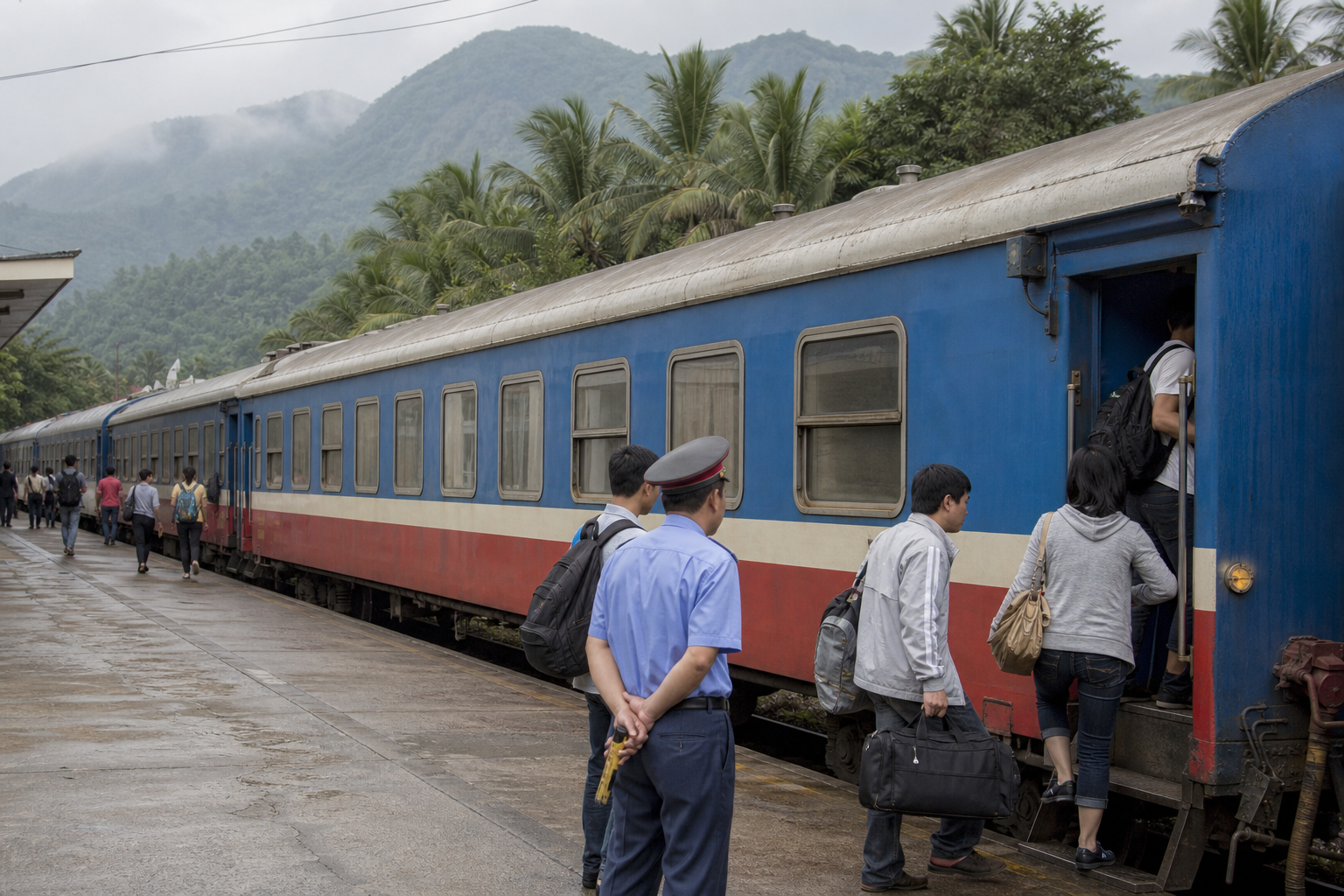
The Reunification Express is the slowest way of getting around Vietnam, and that is the entire point. Danang to Hue is 3 hours for 100,000–200,000 VND in a soft seat, and the stretch over the Hải Vân Pass — ocean on one side, jungle wall on the other — is genuinely one of the best rail rides in Southeast Asia. Sit on the right side heading north.
Book on the official Vietnam Railways site or dsvn.vn about 3–5 days ahead. Seat classes, from worst to best: hard seat, soft seat, hard sleeper (6 berth), soft sleeper (4 berth). I stopped booking hard sleepers after a night in Carriage 9 where the top berth had about 40 cm of headroom and I hit my forehead on the ceiling twice standing up.
→ Unless the route cuts inland through mountains
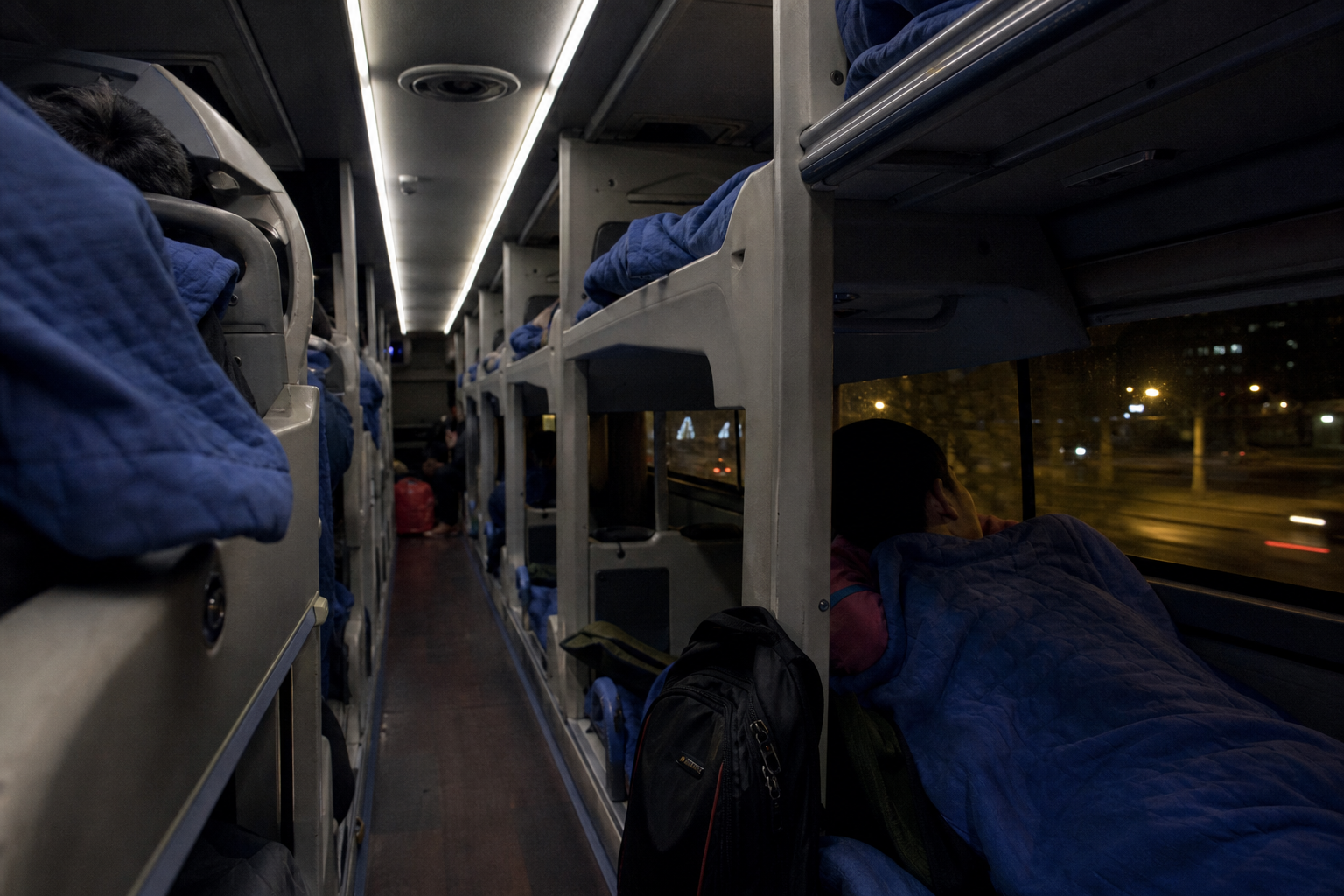
Then the train doesn’t go there and you’re back on the road. Anything into the highlands — Da Lat, Ha Giang, Sapa, Phong Nha — is bus or van territory, because the rail network hugs the coast and always has. For the mountain legs I now pay the extra 100,000–200,000 VND for a cabin sleeper bus with a door rather than an open berth. On the Hanoi–Ha Giang run that’s 400,000 VND versus 280,000, and it’s the difference between sleeping and not.
If you’re heading that way, my honest guide to riding the Ha Giang Loop covers what happens once the bus drops you off, and the 3-day Sapa trip diary has the night-bus timings I actually used.
Question 3: Is It Over 500 km?
→ Then fly, and stop feeling guilty about it
Hanoi to Saigon is 1,600 km. The train takes 32 to 36 hours. I’ve done it once, and I’m glad I did, and I will not do it again. Vietjet, Bamboo and Vietnam Airlines fly the route constantly and I’ve paid between 700,000 and 1,900,000 VND booking 2–3 weeks out. That’s often less than a soft sleeper, and it buys back a day and a half.
My rule: if the overland journey exceeds 12 hours, fly. Below 12 hours, take the ground option and see something.
→ Unless you’re on a strict budget and the overnight replaces a hotel
That’s the honest counter-argument. A 300,000 VND sleeper bus that also removes a 500,000 VND hotel night is real money on a long trip. My 4-day Da Lat budget breakdown shows how that maths plays out over a week.
Two warnings, though. Vietjet delays are routine — budget 90 minutes of slack if you have anything booked on arrival. And domestic checked baggage on the budget carriers is bought separately; adding 20 kg at the airport counter costs roughly triple what it costs online.
Question 4: What About Getting Around Inside a City?
→ Then use Grab, and only Grab
Install Grab before you land and add a card. In-app fares are fixed, which removes the entire negotiation problem: a 4 km ride across Hanoi runs 35,000–60,000 VND by car and 18,000–30,000 VND by GrabBike. Xanh SM (the electric fleet) is a solid backup and their cars are newer.
The one thing that catches people out: at Noi Bai and Tan Son Nhat airports, app pickup happens at a designated pillar or lane, not at the arrivals door. Look for the numbered column in your app’s message, walk to it, and ignore anyone who approaches you first.
→ Unless you’re in the Old Quarter at rush hour
Then walk. Seriously. Between 5 and 7 p.m. a Grab car through central Hanoi will crawl, and the driver may quietly cancel on you. GrabBike still moves; a car does not. I lost 40 minutes in a stationary taxi on Hàng Bông once for a distance I could have walked in 12. There’s more on navigating those streets in the Hanoi Old Quarter honest guide.

Getting Around Vietnam by Motorbike: The Branch Most People Get Wrong
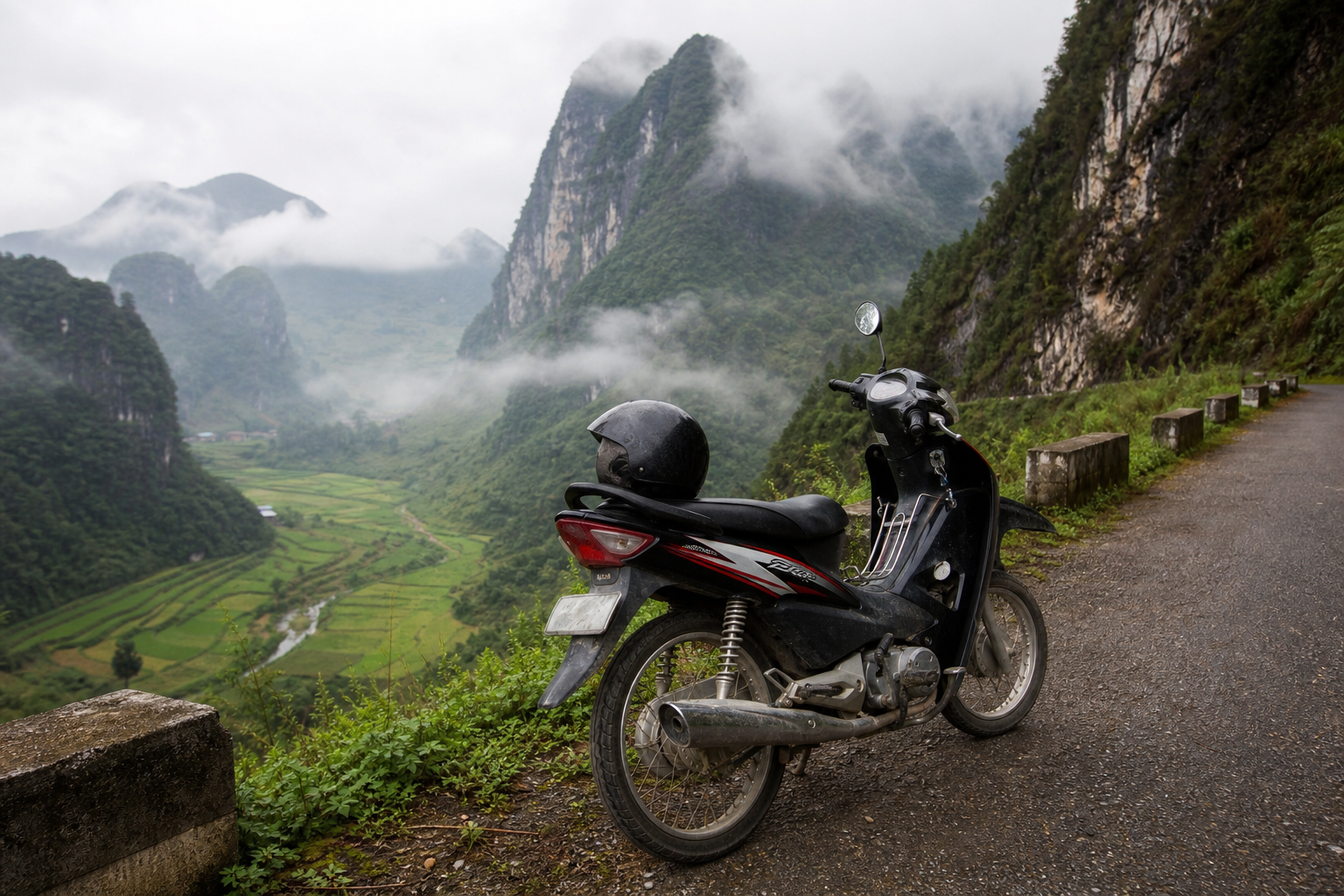
→ Rent one only if you’ve ridden before, off Vietnam, for more than a week
Rental is 120,000–200,000 VND a day for a semi-automatic, 150,000–250,000 for an automatic. That’s not the issue. The issue is that your travel insurance almost certainly voids motorbike claims unless you hold a valid motorcycle licence plus an International Driving Permit recognised in Vietnam. Read your policy wording before you decide, not after.
I ride, and I still don’t rent in Saigon or Hanoi. I rent in Ninh Binh, Phong Nha, Mai Chau, Con Dao — places where the road is the reason you came. The 48-hour Phong Nha itinerary is built around exactly that kind of riding.
→ If you do rent: three non-negotiables
- Photograph the bike from all four sides before you leave, with the shop in frame. Scratch disputes are the most common rental scam and photos end them instantly.
- Never hand over your passport as deposit. Offer 2,000,000 VND cash or a photocopy. A shop that insists on the physical passport is a shop to walk away from.
- Wear a real helmet. The 80,000 VND plastic shells handed out with rentals are decorative. Buying a proper one for around 500,000 VND was the best money I’ve spent in Vietnam.
Quick Comparison Table
| Option | Typical cost | Best for | Worst for |
|---|---|---|---|
| Limousine van | 150,000–350,000 VND | Legs under 150 km | Anything overnight |
| Train (soft seat) | 100,000–400,000 VND | Coastal legs, scenery | Inland and mountain routes |
| Train (soft sleeper) | 700,000–1,300,000 VND | Overnight coastal legs | Tight schedules |
| Sleeper bus | 250,000–500,000 VND | Budget overnights, mountains | Anyone over 1.8 m |
| Domestic flight | 700,000–1,900,000 VND | Anything over 500 km | Same-day connections |
| Grab / Xanh SM | 18,000–80,000 VND | All city travel | Old Quarter rush hour |
| Rented motorbike | 120,000–250,000 VND/day | Rural loops | Cities, inexperienced riders |
Those are the numbers I work from when I plan a route. Prices are what I paid in 2025 and early 2026. For context on the currency itself and how the notes work, the Vietnamese đồng page is a decent primer — and yes, the 20,000 and 500,000 notes look alike in dim light. I’ve overpaid twice.
Frequently Asked Questions
Is the train or the bus better in Vietnam? Train for coastal legs and for sleep quality; bus for anywhere the railway doesn’t reach, which is most of the mountains. On Danang–Hue the train wins outright.
Do I need an International Driving Permit to ride a motorbike in Vietnam? For legal riding and valid insurance, yes — along with a motorcycle entitlement on your home licence. Plenty of people ride without one; they’re also the people with uncovered hospital bills.
How far ahead should I book transport for getting around Vietnam? Trains and flights 2–3 weeks out around Tết and national holidays, 3–5 days otherwise. Limousine vans can usually be booked the night before.
Is Grab safe for solo travellers at night? Yes, in my experience, and it’s safer than street-hailed taxis because the route and driver are logged. Share the trip link if you’re alone.
What’s the cheapest way of getting around Vietnam from Hanoi to Ho Chi Minh City? An open-tour bus ticket is nominally cheapest, but a booked-ahead Vietjet fare often beats it once you count hotel nights and lost days.
The Short Version
Under 150 km, take a limousine van. Coastal 150–500 km, take the train. Over 500 km, fly. Inside cities, Grab. Rent a bike only where the road itself is the point. Getting around Vietnam stops being stressful the moment you stop optimising for price and start optimising for what each leg actually costs you in hours.