

The first time I tried to eat street food in Vietnam without getting sick, I failed spectacularly. Day three of my first trip, a quiet alley off Hàng Bồ in Hanoi, a bowl of something with pork and tomato that had clearly been sitting in the sun since mid-morning. I paid 35,000 VND for it. I paid a great deal more over the next 40 hours, most of it in a guesthouse bathroom with a broken fan.
Seven trips and roughly eleven months in Vietnam later, I eat from pavement stalls two or three times a day and I’ve been ill exactly twice more — once from a hotel breakfast buffet in Nha Trang, which felt like a personal insult, and once from a smoothie I watched being made with ice I should have questioned.
So instead of giving you another generic hygiene listicle, I’m going to show you the actual before-and-after. On the left, what first-trip me did. On the right, what I do now, and why the change matters. Same country, same food, completely different outcome.
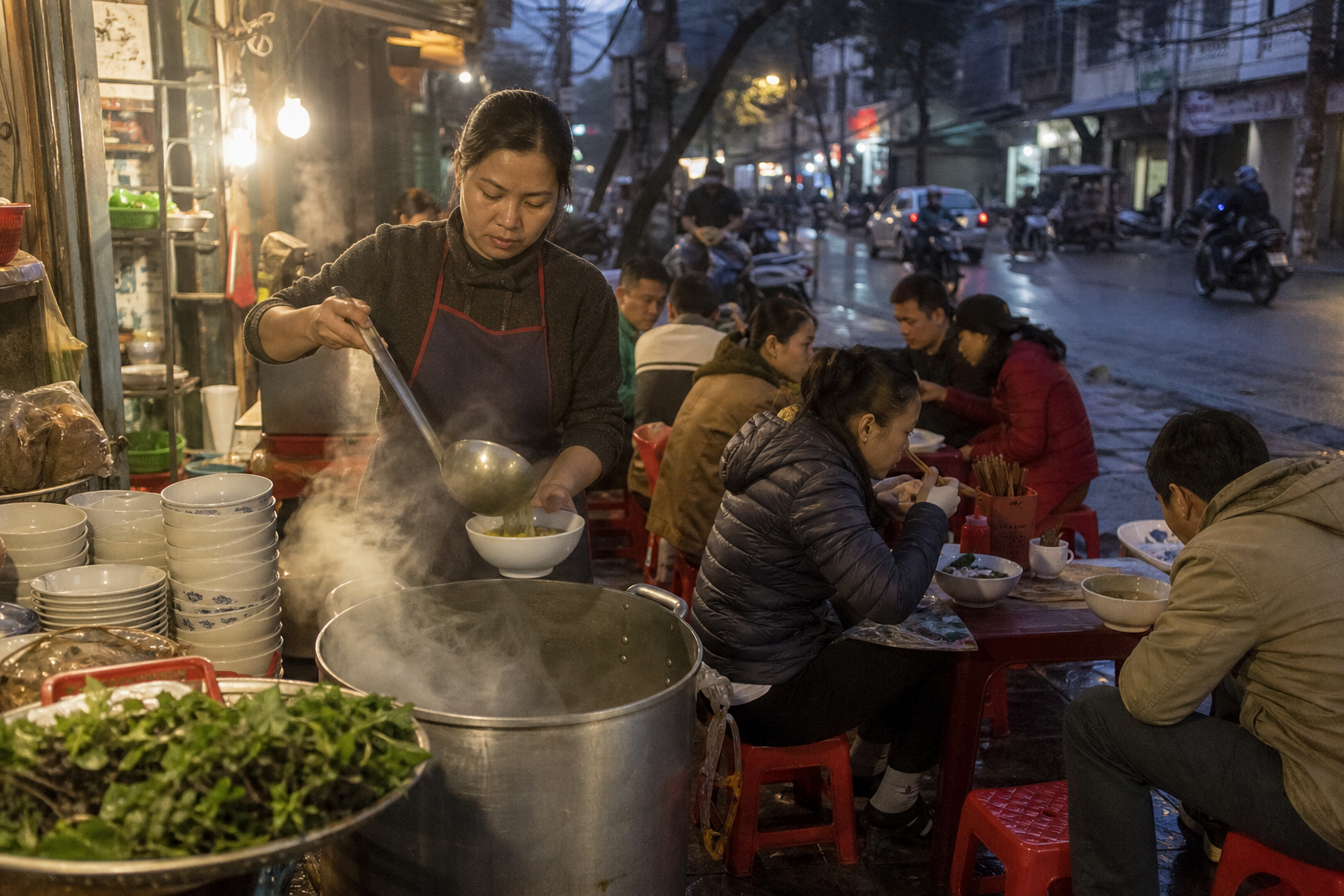
Rule 1: How I Choose a Stall
Before: I picked whatever looked clean. Wiped tables, tiled floor, an English menu, a laminated photo of the dish. Empty stalls felt calmer and less intimidating, so I chose them on purpose. I genuinely believed “clean-looking” and “safe” were the same thing.
After: I pick whatever is busiest, and specifically busiest with Vietnamese people between 30 and 70 years old. I don’t care if the table is scratched or the floor is wet. Turnover is the whole game — a stall selling 200 bowls between 6am and 10am is cooking in small batches and never holding food long. That empty tiled place with the photo menu is reheating something from three hours ago.
My practical test: if I count fewer than four people eating and it’s a normal meal hour, I keep walking. It costs me maybe 90 seconds and it has saved me more than any other habit.
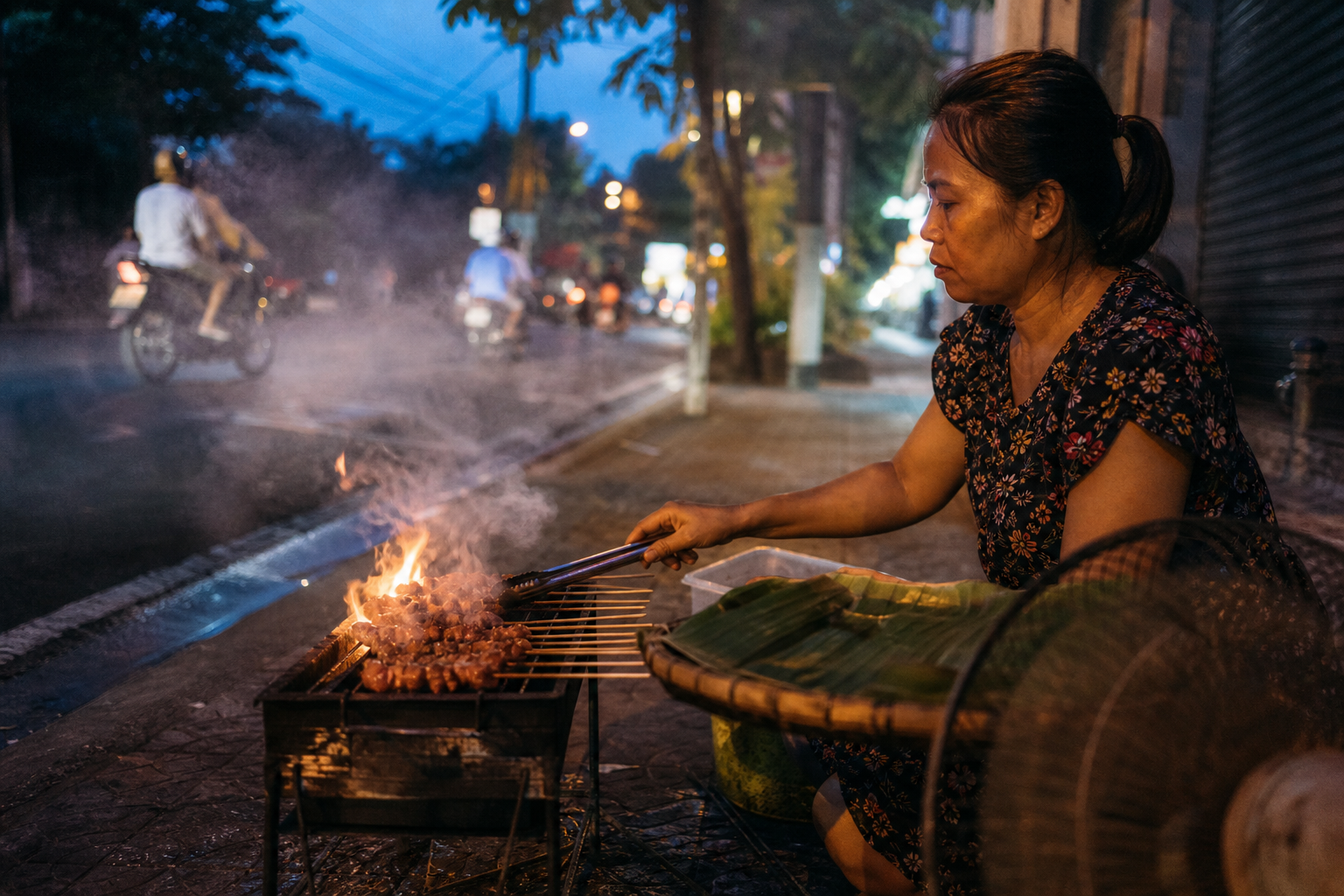
Corollary I learned the hard way: avoid the 2pm–4:30pm dead zone. Vietnamese eating hours are roughly 6–9am, 11am–1pm, and 6–8:30pm. Food sold outside those windows has usually been sitting somewhere. If I’m hungry at 3pm I go for something cooked to order — bánh mì assembled in front of me, or grilled skewers off live charcoal — never a pre-portioned bowl.
Rule 2: What I Actually Order
Before: I ordered whatever was most photogenic, which meant a lot of cold rice-paper rolls, seafood salads, and anything with a dramatic pile of raw vegetables on top.
After: I order from a mental hierarchy, and I break it only when the stall has passed the busy test.
The order I trust most, to least
- Boiling soups and noodle broths. Phở, bún bò, hủ tiếu, bánh đa cua. The broth sits at a rolling simmer all service. Bacteria don’t survive it.
- Anything grilled to order over charcoal. Skewers, grilled pork, whole fish. I watch it hit the fire.
- Fried to order. Bánh xèo, nem, bánh gối. Hot oil, immediate service.
- Steamed to order. Bánh cuốn, steamed buns.
- Rice plates with hot components. Cơm tấm where the pork is grilled fresh and the rice is under a lid.
- Room-temperature assembled dishes. Rolls, salads, sliced cold cuts. Fine at a great stall, my first suspect everywhere else.
- Raw seafood, oysters, blood dishes, anything with mayonnaise sitting out. I eat these, but only at proper restaurants with refrigeration I can see.
This isn’t about avoiding “weird” food — that’s a completely different fear and a useless one. Some of the most confronting things I’ve eaten in Vietnam, like the fermented shrimp paste in bún đậu mắm tôm, have never caused me a moment’s trouble. Fermentation is preservation. Lukewarm chicken is the actual enemy.
Rule 3: The Raw Herbs Question
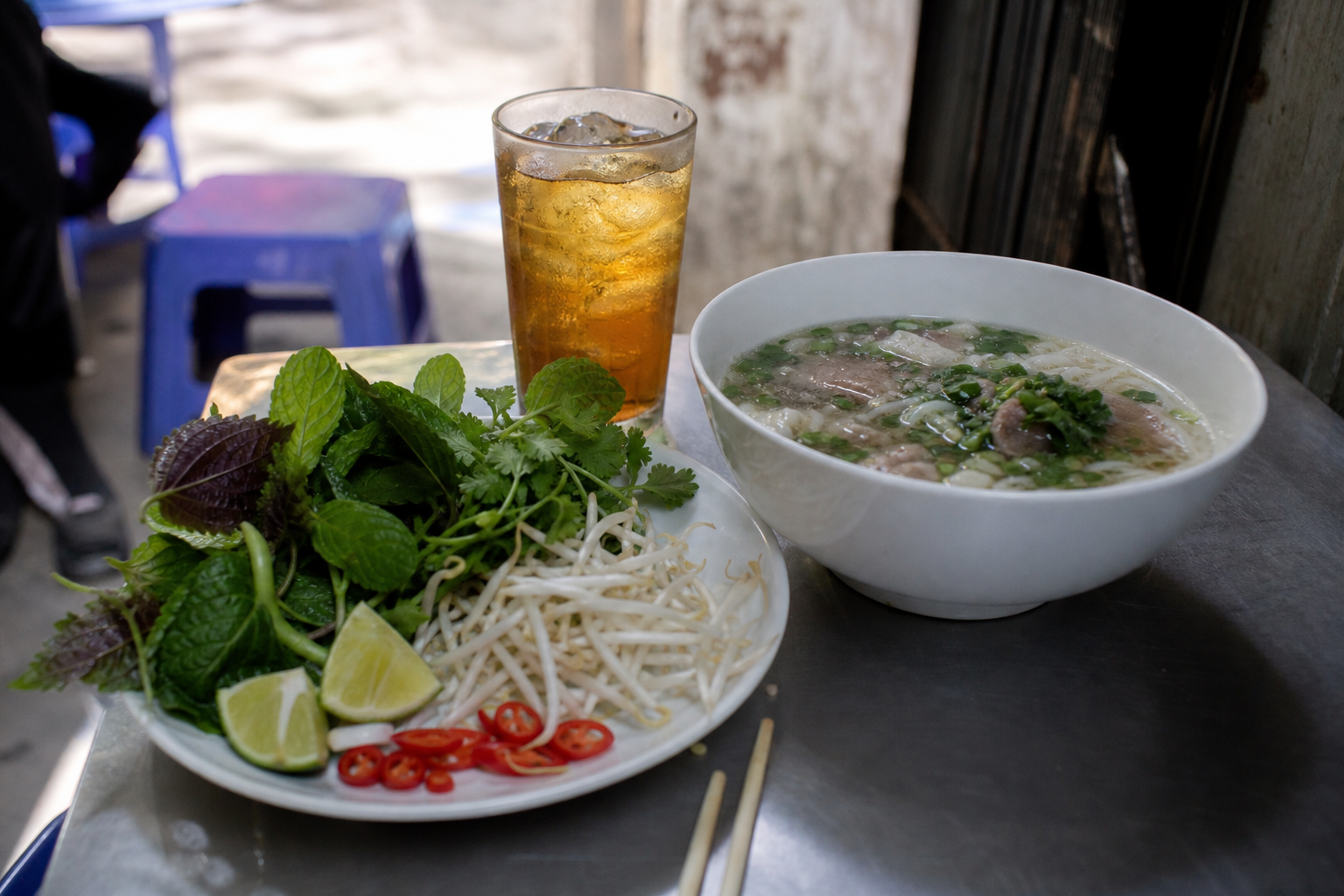
Before: I refused the plate of herbs entirely. Every guidebook I’d skimmed said “avoid raw vegetables,” so I pushed away the perilla, the bean sprouts, the coriander — and ate a version of every dish that was missing about a third of its flavour.
After: I eat the herbs. Almost always. In seven trips they have never once been the problem.
The nuance nobody explains: the risk isn’t the leaf, it’s the water it was rinsed in and how long it sat. So I look at the plate. Are the herbs crisp, dry-ish, clearly put out recently? Eat them. Are they wilted, warm, sitting in a puddle of grey water at the bottom of a communal basket that’s been picked over by forty people? Skip them.
Bean sprouts I’ll drop straight into hot broth for 20 seconds rather than eating raw, which is what most Vietnamese people around me do anyway. Not out of fear — it’s just better that way.
Rule 4: Ice, Water and Drinks
Before: I avoided ice religiously and drank warm bottled water for two weeks like a man serving a sentence, then destroyed all that discipline with a roadside smoothie made from unknown ice and unwashed fruit.
After: I drink ice constantly and I’ve had no issue. Commercial ice in Vietnam is mostly factory-produced from treated water and delivered in sealed bags — you’ll see the delivery guy hauling them off a motorbike at 7am. It’s the standard cylindrical tube ice with a hole through the middle, and it’s fine.
What I actually watch for:
- Tube ice with a hole = factory ice. Trust it.
- Irregular hand-chipped chunks from a block, dragged along the floor in a sack = that’s for keeping fish cold, not for your drink. This is genuinely rare in drinks but I’ve seen it at rural markets.
- Tap water: never. Not even for brushing teeth in the first few days, and I still don’t. A 500ml bottle costs 5,000–10,000 VND. There is no reason to gamble.
- Smoothies (sinh tố): my one real weak point. I only order them from a stall with visible fruit turnover, and I skip anything with condensed milk that’s been sitting open in the heat.
Vietnamese iced tea — trà đá — is served free or for 3,000 VND almost everywhere, brewed hot then chilled, and it’s been part of nearly every meal I’ve eaten in the country.
Rule 5: My Own Hands
Before: I obsessed over the vendor’s hygiene and completely ignored my own. I’d wipe the chopsticks with a tissue, feel virtuous, then eat a bánh mì with hands that had touched a motorbike, three door handles and 200,000 VND in cash.
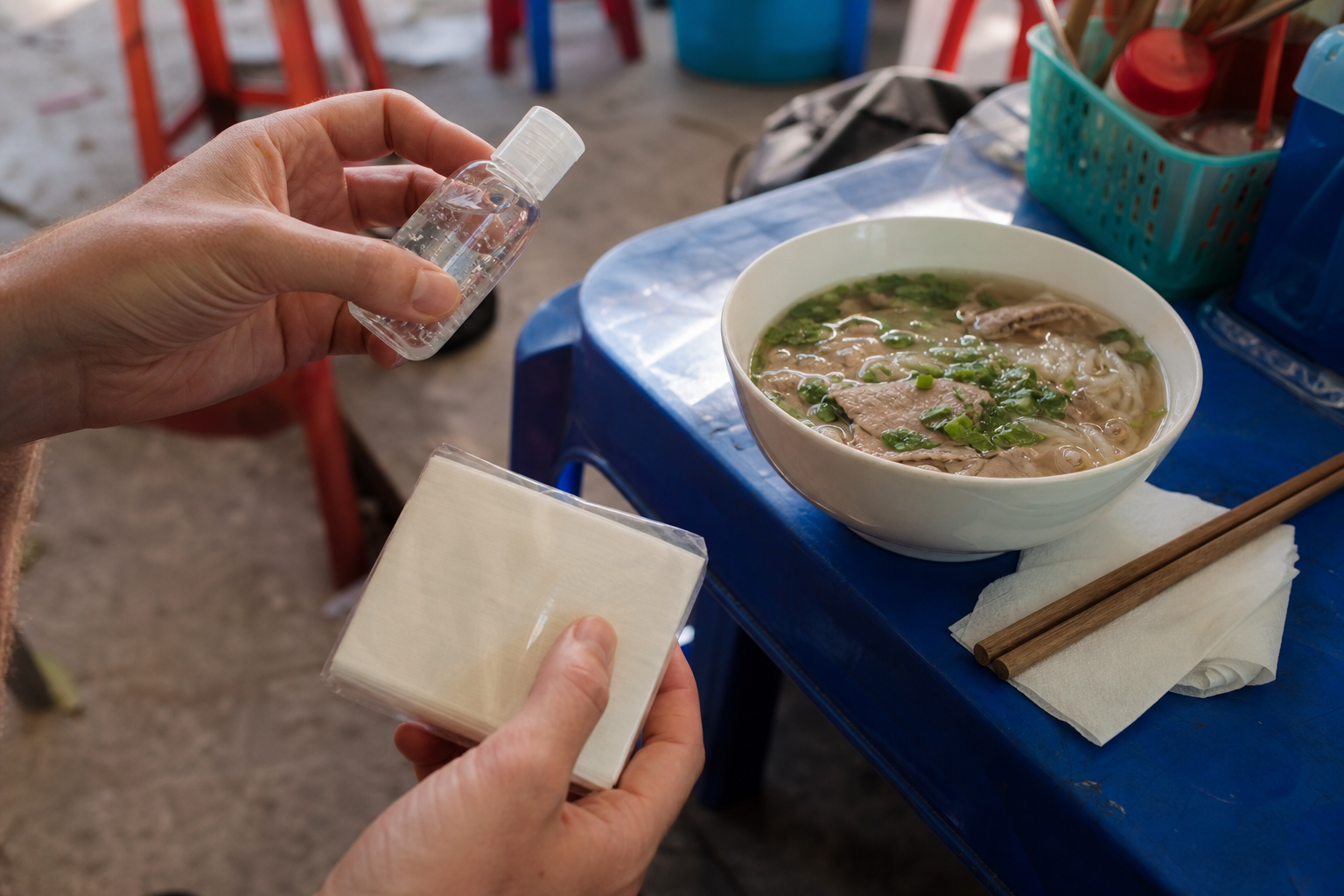
After: I assume my hands are the dirtiest thing at the table, because they are. Small bottle of sanitiser in my left pocket, used before every single meal without exception. That’s it. That one switch probably accounts for half my improvement.
I’ve also stopped tissue-wiping utensils theatrically — it does very little, and at a good stall it’s mildly insulting. If the chopsticks are visibly wet or greasy, I just ask for another pair. “Cho tôi đôi đũa khác” gets a nod, not offence.
Rule 6: The First 72 Hours
Before: I landed in Hanoi at 11pm, slept badly, and by lunchtime the next day had eaten five different street dishes across the Old Quarter because I was excited and jet-lagged and it was all so cheap. My stomach had no chance to adjust to anything.
After: I ramp up. Days one and two, I stick mostly to hot soups and grilled food, two street meals a day, and I go easy on chilli and shellfish. From day three I eat whatever I want. It’s not about fragile foreign guts — it’s just that a different bacterial baseline plus a 6-hour time shift plus dehydration is a bad combination to introduce raw shellfish into.
If you’re staying central, the Old Quarter guide I wrote has the specific streets I start on when I want reliable, high-turnover stalls in walking distance.
Rule 7: What I Do When It Goes Wrong Anyway
Before: I took an anti-diarrhoeal immediately, stopped drinking because drinking meant more bathroom trips, and spent 40 hours making it significantly worse than it needed to be. Classic.
After: I have a two-step routine and it’s boring on purpose.
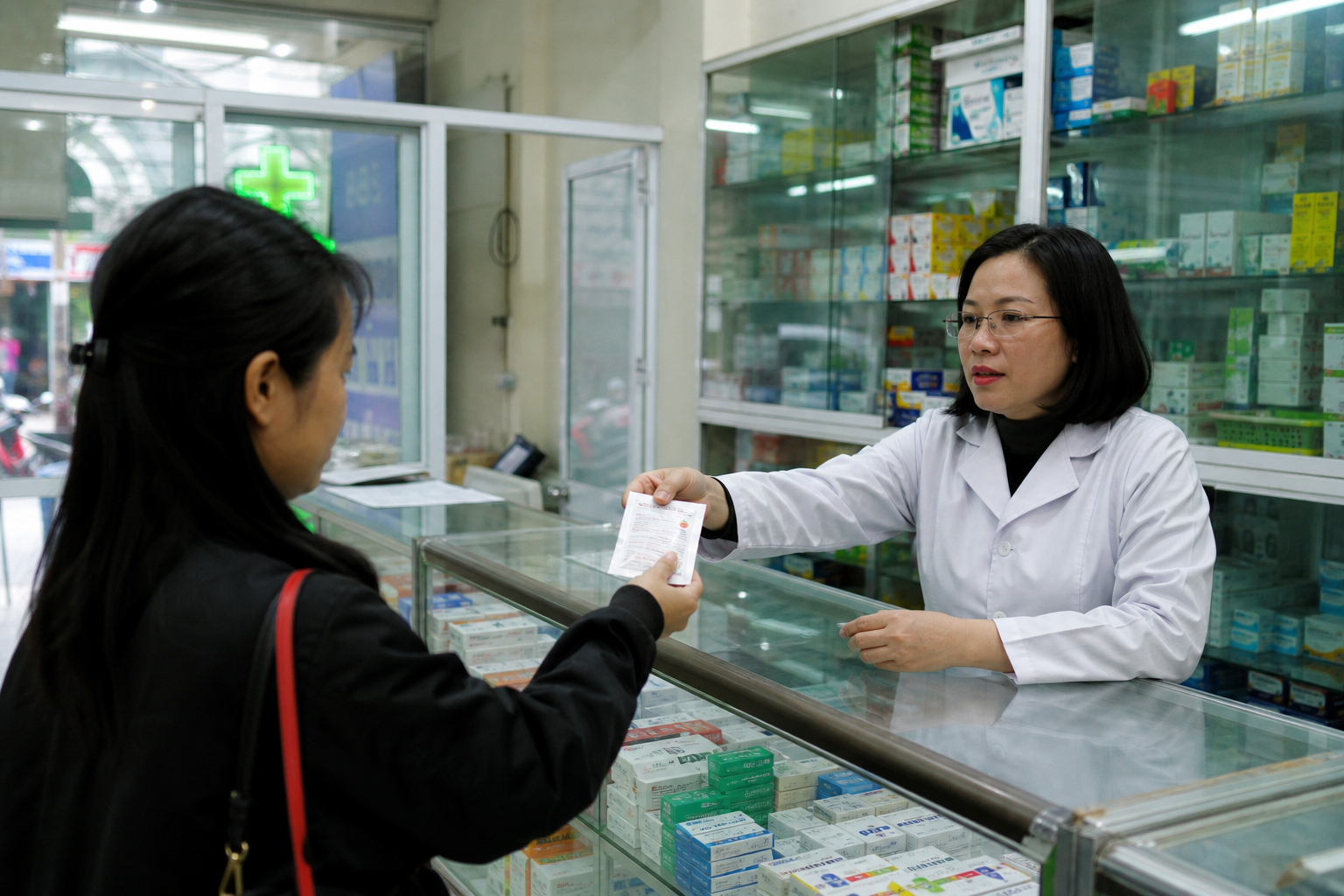
Step one: rehydrate. Oral rehydration salts — ask for “oresol” at any pharmacy, about 3,000–5,000 VND a sachet. Green-cross pharmacies are on nearly every second block in any Vietnamese city and the staff are quick and unbothered. One sachet in 200ml of bottled water, repeat. Coconut water works as a backup.
Step two: wait it out. Ordinary food-related upset resolves in 12–36 hours. I only reach for loperamide if I genuinely have to sit on a bus, and I don’t touch antibiotics without a doctor.
The lines where I stop self-treating: fever above 38.5°C, blood, or symptoms past 48 hours. International clinics in Hanoi and Ho Chi Minh City charge roughly 1,000,000–2,000,000 VND for a consultation. Have travel insurance and keep the receipt.
The Honest Summary
Looking at the before-and-after side by side, what it takes to eat street food in Vietnam without getting sick comes down to timing and turnover, not cleanliness. First-trip me was scanning for tiles and tissues. Current me is reading the crowd, the clock and the cooking method.
And the biggest cost of getting it wrong isn’t the illness — it’s the two weeks I spent on my first trip eating safe, boring, tourist-adjacent food and missing most of what makes Vietnamese cuisine worth flying for. Fear made me eat worse food and still get sick. The plastic stool on the pavement was never the danger. It was the empty restaurant with the laminated menu.
FAQ
Is street food in Vietnam safe for tourists?
Broadly yes, and often safer than mid-range tourist restaurants, because busy stalls cook in small batches with enormous turnover. The risk sits with food held lukewarm for hours, not with the setting. Globally, street food hygiene tracks turnover and cooking temperature far more closely than it tracks how the premises look.
Can I drink the ice in Vietnam?
Yes, in the overwhelming majority of cases. Standard tube ice with a hole through the centre is factory-made from treated water. Avoid hand-chipped chunks from a floor sack, and never drink tap water.
Should I avoid raw herbs and vegetables?
No — you’d lose a third of the flavour of most dishes. Judge the plate: crisp and freshly put out is fine, wilted and sitting in warm water is not. Blanch bean sprouts in your broth for 20 seconds if you want extra margin.
What should I pack for stomach trouble in Vietnam?
Hand sanitiser, oral rehydration salts, and loperamide for travel days only. Everything else — including the rehydration salts — is cheap and available at any Vietnamese pharmacy for a few thousand đồng.
How long does travellers’ diarrhoea usually last?
Most ordinary cases settle in 12–36 hours with rehydration and rest. See a doctor if you have a fever over 38.5°C, blood in your stool, or symptoms lasting more than 48 hours.