

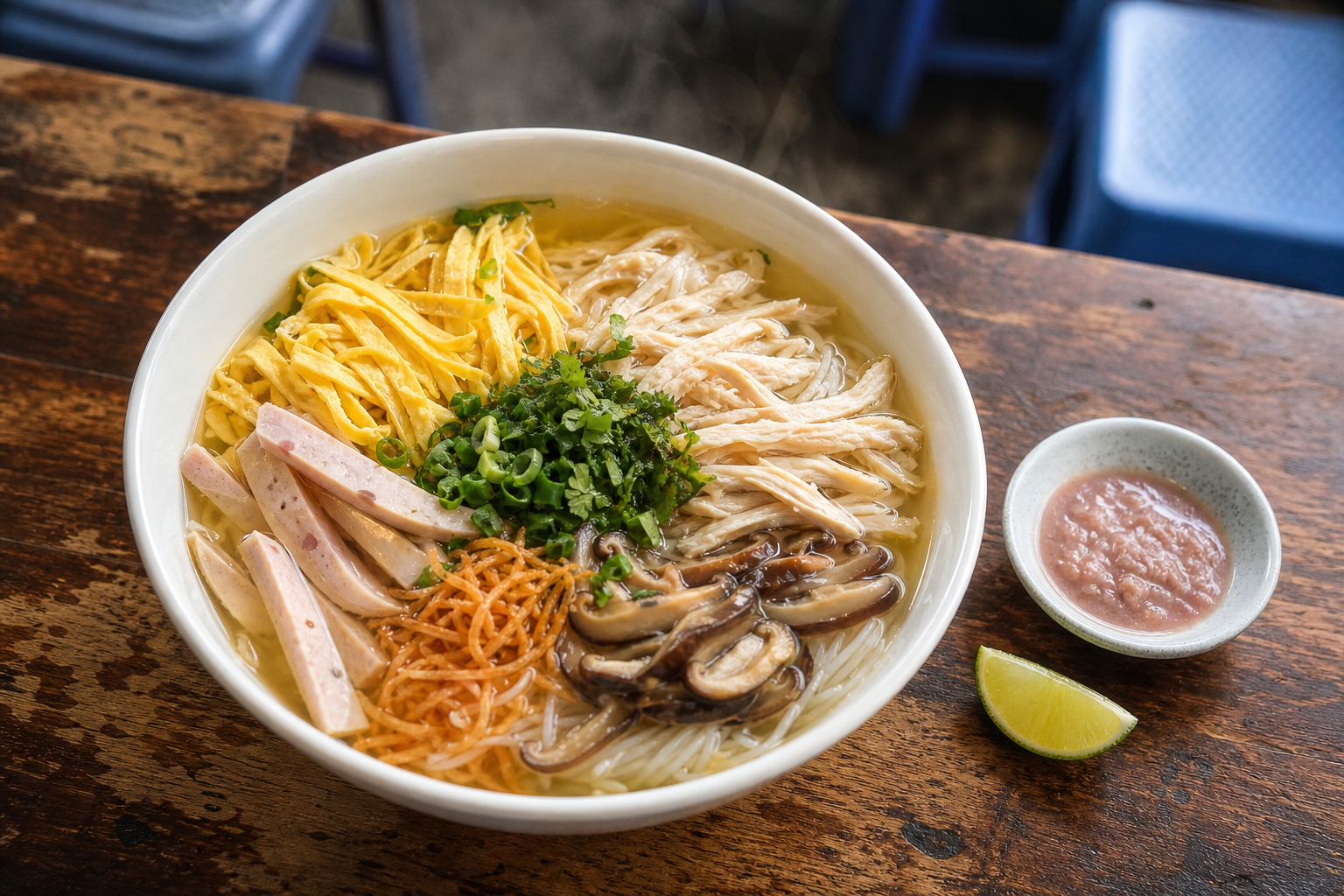
Hanoi chicken noodle soup, known locally as bún thang, looks simple and is anything but. A single bowl carries chicken, egg, pork sausage, mushroom, dried shrimp, pickled radish and a fermented shrimp finish, and each part is prepared separately. Most of the work happens before a customer sits down.
This guide follows the kitchen clock: what gets done at each stage of a 24-hour cycle, and what that means for the bowl you are served. Knowing the sequence also tells you how to judge a shop, because the shortcuts show up in the broth first.
What Hanoi Chicken Noodle Soup Actually Is
This Hanoi chicken noodle soup is built on thin rice vermicelli (bún) and a clear, lightly sweet broth made from chicken and pork bones with dried seafood. It is not a spicy bowl and not a murky one. The broth should be see-through and pale gold.
The usual story ties it to Tet. Households ended the new-year holiday with leftover boiled chicken, ham, sausage and eggs, and turned them into a refined soup. The “thang” part of the name is explained in several ways, so treat any single etymology with caution. What is consistent is the look: toppings in thin, even strips, arranged like a small garden on the noodles.
It sits in the same Hanoi family as phở bò and bún chả, but the broth is lighter than phở and the topping count is far higher than either.
The 24-Hour Kitchen Clock
Day Before, 4 pm: Buying and Soaking
Dried shiitake mushrooms, dried squid (mực khô) and dried shrimp (tôm khô) go into water to soften and release flavour. Dried shrimp is also ground or pounded for use as a topping. Pork bones are blanched and rinsed to remove scum, which is what keeps the final broth clear.
Whole chickens are chosen for the bird’s age and size. Free-range birds (gà ta) give firmer meat and a more aromatic stock than industrial broilers, and they cost more, often 150,000-250,000 VND per kilo (about $6-10) in Hanoi markets, against roughly half that for broilers. The price gap reaches the bowl.
Day Before, 8 pm: The First Simmer
Bones, the soaked dried squid and a small amount of dried shrimp go into a large pot with cold water. The heat stays low. A rolling boil breaks fat into the liquid and clouds it, so the surface is only allowed to tremble.
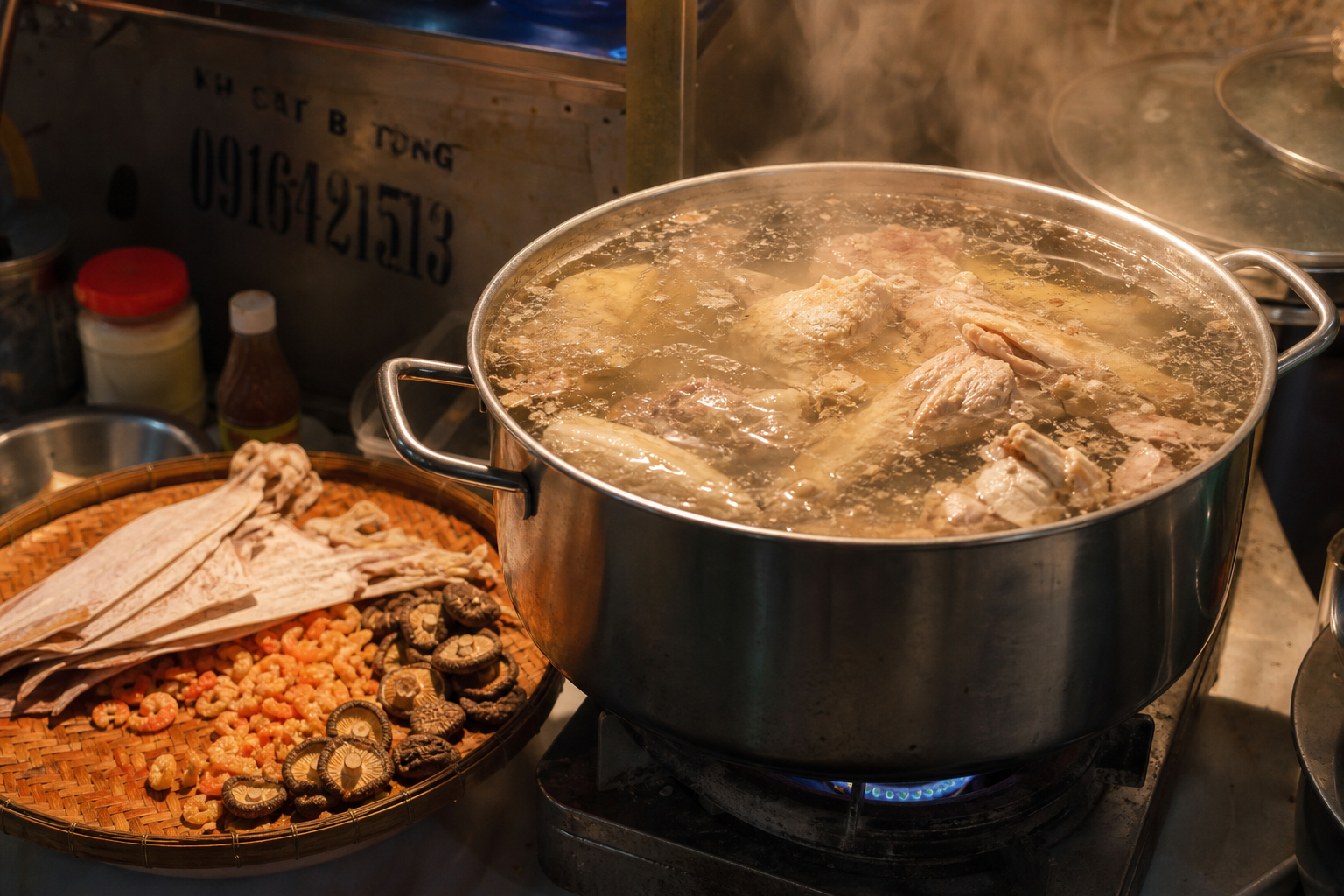
The whole chicken is added and poached until just cooked, usually 25-35 minutes depending on size, then lifted out and cooled in water or ice. Rapid cooling keeps the skin tight and the meat moist.
Midnight to 3 am: The Slow Extraction
The bones keep simmering for several more hours. Sweetness is meant to come from the bones, the dried squid and a little rock sugar, not from added sugar or flavour powder. A few strips of dried radish (củ cải khô) sometimes join the pot for a faint savoury-sweet edge.
4 am: Cutting the Toppings
This is the labour-heavy stage and the one that defines the dish. Every topping is cut into narrow, matching strips.
- Chicken: hand-shredded along the grain, not chopped, so it stays soft.
- Egg: a very thin omelette (trứng tráng) is fried, rolled and sliced into ribbons a few millimetres wide.
- Pork sausage: chả lụa, the smooth steamed pork roll, is sliced paper-thin; some shops add a second sausage or ham.
- Mushroom: rehydrated shiitake, sliced and often braised with a little seasoning.
- Radish: dried radish threads add crunch and a salty-sweet note.
- Shrimp floss: dried shrimp pounded into fine, fluffy threads.
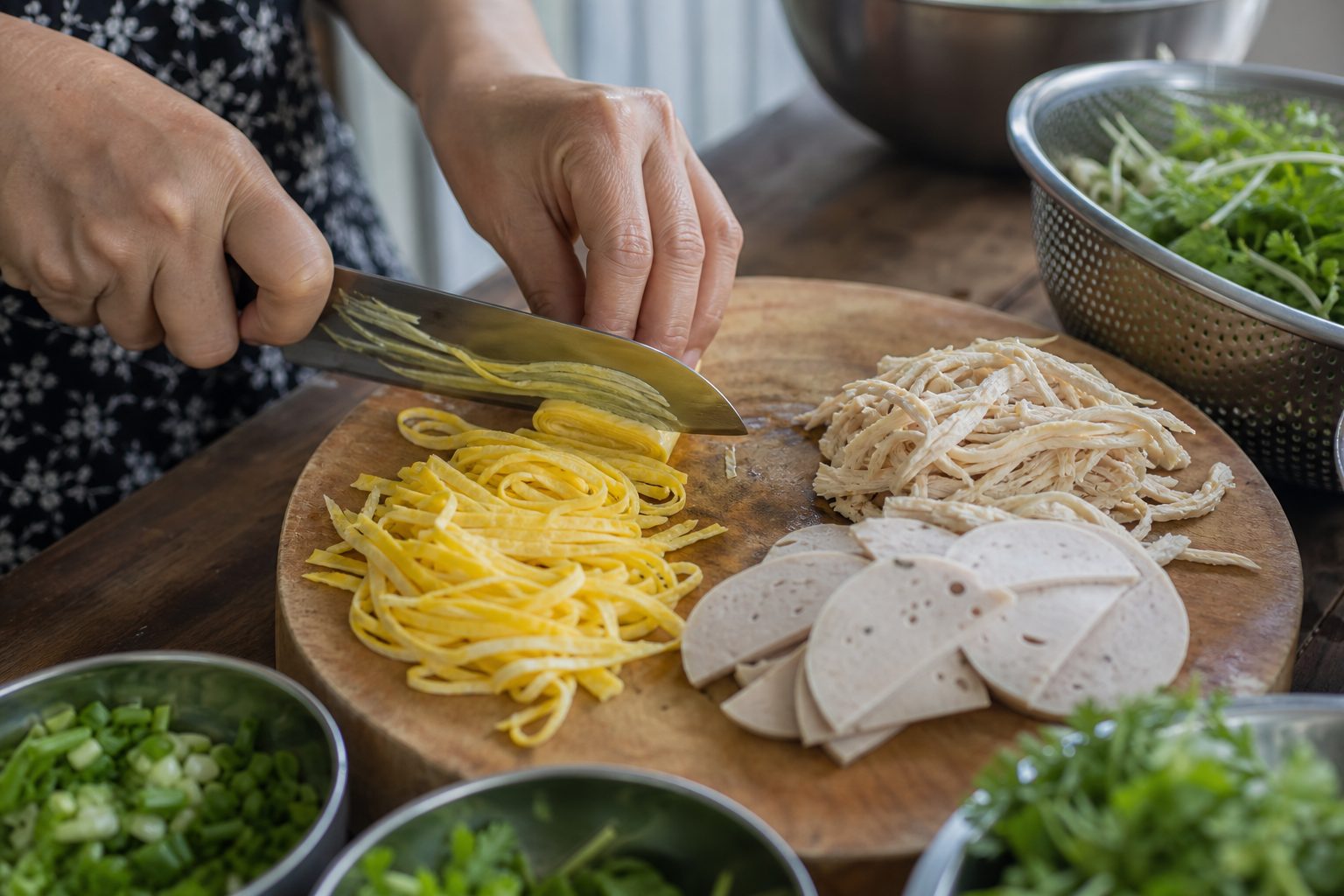
Herbs are cut last so they stay fragrant: scallion, culantro and Vietnamese coriander (rau răm). Rau răm has a peppery bite and is essential to the flavour.
5:30 am: Seasoning and Skimming
The broth is strained, skimmed again and seasoned with fish sauce and salt. Many traditional recipes also use a drop of cà cuống, an essence from a giant water bug that gives a perfumed, pear-like aroma. Genuine essence is rare and expensive. Most shops now use a synthetic version or leave it out, so its absence is normal rather than a red flag.
6 am to 9 am: Service
Serving is done in a fixed order. Noodles go into the bowl first, then the toppings are fanned out in sections, then the hot broth is ladled around the edge so it does not wash the pattern away. A small dish of fermented shrimp paste (mắm tôm) with lime comes alongside.
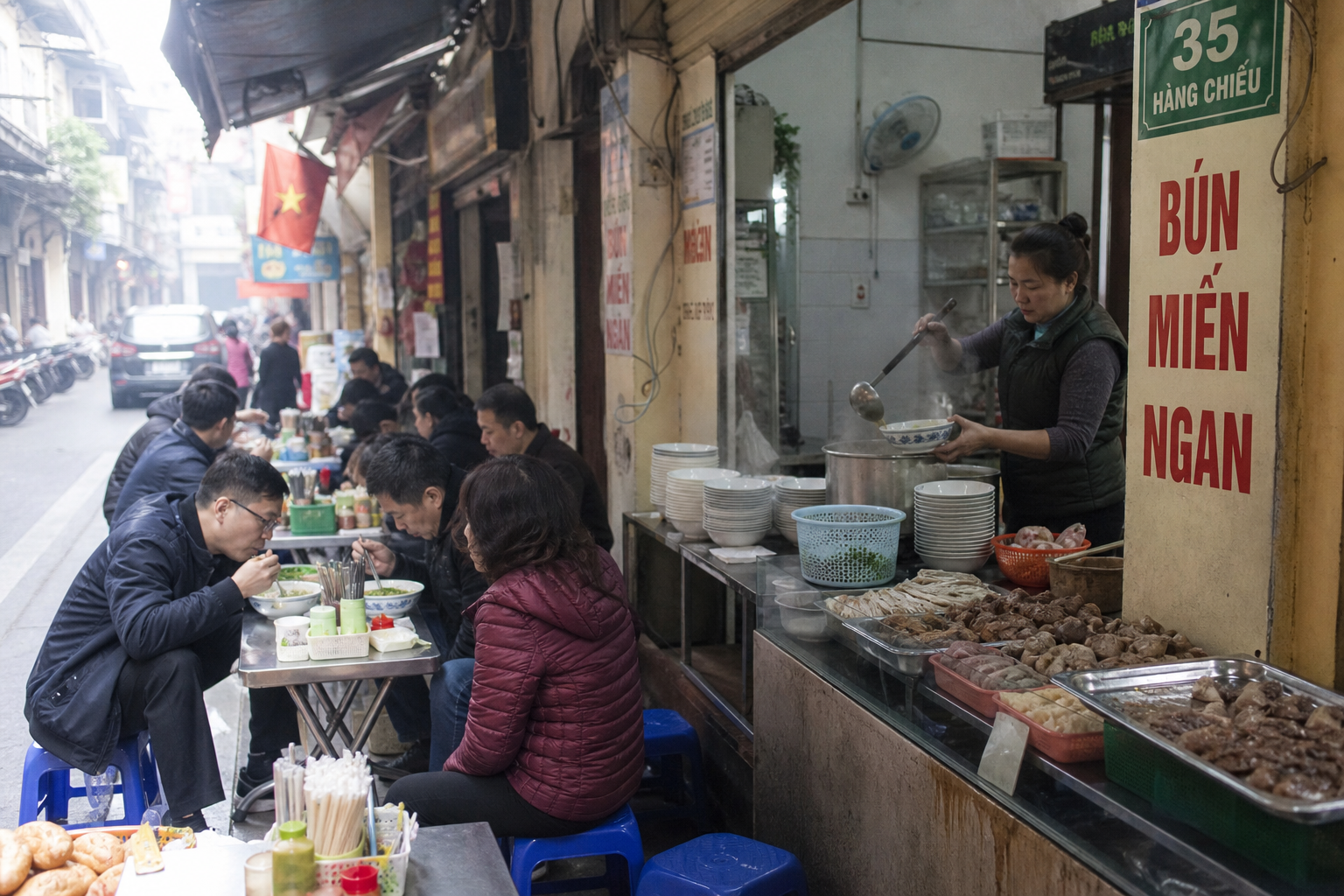
Breakfast is the core window. Many specialist shops stop by 10 or 11 am; a few reopen briefly in the evening. Arriving at midday often means the best toppings are gone.
Reading the Clock From the Table
Each stage leaves evidence in the bowl.
| What you see or taste | Which stage it reflects |
|---|---|
| Clear, pale gold broth | Gentle simmer and careful skimming |
| Faint sweetness with no sugary aftertaste | Bones and dried squid did the work |
| Egg ribbons of even width | Early-morning knife work |
| Chicken in long soft strands | Hand shredding, fresh poaching |
| Broth with oil slick or cloudiness | Boiled too hard or reheated repeatedly |
| Sharp chemical sweetness | Added flavour powder |
Where Hanoi Chicken Noodle Soup Is Sold
A standard bowl runs about 50,000-80,000 VND ($2-3.20) in everyday Old Quarter and Hoàn Kiếm shops. Bowls with free-range chicken, extra egg or extra sausage reach 90,000-130,000 VND ($3.60-5.20). Prices vary mainly with the chicken and the number of toppings.
Most dedicated shops cluster in the Old Quarter and the streets just south of Hoàn Kiếm Lake, with Cầu Gỗ among the best-known addresses for the dish. Because bún thang depends on a day’s prep, specialist shops tend to be better than places that list it among twenty other items.
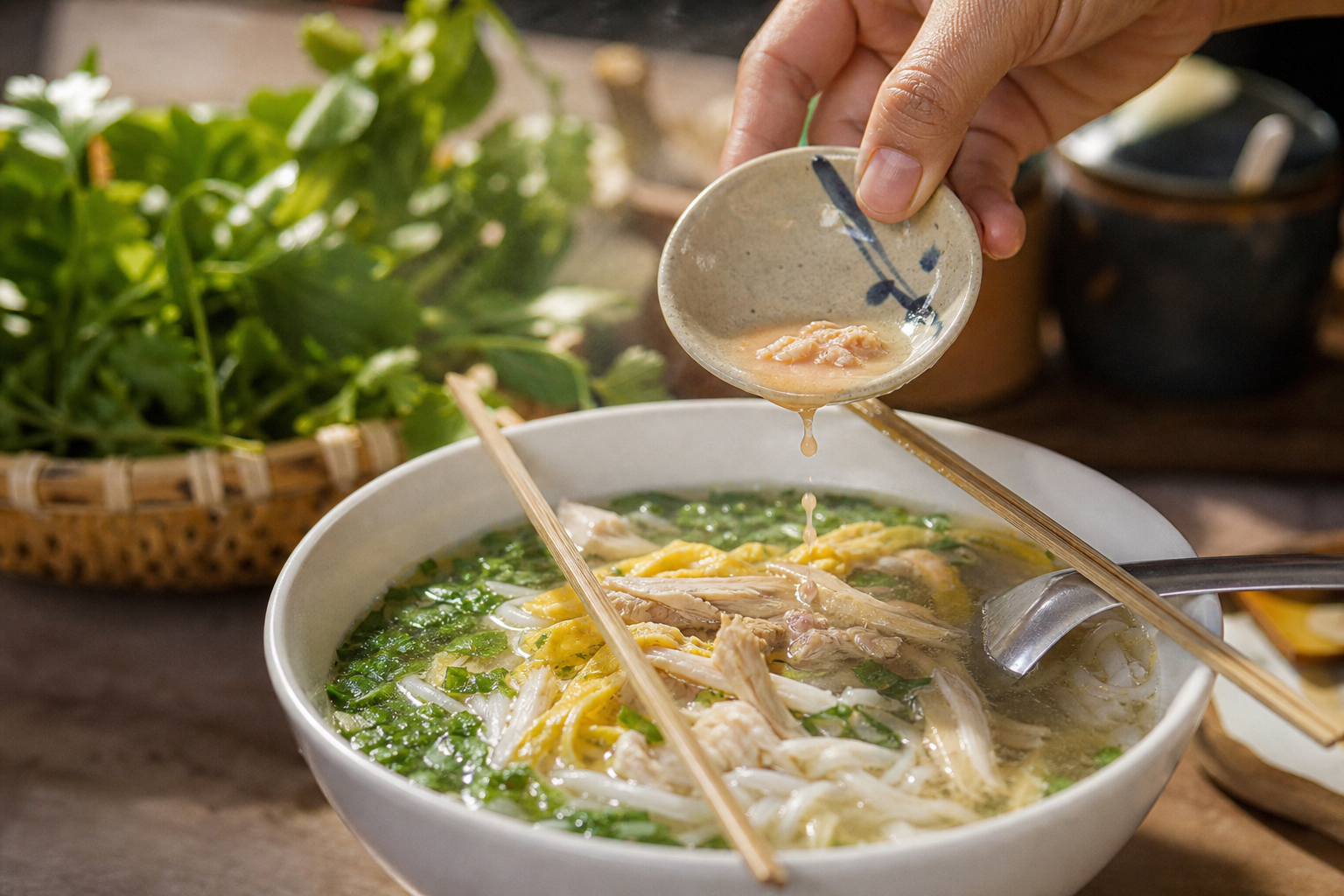
Finishing the Bowl
- Taste the broth plain first.
- Add 2-3 drops of mắm tôm diluted with lime, then stir once.
- Add chilli only if wanted; the dish is not meant to be hot.
- Eat the toppings with noodles, not separately, and finish the broth.
If the smell of fermented shrimp is unwelcome, skipping it is common and acceptable. Fish sauce and lime on the side are the usual substitutes.
Why Hanoi Chicken Noodle Soup Costs What It Does
The price of a bowl of Hanoi chicken noodle soup can be traced back to the clock. Labour is the largest cost. Cutting six toppings by hand before dawn takes one or two people several hours, and that is spread across perhaps 60 to 150 bowls a morning. The chicken is the second cost, followed by dried squid and dried shrimp, which are priced by weight and add up quickly in a large pot.
That explains two patterns. First, bowls under 40,000 VND ($1.60) usually mean thin toppings, a smaller chicken portion or a broth that leans on seasoning powder. Second, tourist-area restaurants charging 120,000-180,000 VND ($4.80-7.20) are often paying for rent and service, not a better broth. The 60,000-100,000 VND range ($2.40-4) at a specialist counter is the most reliable value.
Seasons, Home Versions and Tet
Hanoi chicken noodle soup is a year-round dish, but it fits the cooler months best. From November to March, when Hanoi drops to roughly 10-18°C, a hot, clear broth is more appealing than a heavy one, and shops fill earlier. In summer heat, many diners shift to cold noodle dishes and eat bún thang at the first opening hour only.
At home, the dish is still seen as a project. Families in Hanoi traditionally make it in the days after the lunar new year, when boiled chicken, sausage and eggs are already in the kitchen, and the broth can be built from the carcass. This is the origin of the Tet link, and it is why restaurant versions tend to be more uniform than home versions: the shop needs the same look every morning, while a household uses what is left.
Five Quality Checks Before You Sit Down
Use these quick filters when choosing a counter.
- Look at the topping trays. Egg, chicken, sausage and mushroom should each be in a separate tray, cut evenly. A single mixed pile signals a shortcut.
- Check the pot. A large pot kept just below a simmer is a good sign. A pot at a hard boil means a cloudy broth.
- Watch the assembly. The toppings should be arranged in sections, not dumped in the centre.
- Smell the bowl. A clean aroma of chicken, herbs and a little seafood is right. A strong sweet or chemical smell points to flavour powder.
- Count the herbs. Scallion and rau răm should be fresh and green, not wilted.
A shop that passes four of five is usually worth ordering from.
How It Compares With Other Chicken Dishes
Hanoi chicken noodle soup shares chicken-and-herb ground with Hội An chicken rice, but the two are very different plates: one is a dry rice dish cooked in stock, the other a layered soup with many separate toppings. For the Tet link, the history of the Tet sticky rice cake explains the holiday food culture that produced dishes made from festive leftovers.
Fitting It Into a Hanoi Food Day
Hanoi chicken noodle soup pairs best with an early start. Plan it for 7-8 am, when the broth is freshest, then keep the rest of the morning light. A Hanoi food-focused schedule works well when built around breakfast soups first and grilled dishes later; private northern Vietnam tours usually structure days this way. For short stays, the Hanoi city tours at C Vietnam Tours cover the Old Quarter on foot, which is where most bún thang shops are.
FAQ
Is bún thang spicy?
No. The broth is mild and slightly sweet. Chilli is optional and served on the side.
What does bún thang taste like?
Clean, savoury and lightly sweet, with a seafood depth from dried squid and shrimp, plus fresh herb notes from rau răm.
Why is bún thang more expensive than phở?
It requires more separate preparation: shredded chicken, egg ribbons, sausage, mushroom and dried shrimp floss. The labour and ingredient count are higher.
Can you eat bún thang without fermented shrimp paste?
Yes. The paste is an optional add-on, and the bowl works with just fish sauce and lime.
What time should you eat it?
Between 6 and 9 am, when the broth and toppings are freshest.