

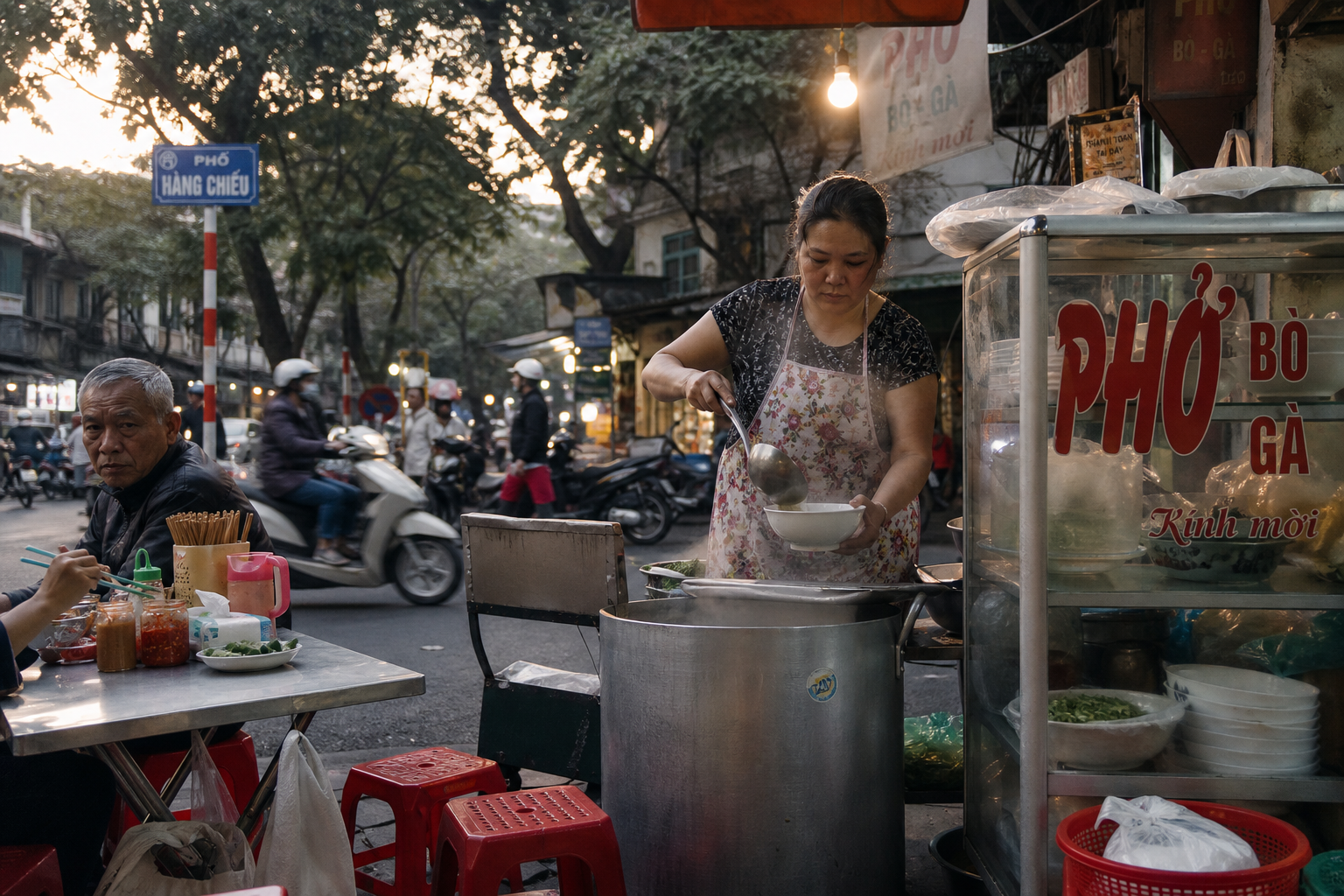
The first time I sat down at a phở stall in Hanoi, I said “hello” in English, pointed at a random line on the wall, and ended up with a bowl of raw beef I hadn’t ordered and a plate of intestine I definitely hadn’t. It cost me 55,000 VND and a lot of dignity. I ate about a third of it.
That was six trips and roughly three months of living in Vietnam ago. What changed everything wasn’t fluency — my Vietnamese is still bad enough that vendors laugh at me — it was about two dozen words. This is not a language lesson. It’s a working field phrasebook of the Vietnamese street food phrases I actually use, written as dictionary-style entries: the phrase, how I say it out loud, what physically happens when I say it, and the mistake I made learning it.
I’ve grouped the entries by the order the moments happen: sitting down, ordering, saying no, asking for more, paying, leaving. Read it in that order and you basically have a script for one meal.
How to Read These Entries
Each entry looks like this:
Phrase — my rough pronunciation — literal meaning
What actually happens when I say it. My mistake.
All of the Vietnamese street food phrases below are written this way. My pronunciations are deliberately clumsy English approximations, not proper diacritics-and-tones transcription. Vietnamese is tonal, and yes, tone matters — six of them in the northern dialect, as the Vietnamese language Wikipedia page will happily explain. But at a food stall, context does about 70% of the work for you. Nobody thinks you’re asking for a coffin when you’re pointing at a bowl of noodles.
One structural note before the entries: em / chị / anh / cô are the words that do the most work in all of these Vietnamese street food phrases. Vietnamese swaps “you” for a family word based on rough age. Chị for a woman a bit older than you, anh for a man a bit older, cô for a woman clearly your mother’s age or above, em for someone younger. Get it approximately right and everything else you say sounds warmer than it deserves to.
Part 1: Vietnamese Street Food Phrases for Sitting Down
1. Chị ơi
chee oy — “older sister, hey”
The single most useful thing in this entire article. It’s how you get attention without shouting or waving. Say it once at normal volume toward the person at the pot. They will look up. Swap in anh ơi, cô ơi, em ơi as needed. My mistake: For two weeks I said “excuse me” in English to women in their sixties. It works, technically. But cô ơi got me a nod and a stool pulled out for me. English got me a wary stare.
2. Còn không?
gawn khome — “still have, or no?”
Point at the thing, say this, and you learn whether the food is sold out. At 1pm, half the good stalls have already run dry. This saves you sitting down at a table where the only thing left is the broth. My mistake: I once sat for eleven minutes at a bánh cuốn stall before anybody had the heart to tell me the batter was finished.
3. Một mình
mote ming — “one person / alone”
Answers the question they’re about to ask: how many of you. Also hai người (hai ngew-oy) for two. My mistake: Holding up one finger. In Vietnam a raised index finger is fine, but I once held up a thumb meaning “one” — Vietnamese counting starts the thumb at one — and got two bowls.
4. Ngồi đây được không?
ngoy day dook khome — “can I sit here?”
Useful when the stools are half-occupied by the family who owns the place, or by delivery drivers on break. Nine times out of ten someone shuffles over. My mistake: Sitting on the vendor’s own stool, the one next to the cash tin. She was gracious. Her daughter was not.
Part 2: Vietnamese Street Food Phrases for Ordering
5. Cho tôi một bát
chaw toy mote baht — “give me one bowl”
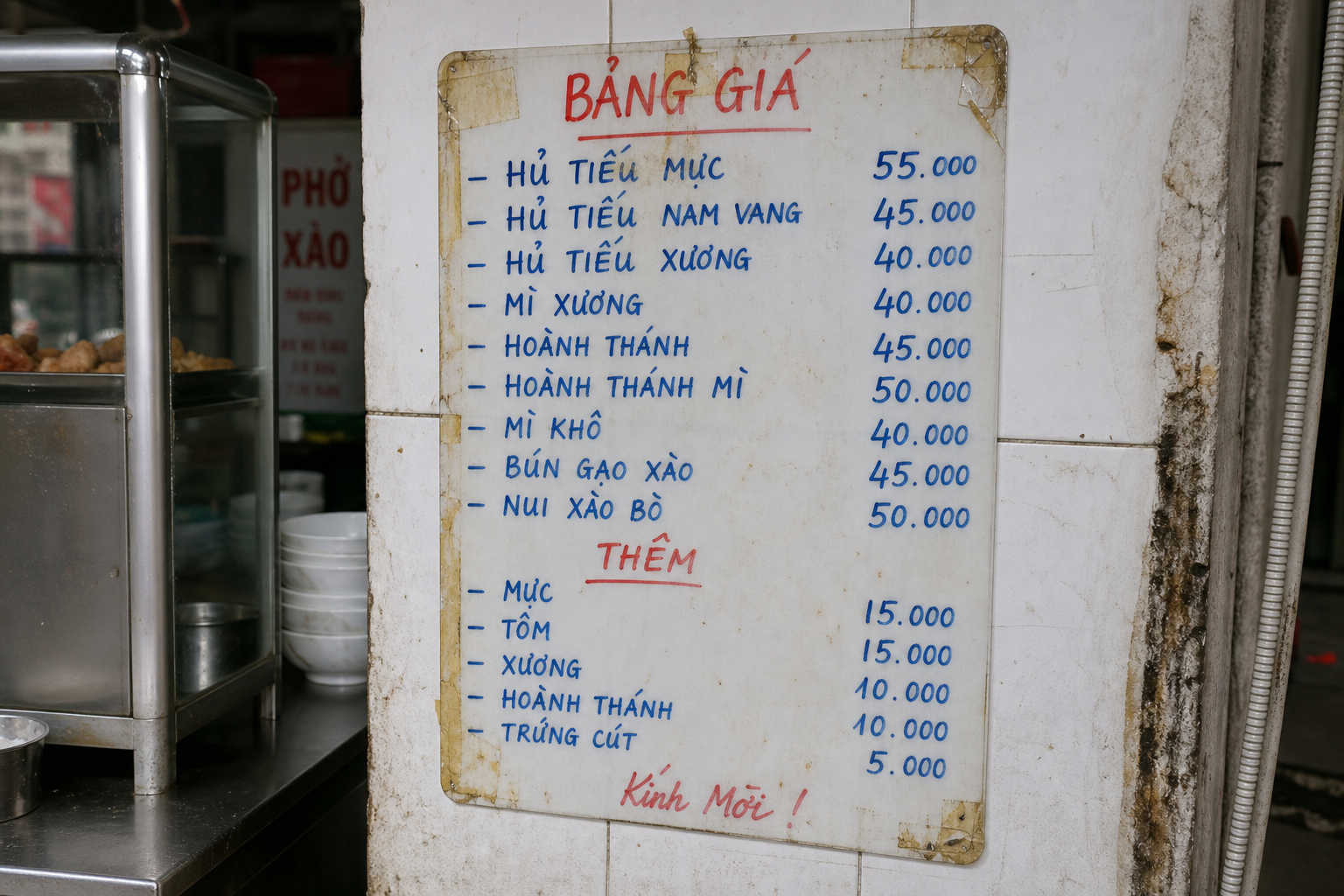
The backbone sentence. Cho tôi + quantity + thing. Northern Vietnam says bát for bowl; the south says tô. Both are understood everywhere. My mistake: I over-engineered it. I’d try to construct a full polite sentence, stall out halfway, and get nothing. Cho tôi một bát plus a point is complete and correct.
6. Cái này
kai nay — “this one”
Said while pointing at another table’s bowl, a tray of grilled meat, or a photo. This is the phrase that unlocks the entire menu without reading a word of it. My mistake: Pointing at something on a neighbouring table that turned out to be the customer’s own home-brought side dish. She thought it was hilarious. I bought her a tea.
7. Giống cái kia
yowng kai kya — “same as that one”
A step up from cái này. Point at a stranger’s bowl across the stall and you get exactly what they got, including the toppings you’d never know to ask for. When I use it: Any stall where a local orders confidently ahead of me. It’s my single highest hit-rate ordering strategy in Vietnam, and it’s how I found the best bún đậu mắm tôm plate I’ve had.
8. Bao nhiêu tiền?
bao nyew tien — “how much money?”
Ask before eating at stalls with no written prices, especially in tourist-dense blocks of Hanoi’s Old Quarter. Not because scamming is rampant — it mostly isn’t — but because it removes the one thing that can sour a good meal. Real numbers, mid-2026: a bowl of phở runs 40,000–60,000 VND; bánh mì 20,000–35,000; cà phê sữa đá 20,000–30,000; iced tea often free or 3,000. If a number lands wildly outside that, ask again slowly.
9. Mang đi
mahng dee — “take away”
Two syllables that save you from awkward pantomime. Say it at the moment you order, not after — the packing method differs. My mistake: Asking after the broth was already in the bowl. She poured it into a bag. It leaked in my backpack. That was a 900,000 VND laptop sleeve.
10. Ăn ở đây
an uh day — “eat here”
The opposite of the above, and worth saying out loud because a foreigner standing near the counter is assumed to be a takeaway customer.
Part 3: Saying No (Politely and Effectively)
These are the Vietnamese street food phrases I use most often, and the ones that most reliably prevent an unhappy plate.
11. Không cần
khome kun — “don’t need”
Softer than a flat “no”. Use it for the extra egg, the extra rice, the plastic-wrapped wet towel that costs 5,000 VND.
12. Không ăn được
khome an dook — “can’t eat (it)”
The dietary workhorse. Combine with the thing: không ăn được mắm tôm (fermented shrimp paste), không ăn được nội tạng (organs). My mistake: Saying không thích (“don’t like”). It reads as fussy. Không ăn được reads as a constraint, and people respect a constraint.
13. Ít cay
eet kai — “little spicy”
Not không cay unless you mean zero. Vietnamese street food isn’t Thai-hot by default, but a stall’s chili paste can be brutal.
14. Không mì chính
khome mee ching — “no MSG”
If you’re sensitive. Say it early; broth is usually pre-seasoned and the answer may honestly be “not possible”, in which case they’ll tell you.
15. Tôi ăn chay
toy an chai — “I eat vegetarian”
Critical caveat: most “vegetable” dishes still involve fish sauce or pork broth. If you’re strict, look for a shop with a chay sign, often near a pagoda. The broader context on this is well summarised in the Vietnamese cuisine overview. My mistake: I once assured a vegetarian friend that bánh cuốn was safe. The dipping sauce is nước chấm. It is not safe.
Part 4: Asking For More
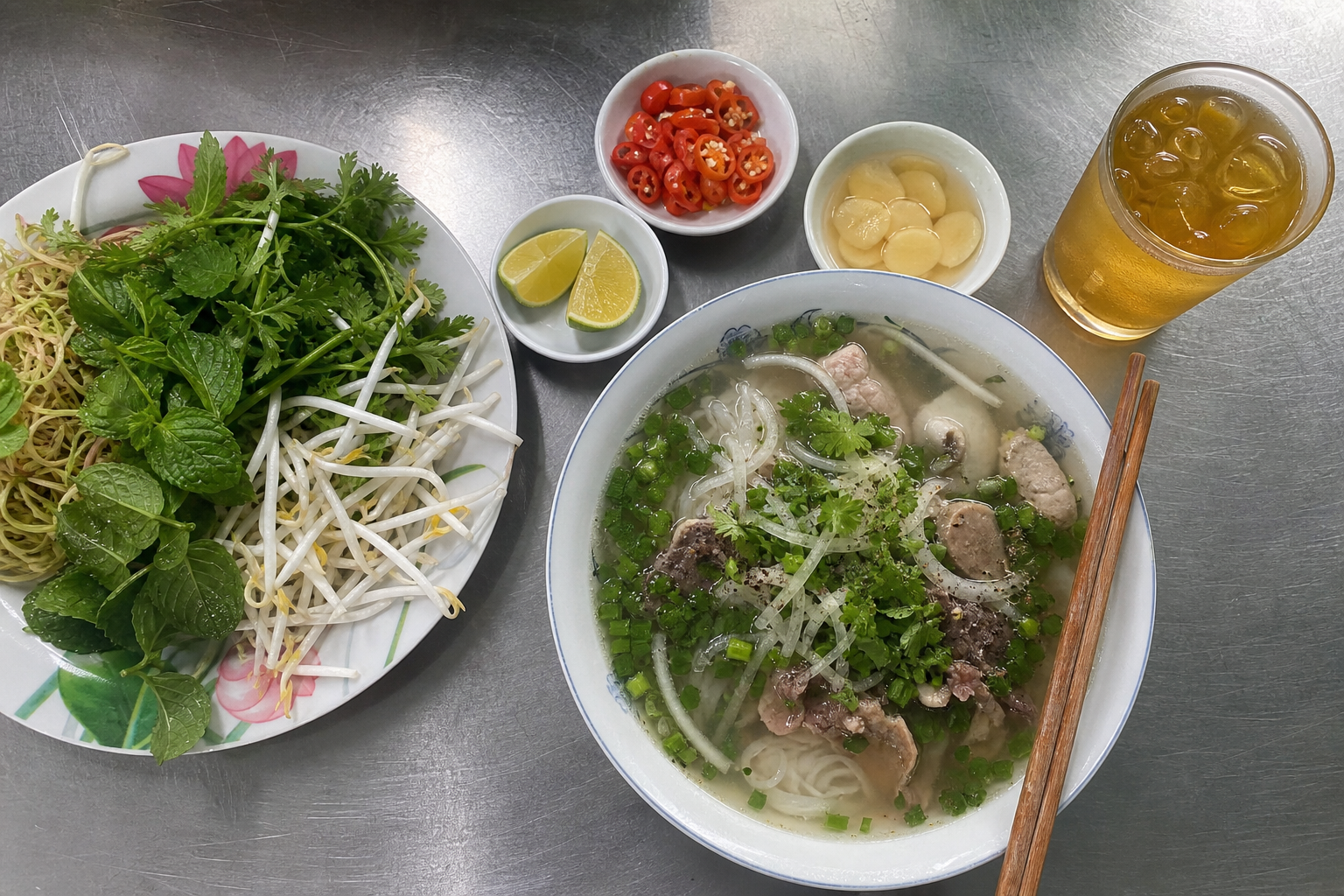
Half the value of Vietnamese street food phrases is knowing what’s free. Herbs and broth usually are.
16. Cho thêm
chaw tem — “give more”
Then name it: cho thêm rau (herbs), cho thêm bún (noodles), cho thêm nước (broth). Extra herbs and broth are almost always free — worth knowing before you order a second plate of cơm tấm you didn’t need. Extra noodles or meat usually add 10,000–20,000 VND. The thing nobody told me: that plate of herbs is a refill, not a portion. I spent a month rationing basil like it was billed by the leaf.
17. Nước mắm / tương ớt / dấm tỏi
nook mahm / tuong ut / yum toy — fish sauce / chili sauce / garlic vinegar
Name what you want and it appears. Garlic vinegar in particular is what makes a Hanoi bowl taste like Hanoi — I go into why in my write-up of phở bò in Hanoi.
18. Trà đá
cha dah — “iced tea”
The default street drink. Weak, cold, faintly smoky, endlessly refilled. Usually free with a meal in the north, 3,000–5,000 VND elsewhere.
19. Nóng / lạnh
nome / lang — “hot / cold”
Attach to any drink. Cà phê sữa nóng is a completely different experience from cà phê sữa đá, and in December in Hanoi you want the first one.
20. Ngon quá!
ngon kwah — “so delicious!”
Zero practical function. Highest return of any phrase here. I have been given free extra broth, a second spring roll, and directions to a better stall, all downstream of saying this once with genuine feeling.
Part 5: Vietnamese Street Food Phrases for Paying and Leaving
21. Tính tiền
ting tien — “calculate money”
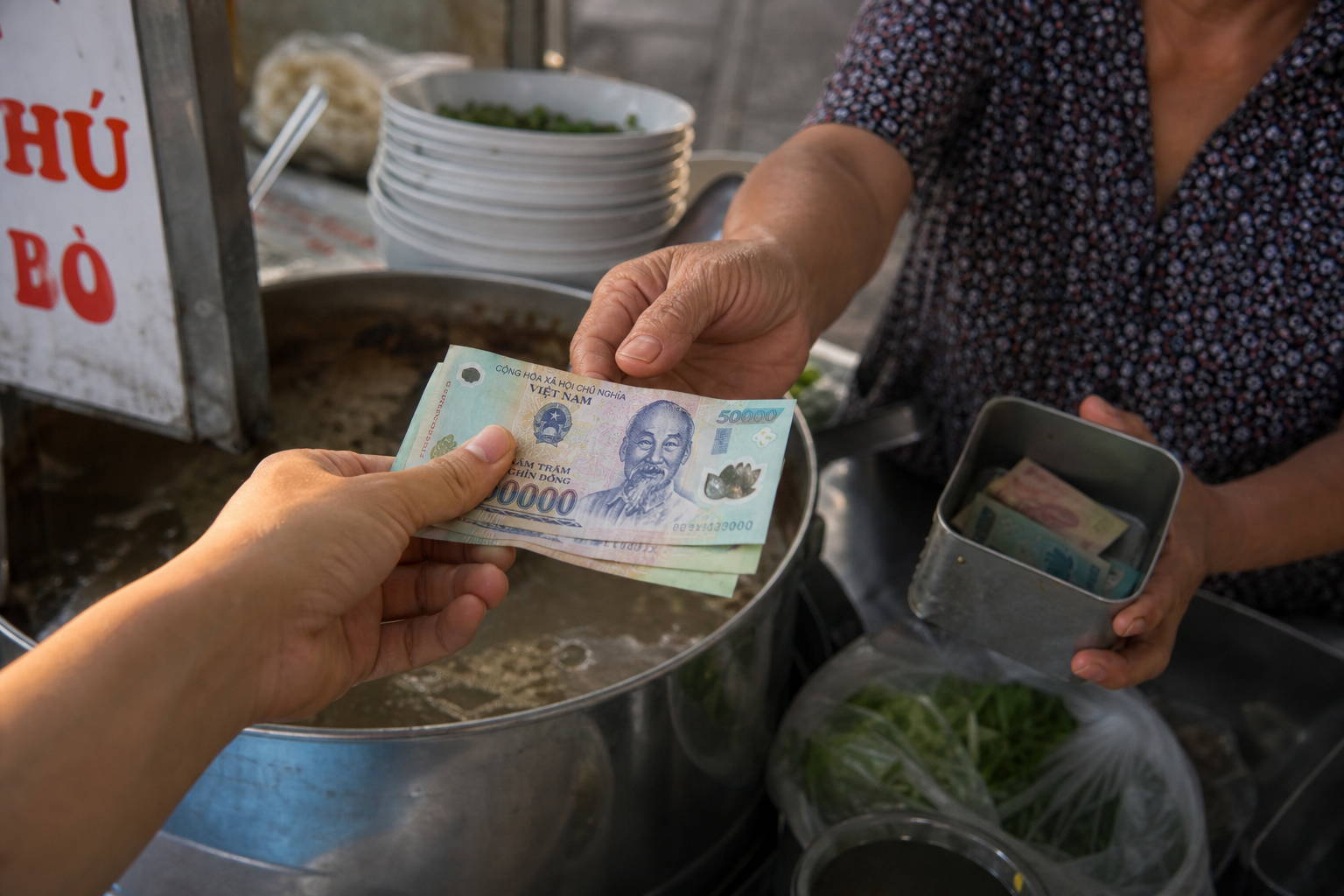
How you ask for the bill. Say it toward the counter, or catch an eye and make a small writing gesture. You almost always pay at the end, at your seat. My mistake: Walking up to the counter mid-meal to pay, blocking the entire assembly line at rush hour. Sit. Say tính tiền.
22. Chuyển khoản được không?
chwen khwahn dook khome — “can I bank transfer?”
Vietnam has gone very cashless, very fast. Most stalls now have a QR code taped to the pot. If you have a Vietnamese bank account, this is the smoothest way to pay. If you don’t, bring small notes — a 500,000 VND note at a 40,000 VND stall is a genuine problem for the vendor.
23. Không cần trả lại
khome kun cha lai — “no need to return (the change)”
Tipping isn’t expected at street stalls. This is my compromise: round up, leave the coins-equivalent, don’t make a ceremony of it.
24. Cảm ơn nhiều
gahm un nyew — “thanks a lot”
Say it standing up, looking at the person who cooked. This is the entry that turns a transaction into being recognised the next time you walk past.
The Four I’d Learn First, If You Only Learn Four
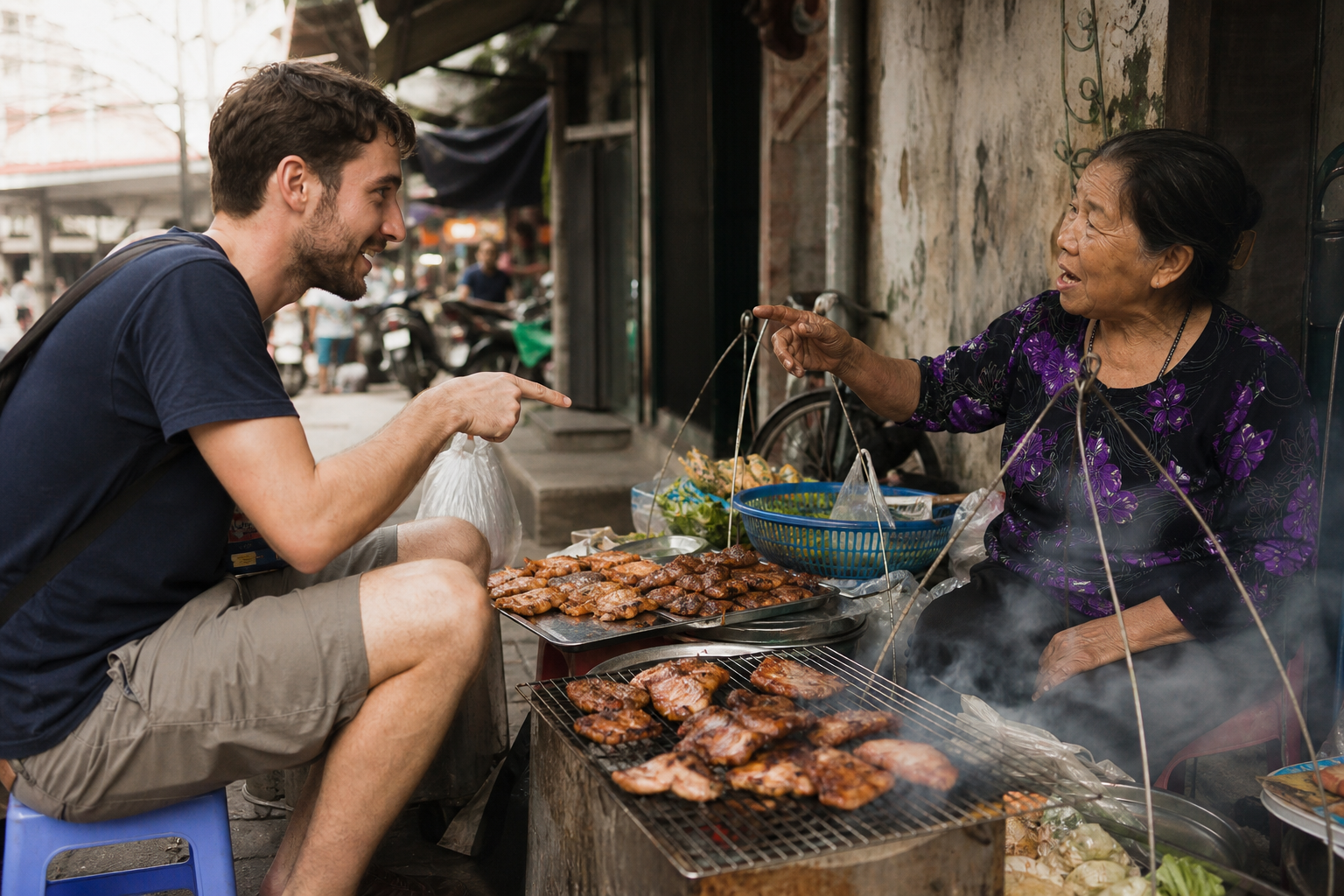
If this list of Vietnamese street food phrases is too long to carry around, carry this: chị ơi, cái này, bao nhiêu tiền, cảm ơn nhiều. Attention, order, price, thanks. That’s a complete meal. Every other entry in this Vietnamese street food phrases list is refinement.
And one habit that isn’t a phrase at all: eat at the busiest hour, at the stall with the most locals and the fewest laminated photos. If you want a concrete map of where to point that instinct, my honest guide to Hanoi’s Old Quarter has the specific streets and times I keep returning to.
FAQ
Do I really need Vietnamese street food phrases to eat well in Vietnam?
No. You can eat brilliantly with pointing alone, and I did for weeks. But four words changes how you’re treated — you stop being a walk-past customer and start being a person at the table. That’s worth twenty minutes of practice.
Is my pronunciation going to be a problem?
Less than you fear. Tones matter in conversation; at a stall, you’re saying two-word phrases while pointing at physical objects. Context carries you. Vendors are also extremely good at decoding foreigners.
Should I say “xin chào” when I arrive?
Honestly, rarely. Vietnamese people don’t usually open a street food interaction with a formal greeting. Chị ơi or cô ơi is the natural opener and sounds far more local than “xin chào”.
Is it rude to ask the price before ordering?
Not at all. It’s normal, and at unmarked stalls it’s what locals do too. Ask casually, before you sit, not accusingly after you’ve finished.
Cash or QR code in 2026?
Both. QR bank transfer is now accepted at a surprising number of small stalls, but cash never fails. I carry 300,000–400,000 VND in small notes for a full day of eating and rarely spend all of it.