
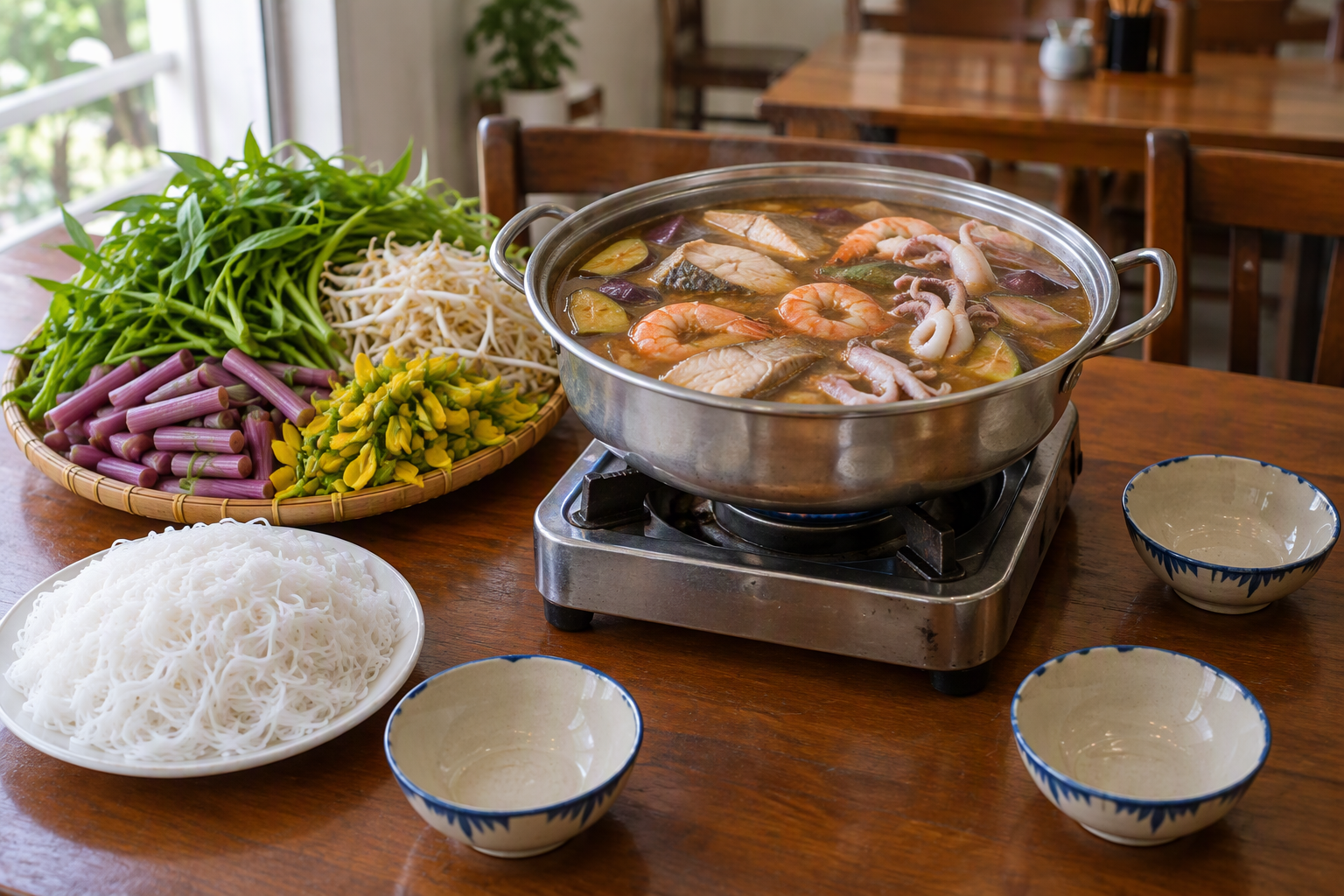
Fermented fish hotpot is a shared Mekong Delta meal built around a salty, aromatic broth, fresh fish or seafood, vegetables and rice vermicelli. Known as lẩu mắm, it arrives with enough separate ingredients to make ordering only half the job. Someone must check the portions, someone must manage the burner, and everyone needs to know which platter contains uncooked food. This Can Tho guide divides those tasks into table roles, so you can order a workable set and keep the meal moving without turning the pot into a crowded stew.
Match the menu to the group
Start with the dish name, lẩu mắm, rather than simply asking for a seafood hotpot. The defining ingredient is fermented fish in the broth, not the seafood arranged beside it. Recipes commonly use fermented gourami, Siamese mud carp, or a mixture. Lemongrass, garlic, eggplant and sometimes coconut water balance the concentrated fish flavour.
The result should taste savoury and distinctly fermented. Coconut water does not make it a creamy coconut soup, and extra seafood does not remove the broth’s fish content. Think of the fermentation as the base seasoning throughout the meal, not an optional dipping sauce.
For two diners, ask whether the smallest set is genuinely sized for two. For four, establish which fish, shellfish and meat come with the quoted pot. A large vegetable tray can make a set look enormous while the protein portion remains modest. Ask whether noodles, replacement broth and extra vegetables are included before adding another platter.
Explain restrictions before the order reaches the kitchen. Fish allergy rules out the standard broth even if all visible fish pieces are removed. Shrimp and squid may share utensils and preparation surfaces with other ingredients. A seafood-looking set can also contain pork belly, roast pork or pork-based stock. Removing a topping is not the same as changing the broth.
Choose an address with usable information
Can Tho is a practical place to order fermented fish hotpot in a specialist restaurant rather than improvising at a general snack stall. The Ninh Kieu and Xuan Khanh names still appear in restaurant listings and older maps. Use the full street address when arranging transport; neighbourhood labels alone are less precise.
PasGo’s guide, updated on 18 September 2026, lists a specialist at 162/18 Tran Ngoc Que, with published hours of 09:30–22:30. These are directory hours, not a guarantee of the kitchen’s final order time. Confirm service before making a late journey.
Da Ly is another established name, but its listing needs extra care. The official Can Tho tourism portal describes the restaurant on 3 Thang 2 Street and publishes 08:00–18:30, while PasGo gives 89 Tran Hoang Na and 08:00–20:00. Do not treat those conflicting addresses and hours as interchangeable. Call the tourism-listed number, 0292 3838 764, and request the current map pin.
Use the Can Tho travel guide to fit the meal around transport and accommodation. A shared pot needs seated restaurant time; it is not a snack to squeeze into a brief vehicle stop.
If you are arriving from Ho Chi Minh City, CTour’s southern Vietnam itinerary explains how an overnight in Can Tho fits between the city and onward island travel. Leave the restaurant meal separate from the transfer schedule rather than relying on a roadside stop to serve this dish.
The ingredient steward: organize fermented fish hotpot platters
Separate the broth from the additions
The kitchen prepares the fermented base before it reaches your table. A common method simmers the preserved fish, strains out bones, then combines the liquid with the stock and aromatics. Fresh fish, shrimp, squid and pork are additions, not substitutes for that base.
Ask which ingredients are already cooked. Some restaurants send seafood out raw; others briefly cook it first or put part of it directly into the pot. Colour alone is an unreliable guide when sauces or marinades are involved. Keep the raw platter away from the bowls used for eating, and leave its serving utensil with that platter.
A whole fish section can contain bones even though the fermented base has been strained. Choose pieces with visible flesh if you want easier portioning, and ask staff to identify unfamiliar cuts. Families sharing with children should remove bones in an individual bowl rather than assuming every piece is a fillet.
Give the vegetables their own space
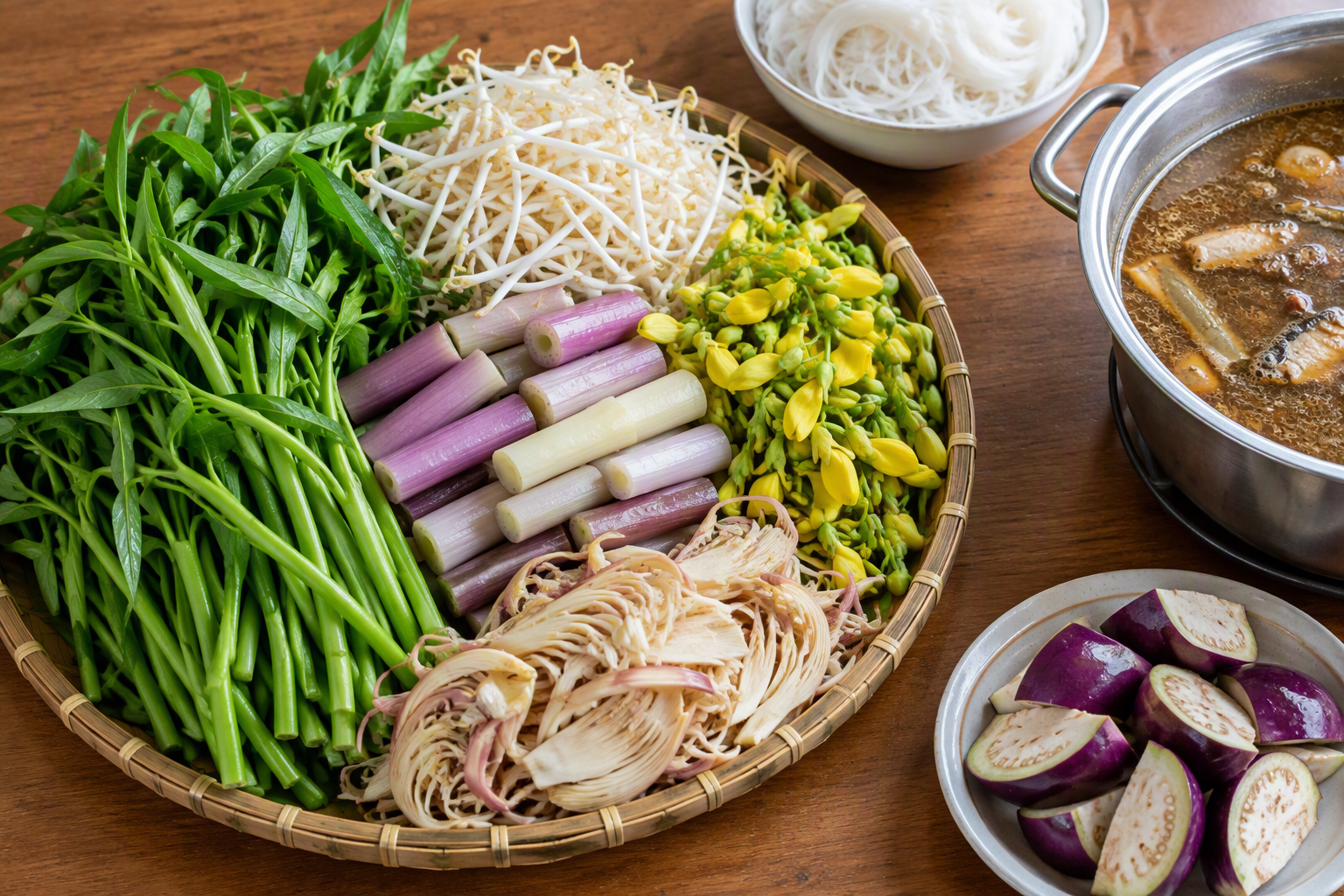
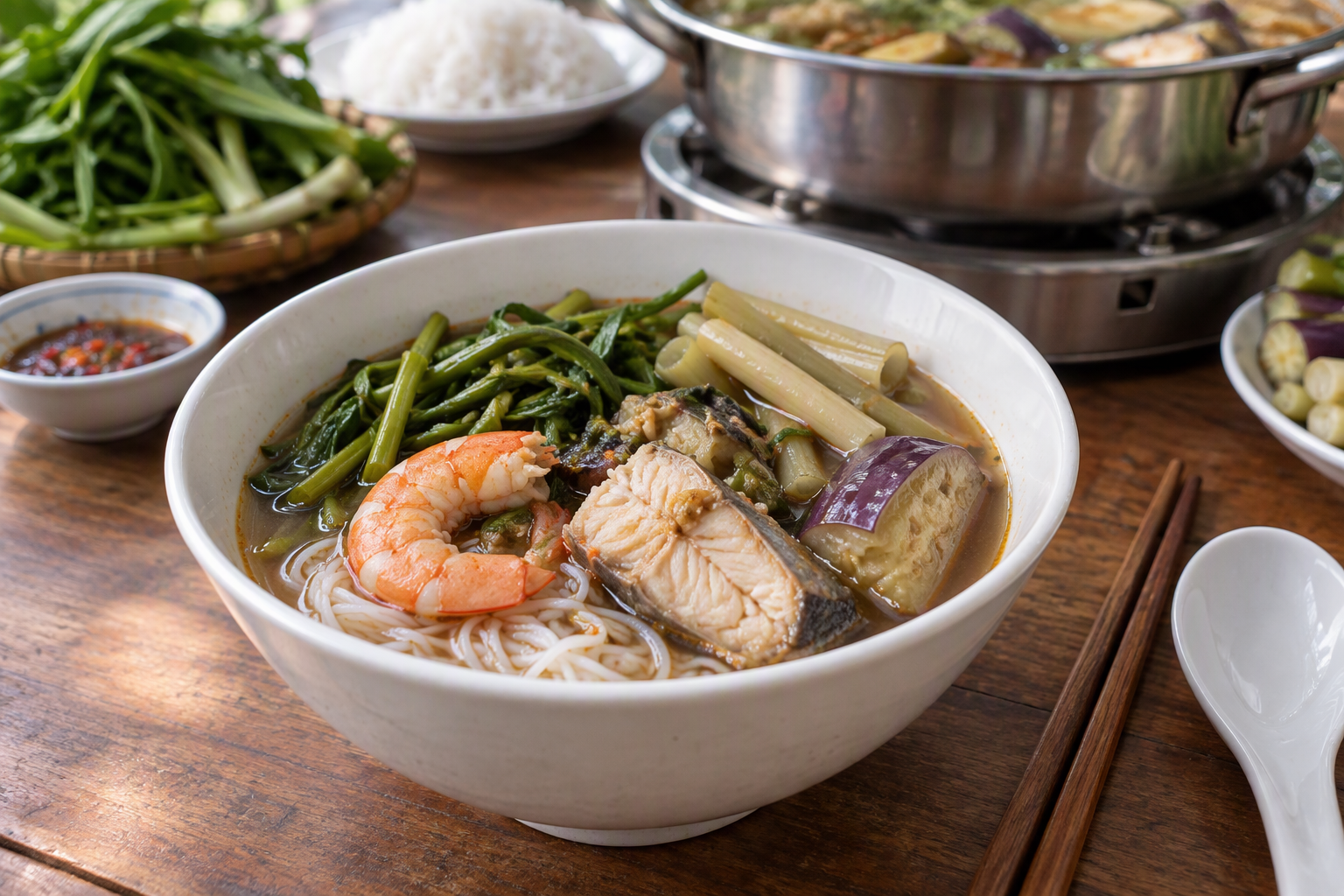
Fermented fish hotpot often comes with water spinach, bean sprouts, eggplant, banana blossom and water lily stems. Some sets include bitter greens and yellow sesbania flowers. The exact combination varies with the restaurant, market supply and season; a fixed count of vegetables is not a quality guarantee.
Water lily stems provide a crisp, porous bite. Water spinach brings both stalks and leaves. Banana blossom offers firmer shreds, while eggplant softens and absorbs broth. Ask staff to identify anything unfamiliar before dividing it between diners. Keeping unlike vegetables separate makes cooking and portioning much easier.
Do not request flowers merely because an advertising photograph shows them. Availability changes, and substituted greens can still make a balanced platter. October falls within the broader wet-season period in the Mekong Delta, but that does not promise any particular flower or fish on the menu.
Keep a clean section of table for cooked food. The vegetable tray should not become a parking place for used seafood chopsticks, discarded shells or tissue. If table space is tight, ask for a smaller serving platter instead of stacking dishes beside the burner.
The heat keeper: control fermented fish hotpot cooking
Let the restaurant manage the equipment
The hot pot cooking method keeps a cooking vessel at the table while diners add ingredients. Restaurants may use a portable gas burner, an electric heater, or a traditional pot with a central charcoal chamber. The equipment changes; the need for stable heat does not.
Ask staff to light or adjust unfamiliar equipment. Keep bags, loose sleeves and paper away from the heat. A charcoal-heated pot belongs in a properly ventilated setting, not a closed room improvised by diners. Never move a lit burner to make space for another plate.
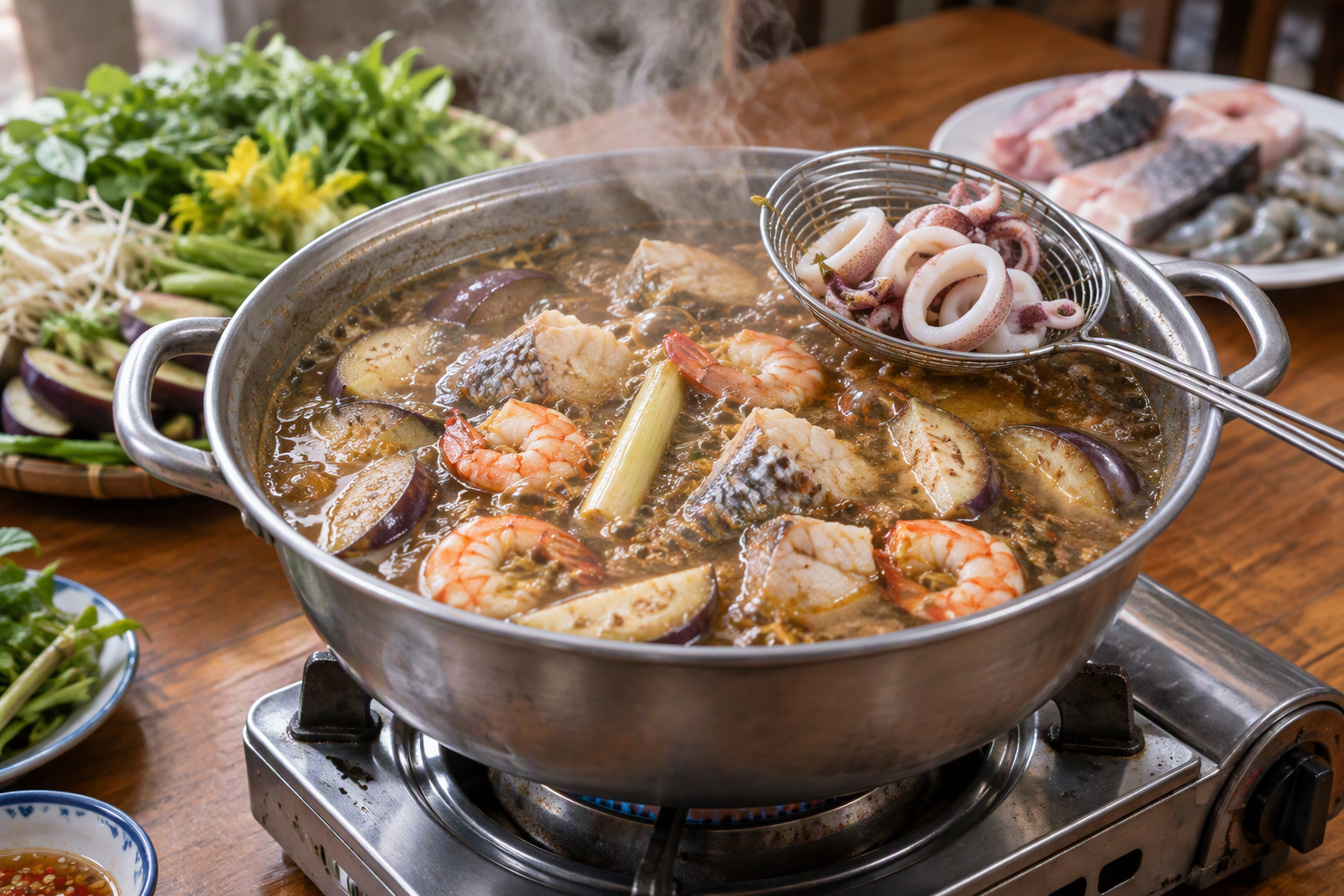
Wait for the broth to return to a proper simmer after additions. Loading the entire raw platter at once cools the liquid and makes it difficult to track which pieces are cooked. Add manageable batches, leave room to retrieve them, and ask staff for help if the pot repeatedly loses heat.
There is no reliable universal cooking time for an unidentified fish cut. Thickness, whether it was precooked, and the actual broth temperature all matter. Fish should be cooked through, and shrimp should be opaque rather than translucent. If a piece’s status is unclear, leave it cooking and ask the server rather than copying another diner’s timing.
Protect texture without compromising cooking
Use the thicker stems and eggplant for longer cooking, then add delicate leaves and flowers in smaller quantities. Retrieve vegetables when cooked instead of leaving the entire tray submerged until the last bowl. This keeps some crunch in the meal and leaves space for seafood.
Use separate tools for raw handling and serving cooked food. If the restaurant supplies only one pair of communal chopsticks, request another. Your personal chopsticks should not shuttle uncooked seafood into the pot and then return straight to your mouth. The site’s Vietnamese dining etiquette checklist explains the wider distinction between communal serving and individual eating.
Keep the broth at a controlled simmer once the raw additions are cooked. A fierce boil evaporates liquid, concentrates salt and breaks delicate fish into fragments. Request hot replacement broth from staff when needed. Do not pour in water from an unidentified table jug or assume every refill is free.
The bowl builder: serve fermented fish hotpot in balance
Start with a small bowl
Put a modest amount of rice vermicelli into your own bowl, add cooked vegetables and protein, then ladle over enough broth to moisten the noodles. Keep most noodles out of the communal pot unless staff recommends otherwise. Leaving them submerged makes portioning harder and can turn the remaining meal into a noodle-heavy soup.
Taste before adding chilli or another salty condiment. Fermented fish hotpot already has concentrated seasoning; extra fish sauce may amplify salt more than flavour. Chilli can be adjusted individually, but check whether the kitchen has already cooked it into the broth if someone needs a mild serving.
Alternate fish and vegetables rather than constructing a bowl entirely from seafood. Bitter greens, mild eggplant and crisp stems change how the fermented broth tastes from one bite to the next. That variety is the point of the separate platter, not decoration around the main protein.
Keep the later bowls balanced
The first ladle and the last can taste different. Evaporation concentrates seasoning, while added seafood and vegetables alter the broth. Make later bowls smaller if the liquid has become intense, request a suitable refill, and avoid repeatedly adding salty sauce to compensate for a pot that needs attention.
You do not have to finish all the broth. Treat it as part of the serving, not a challenge attached to an empty pot. Remove shells and bones to a discard plate so they do not become mixed with the remaining cooked food.
The bill checker: pay for the serving you agreed
Read the price unit, not just the number
For Can Tho restaurant planning, PasGo publishes meal ranges of 100,000–300,000 VND per person, approximately US$3.85–11.54, across its featured venues. Its Tran Ngoc Que listing uses 200,000–300,000 VND per person, approximately US$7.69–11.54. These are directory spending bands, not verified prices for a specific pot.
The conversions here use a rounded 26,000 VND to US$1 for orientation, close to early-October 2026 published exchange levels. Your cash exchange or card rate will differ. Larger seafood portions, premium fish, extra meat and drinks can move the bill beyond an advertised starting figure.
Confirm whether the menu charges per pot, per person or by ingredient weight. A price without its unit cannot tell you whether a set is affordable. Have one diner handle additions so several people do not independently order duplicate seafood plates. Check noodles, vegetables, broth refills, drinks and any stated service charges against the agreement.
Bring VND and ask about payment methods before ordering if you depend on a foreign card. The site’s Vietnam payment guide covers why a domestic transfer option does not necessarily help an overseas visitor.
Finish without creating a transport problem
Order conservatively, then add more if needed. A mixed leftover bag containing broth, noodles, vegetables and seafood is awkward to carry and loses texture quickly. If you need takeaway, ask the restaurant whether it can package the cooked components separately and explain safe storage for your journey.
For the wider trip, C Vietnam Tours’ Mekong Delta guide compares Can Tho, Ben Tre, Vinh Long and Chau Doc as bases. Choose your overnight location before booking dinner: a restaurant in Can Tho is not automatically convenient for a rural homestay elsewhere in the delta.
The roles need not become formal jobs: two diners can share them. What matters is that someone checks the order, raw ingredients stay separate, the heat remains controlled, and each bowl is built from properly cooked food. That arrangement makes fermented fish hotpot a manageable shared meal rather than a pot everyone assumes someone else is watching.