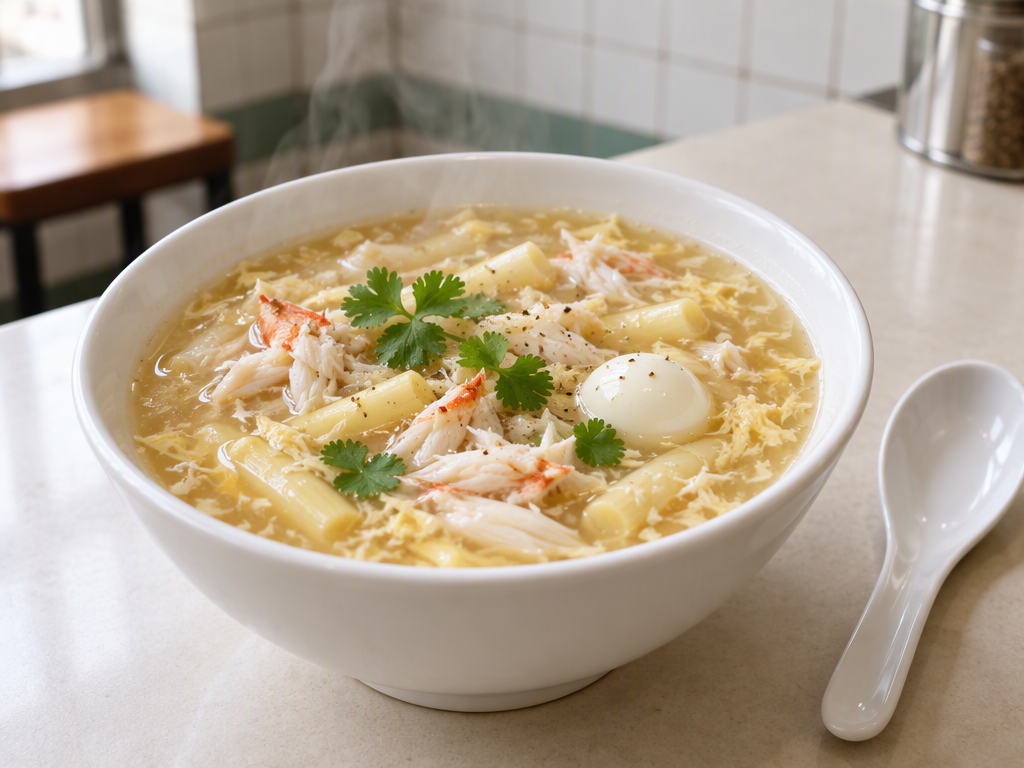
Vietnamese crab and asparagus soup, known as súp măng cua, is a lightly thickened broth carrying crab flakes, asparagus pieces and fine ribbons of egg. It is commonly served as a banquet starter, but you do not need a wedding invitation to understand or order it. The useful distinctions are practical ones: whether asparagus is actually included, what kind of crab goes into the pot, how large the serving is, and which toppings are already mixed in. Those details matter more than an overflowing bowl.
The exchanges below are an illustrative English-language ordering script, not quotations from a vendor or a record of a visit. Each margin note explains what to establish before accepting the order. Images are generated illustrations, not photographs documenting particular businesses.
Opening exchange: name the soup precisely
Customer: “One small serving of Vietnamese crab and asparagus soup, with asparagus included.”
Server: “Confirm the asparagus version before the order goes to the kitchen.”
Margin note: the short menu name can hide a different bowl
The defining vegetable is asparagus, not automatically bamboo shoots. Vietnamese menu wording can shorten the asparagus reference, so the name alone is not a reliable ingredient inventory. Some recipes include bamboo shoots as an extra, but they do not make asparagus unnecessary in the version covered here.
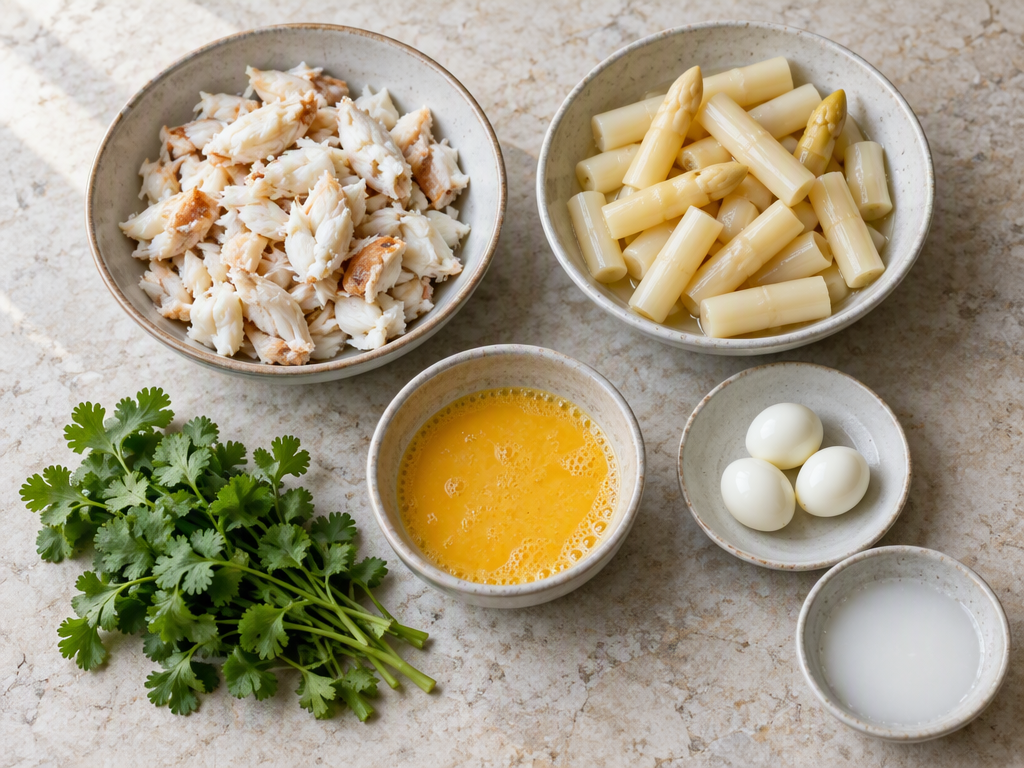
Look for the pale spear tips or short stem sections, or ask the staff to identify them. White asparagus is common in published recipes, particularly the canned kind. Green asparagus is also used and gives a firmer bite and a more grassy flavour.
White and green asparagus are not separate soup categories: white spears are grown without exposure to light. A green-asparagus bowl is not automatically inferior. What matters is whether the vegetable is tender enough to eat comfortably with a spoon, without woody ends.
A counter advertising crab soup may sell a corn-heavy version without asparagus. That can be a legitimate dish, but it is not the precise order described here. The site’s guide to Vietnamese eatery types helps distinguish a snack counter from a restaurant serving a banquet-style starter.
Ingredient exchange: specify crab, not just extra toppings
Customer: “The crab-and-asparagus version, with the crab type confirmed. No additional toppings unless agreed.”
Server: “Check the main pot as well as anything added to the serving.”
Margin note: a crowded surface does not prove a generous crab portion
Real crab breaks into irregular fibres and flakes. Imitation crab usually appears as more uniform strips or pieces, often with a coloured outer surface. Some cooks combine the two. Ask explicitly rather than relying on the menu photograph or the number of eggs floating on top.
Freshly picked, refrigerated, frozen and canned crab meat can all appear in recipes. Those labels describe different sourcing and storage choices; they do not provide a complete quality ranking. A properly handled frozen product can be a sensible ingredient, while the word “fresh” does not explain how long the finished soup has been held.
Quail eggs, shredded chicken, mushrooms, corn, snow fungus and fish maw are possible additions, not a compulsory set. Fish maw is the dried swim bladder of a fish; it contributes a spongy texture rather than replacing the crab. Snow fungus adds a softer, slightly springy bite.
For a first order of Vietnamese crab and asparagus soup, keep the extras limited. That makes it easier to distinguish the sweetness of the crab from the broth and asparagus. Choose additions because you want their texture, not because a more elaborate bowl must be more authentic.
Dietary exchange: explain the restriction before the ladle moves
Customer: “Confirm the stock and seasonings before serving. The restriction applies to the soup itself, not only its garnish.”
Server: “Ingredients already cooked into the shared pot cannot simply be removed.”
Margin note: seafood soup can contain poultry and pork
Vietnamese crab and asparagus soup frequently uses chicken stock, pork-bone stock, or a combination. Fish sauce and chicken bouillon may season it. Removing visible chicken does not make a pork-based or poultry-based broth suitable for someone avoiding those ingredients.
Egg ribbons are normally cooked into the soup, so “no quail eggs” is not an egg-free order. Likewise, removing crab from the surface does not address shellfish allergy. A shared ladle and shared pot can also create cross-contact; do not treat a topping substitution as an allergy guarantee.
If you need a vegetarian version, establish that it is a separately prepared vegetable broth without crab, fish sauce or meat-based seasoning. A mushroom substitution alone proves very little. For strict dietary needs, a restaurant able to explain its recipe is more useful than a busy counter offering only one finished pot.
Portion exchange: agree on the unit before the price
Customer: “Confirm whether the listed amount buys one bowl, a shared serving, or a catering order.”
Server: “The portion size and any separate charges need to be clear before payment.”
Margin note: a banquet-menu number is not a street-bowl price
For a snack-counter search in Ho Chi Minh City, a planning allowance of 20,000–40,000 VND, approximately US$0.80–1.55, is reasonable for an ordinary crab-soup serving. That is a guide to the broader counter category, not a verified quote for asparagus soup at a named stall. Confirm both asparagus availability and the actual charge; extra seafood or premium toppings can move the price above that allowance.
A concrete specialist-menu reference is Thanh Bình’s catering menu, checked on 6 October 2026. It lists crab-and-asparagus soup at 300,000 VND, approximately US$11.55. The page does not state the serving count for that item. Do not divide the price into ten bowls or assume it is an individual restaurant portion. Ask for the number served and whether delivery or staffing is separate.
The USD amounts here use a rounded budgeting conversion of 26,000 VND to US$1, not a guaranteed exchange rate. Pay and compare prices in VND. The site’s Vietnam payment guide explains why carrying small notes is useful at food counters.
For a Vietnamese crab and asparagus soup starter, request a modest serving rather than the largest container. If ordering for a group, settle the bowl count with the caterer instead of trying to infer it from a photograph.
Serving exchange: keep the first spoonful unseasoned
Customer: “Serve it hot, with pepper and any chilli on the side.”
Server: “Leave room to assess the broth before adding condiments.”
Margin note: thickness should carry the ingredients, not bury them
Good Vietnamese crab and asparagus soup has enough body to suspend egg ribbons and crab flakes, but it should still flow from the spoon. A starch slurry creates that texture; potato starch, tapioca starch and cornstarch all appear in published versions. Cream is not required to make the broth feel silky.
Judge texture and seasoning separately. A thick bowl can still taste thin if starch outweighs the stock and crab. Conversely, a slightly looser soup may have a well-developed broth. Smoothness alone is not evidence of expensive ingredients or long cooking.
The first spoonful should let you detect savoury stock, gentle crab sweetness and the asparagus. Pepper adds warmth; chilli changes the balance more forcefully. Add a little at a time. Cilantro and spring onion are common garnishes, but heavy handfuls can obscure the soup’s milder flavours.
The egg should form small threads or delicate ribbons rather than one solid lump. Asparagus should yield without becoming an unrecognisable mash. If a piece of shell appears, set it aside; careful picking reduces that risk but does not eliminate it.
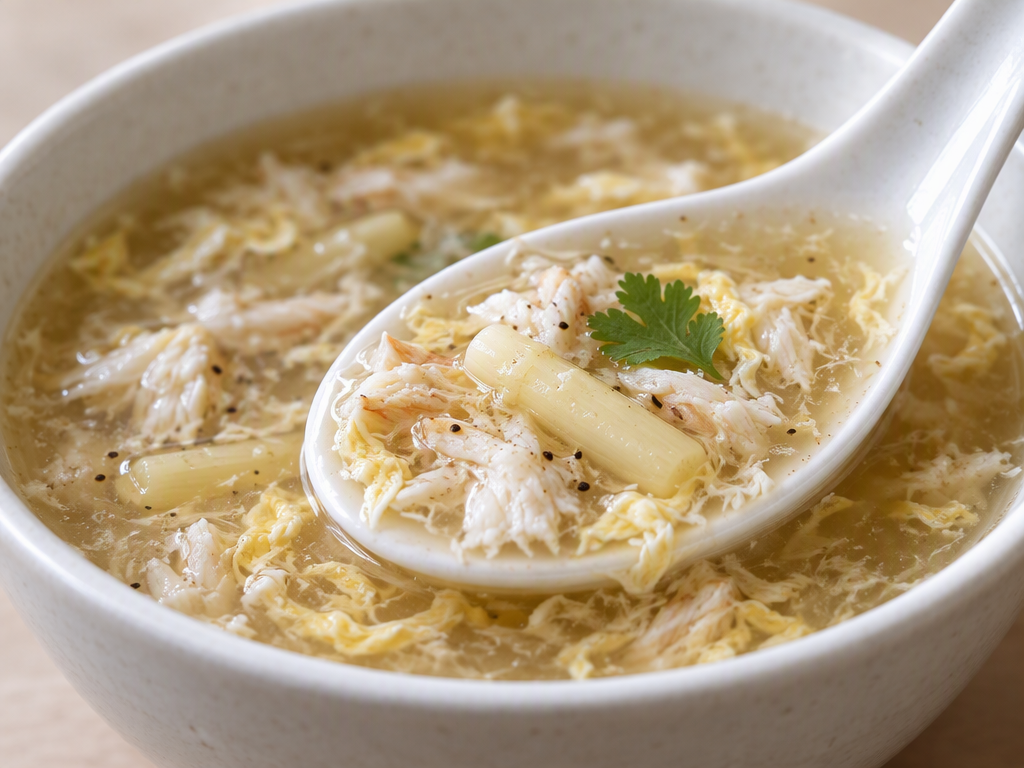
Venue exchange: confirm Vietnamese crab and asparagus soup
Customer: “Confirm that the asparagus soup is available today and can be ordered separately.”
Server: “A general soup listing or an open restaurant does not guarantee this item.”
Margin note: the banquet connection changes how you find it
Vietnamese crab and asparagus soup is well documented as a starter at Vietnamese weddings and large family meals. Catering menus are therefore useful evidence of the dish, but not necessarily places to walk in for a single bowl. Some kitchens prepare it only for pre-booked groups.
There is also evidence beyond southern banquet menus. A July 2026 Nhan Dan report identifies a version with sago at Lạc Thành in Huế’s Thượng Tứ area. The neighbourhood sits along Đinh Tiên Hoàng Street, towards Trần Hưng Đạo Street. That is a specific research lead, not a promise about today’s availability, price or recipe.
In Ho Chi Minh City, Xóm Chiếu is a useful area to investigate crab-soup counters. Older listings often describe it as District 4; that legacy district label still helps locate archived recommendations. Do not assume every counter there includes asparagus. Use the full dish name and confirm the vegetable before travelling specifically for it.
Canned asparagus makes year-round preparation possible; this is not a dish you need to reserve for an asparagus harvest month. For group orders, ingredient availability and the kitchen’s booking requirements are more useful questions than a general “best season” recommendation. If a caterer proposes substituting corn, decide whether you still want that changed order.
For a banquet, agree on the serving time with the organiser. For a restaurant or counter, check current hours directly. There is no dependable nationwide opening window for this soup, and a lunch or dinner booking may be more relevant than a shop’s headline hours.
Takeaway exchange: separate the garnish and plan the handoff
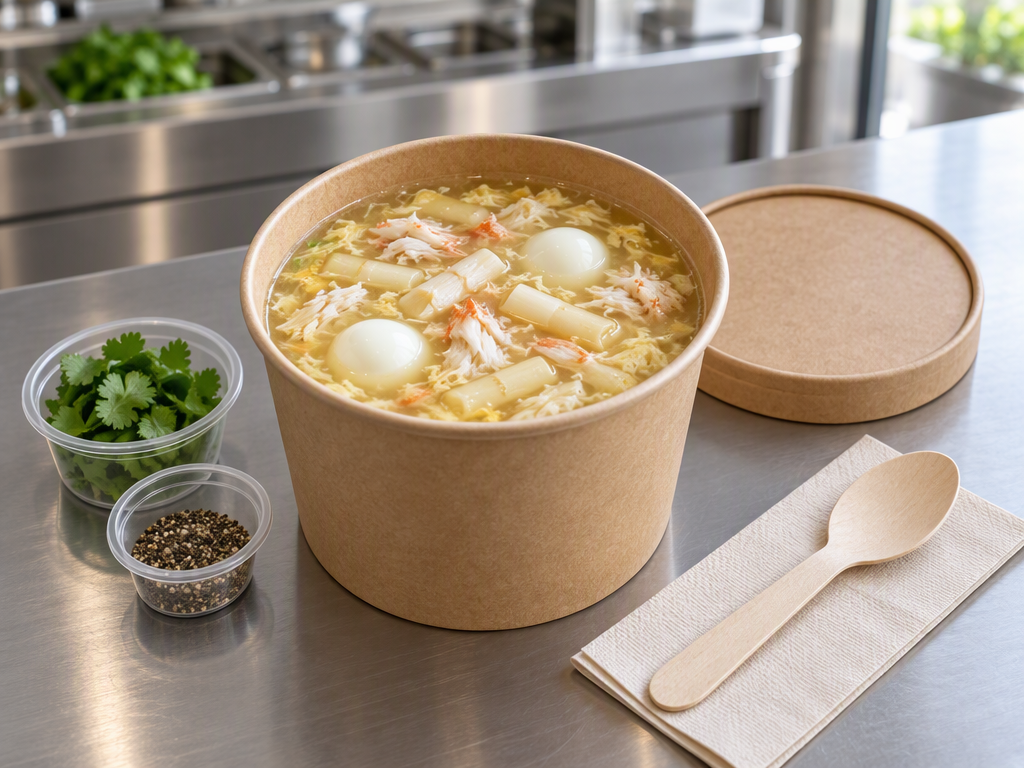
Customer: “Use a secure soup container, with herbs and pepper packed separately.”
Server: “Keep the container upright and arrange prompt collection.”
Margin note: an extra journey changes the texture
Steam trapped under a lid softens herbs, while Vietnamese crab and asparagus soup can change thickness as it cools. Separate garnish keeps the aroma fresher and gives you control over seasoning. A tightly sealed container matters more than a decorative carrier bag.
Eat promptly rather than carrying a warm seafood-and-egg soup around for an afternoon. If it must be kept, refrigerate it promptly; do not rely on reheating to undo poor storage. At home, stir gently while heating so the bottom does not catch and the crab flakes are not broken down unnecessarily.
At a shared meal, use the communal ladle to fill your bowl and your own spoon to eat. The site’s Vietnamese dining-etiquette checklist covers the distinction between serving utensils and personal utensils.
The order worth making is straightforward: confirmed asparagus, an explained crab ingredient, a clear portion price and a hot serving. Additions come after those essentials, not instead of them.