
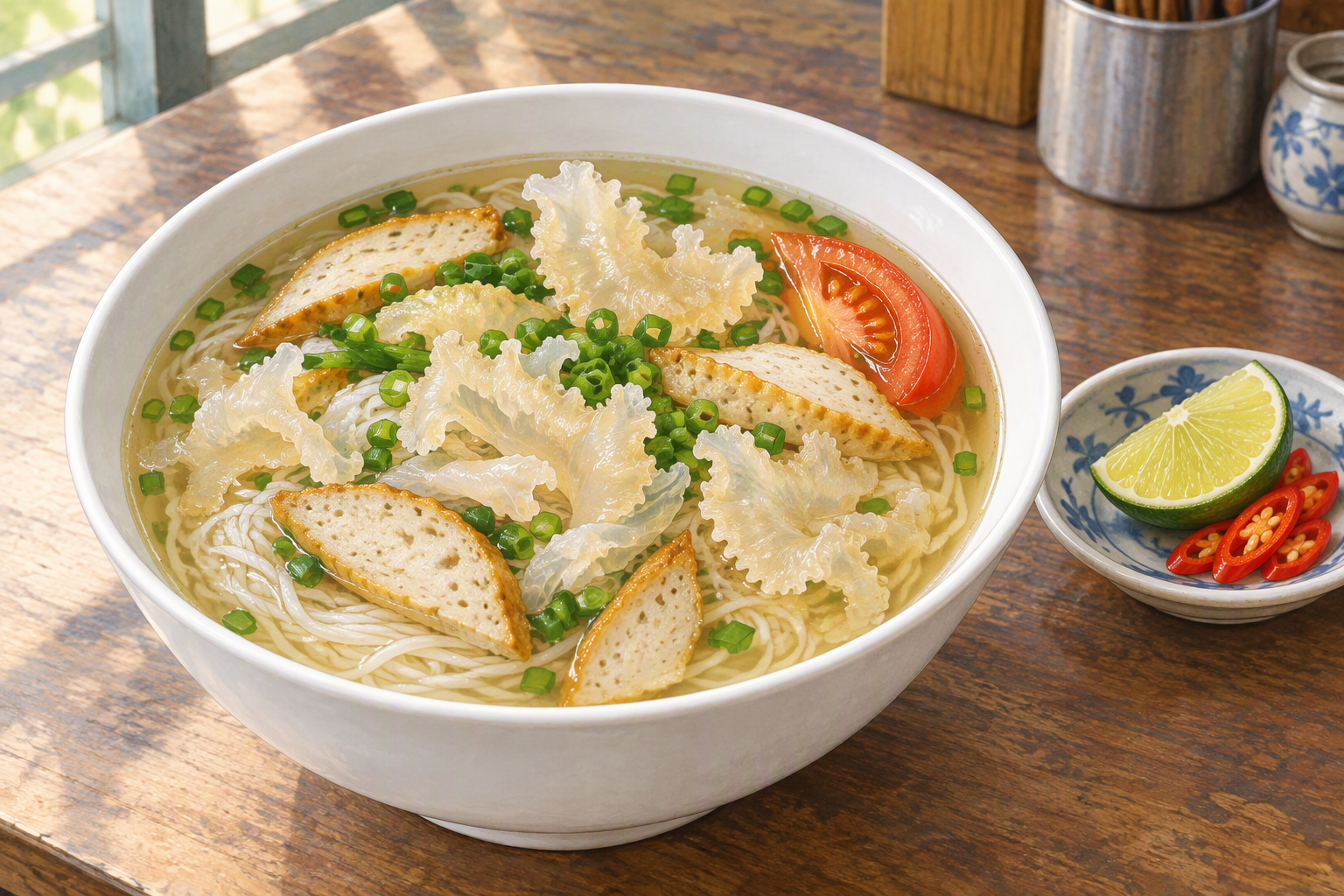
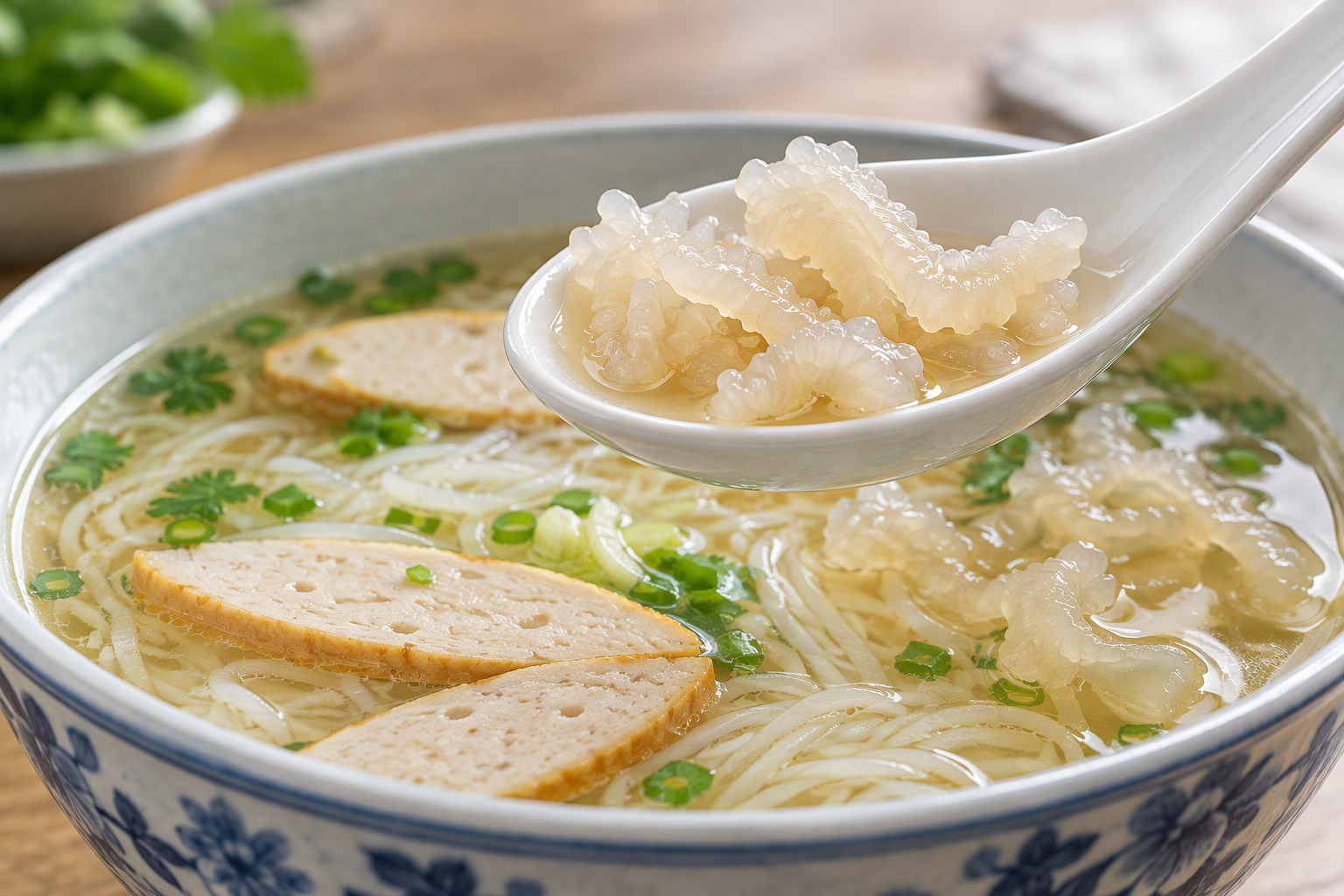
Jellyfish noodle soup, called bún sứa in Nha Trang, combines thin rice noodles, prepared edible jellyfish and a light fish broth, often with sliced fish cake. The jellyfish supplies the crisp bite; the broth supplies most of the flavour. Ordering well means being clear about toppings, portion size and whether the bowl will travel. These four worked scenarios cover a solo breakfast, two different appetites, a takeaway order and dietary restrictions. They are ordering examples, not accounts of meals at particular restaurants.
Solo breakfast: a standard jellyfish noodle soup order
The brief: One person wants a full breakfast without committing to an extra-large bowl or a heavily seasoned broth.
The order: One standard bowl with jellyfish and fish cake, with fresh chilli served separately. Confirm that jellyfish is available before sitting down: a fish-noodle shop can sell several topping combinations, and its default bowl may not include it.
Find the right bowl, not just the right sign
Look for the dish name bún sứa, or the fuller menu name bún cá sứa. Bún chả cá sứa indicates a version with fish cake. These names describe overlapping combinations of the same jellyfish noodle bowl, not a guarantee of identical ingredients. Point to the menu and confirm the toppings rather than relying on an English translation that simply says “fish soup.”
The base uses thin, round rice vermicelli, not broad flat noodles. Typical additions include fried or steamed fish cake, cooked fish, chopped spring onion and herbs. Tomato or pineapple may contribute sweetness and acidity, depending on the kitchen. A side plate can include lettuce and bean sprouts.
Nha Trang versions commonly use sea fish for the stock, including small fish or mackerel. Clear broth is a useful description, not a rule that every bowl must be colourless: tomato can tint it. Nor does a fish-based recipe prove the absence of pork stock or shrimp seasoning. Ask about those separately if they matter.
Choose a breakfast address and allow for changing hours
VinWonders’ restaurant guide lists the noodle shop at 3 Tăng Bạt Hổ with reference hours of 6:00–10:30 am and a reference bowl price of 25,000–35,000 VND, approximately US$0.95–1.35. Treat those as directory figures, not a confirmed same-day menu. A morning-only listing is a reason to go early, not to plan a late lunch there.
For general planning, the same guide gives 30,000–55,000 VND for regular through fuller topping combinations across Nha Trang, about US$1.15–2.10. The amount of fish, fish cake and jellyfish changes the price. Dollar equivalents throughout this guide use a rounded 26,000 VND per US$1 for comparison, not a live exchange quote.
Eat the first mouthful without rebuilding it
Taste a spoonful of broth before adding lime, chilli or extra fish sauce. Then try a small piece of jellyfish with noodles. Prepared jellyfish is mild, with a firm, crisp chew rather than the softness of squid. Lime sharpens the stock; chilli adds heat. Add each gradually so the bowl still tastes of fish.
Use the spoon for broth and small toppings, and chopsticks for noodles. If shared condiments or chopstick placement are unfamiliar, the site’s Vietnamese dining etiquette guide covers the practical table rules without changing what you order.
Expected result: A complete breakfast with jellyfish clearly included, a manageable portion and seasoning adjusted after tasting rather than before it.
Two diners: jellyfish noodle soup for different appetites
The brief: Two people want the same dish. One wants a lighter meal; the other wants more protein and a fuller bowl.
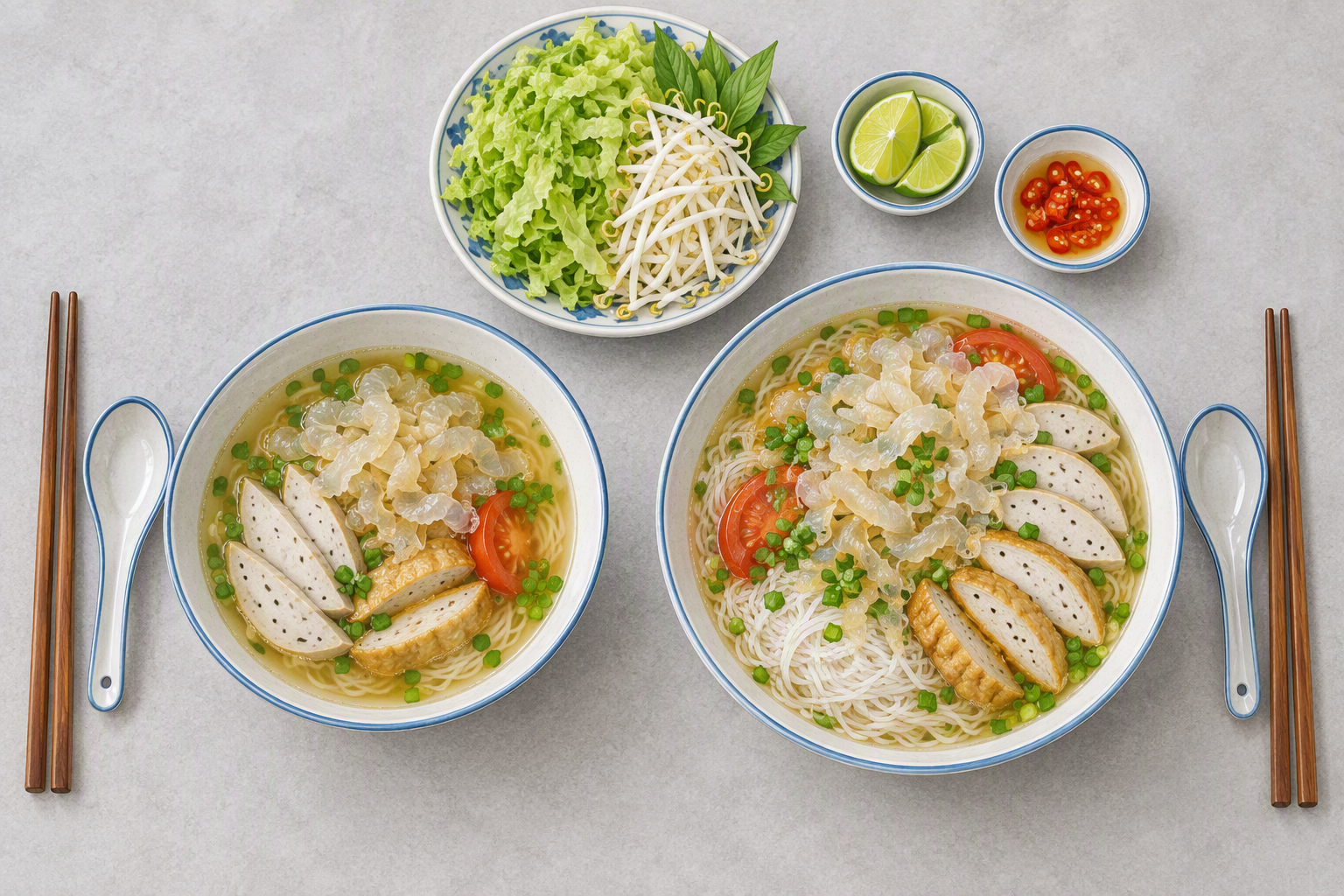
The order: Two separate jellyfish noodle bowls. Ask for fewer noodles in the lighter bowl and extra fish or fish cake in the fuller one. Confirm the supplement price before accepting it. Keep chilli separate for both.
Specify what “more” should mean
A larger bowl may mean more noodles rather than more jellyfish. If texture is the reason for ordering jellyfish noodle soup, request extra jellyfish specifically. If the aim is a more filling meal, cooked fish or fish cake is the clearer request. Do not assume that “special” has a standard definition across shops.
Fried fish cake usually has a browned exterior and a denser bite. Steamed fish cake is paler and softer. Both can appear together. Their composition varies, so neither colour nor springiness tells you the exact fish species or whether starch was added.
Keeping the bowls separate also avoids fishing for small jellyfish pieces in a shared serving. Share the herb plate if everyone is comfortable doing so, but use clean serving utensils rather than transferring toppings with chopsticks already used for eating.
Use a broad-hours shop, with availability confirmed
Nguyên Loan at 123 Ngô Gia Tự is a documented address for jellyfish noodle soup. VinWonders lists reference hours of 5:00 am–10:30 pm and 30,000–35,000 VND per serving, roughly US$1.15–1.35. Other listings give different opening times. Verify the current schedule and ask whether jellyfish is still available; a long opening window does not mean every topping lasts all day.
Two bowls at that published reference range total 60,000–70,000 VND, about US$2.30–2.70, before extras or drinks. That is arithmetic based on the listing, not a quoted two-person set. The general citywide range can be higher for generous topping combinations.
Carry smaller notes and check whether drinks or requested extras are charged separately. The site’s guide to paying for food in Vietnam explains why cash remains useful at small noodle shops, even when a payment QR code is displayed.
Let the jellyfish be a texture, not a challenge
Start with a small piece alongside noodles and fish cake. There is no requirement to eat it alone or finish a large extra portion. The contrast is the point: soft noodles, springy fish cake and crisp jellyfish in the same spoonful.
Expected result: Two bowls of the same dish, adjusted to actual appetite. Neither diner has to accept more noodles just because the other wants more seafood.
A short journey: jellyfish noodle soup packed for takeaway
The brief: The meal needs to reach nearby accommodation without turning into a single container of swollen noodles and crushed herbs.
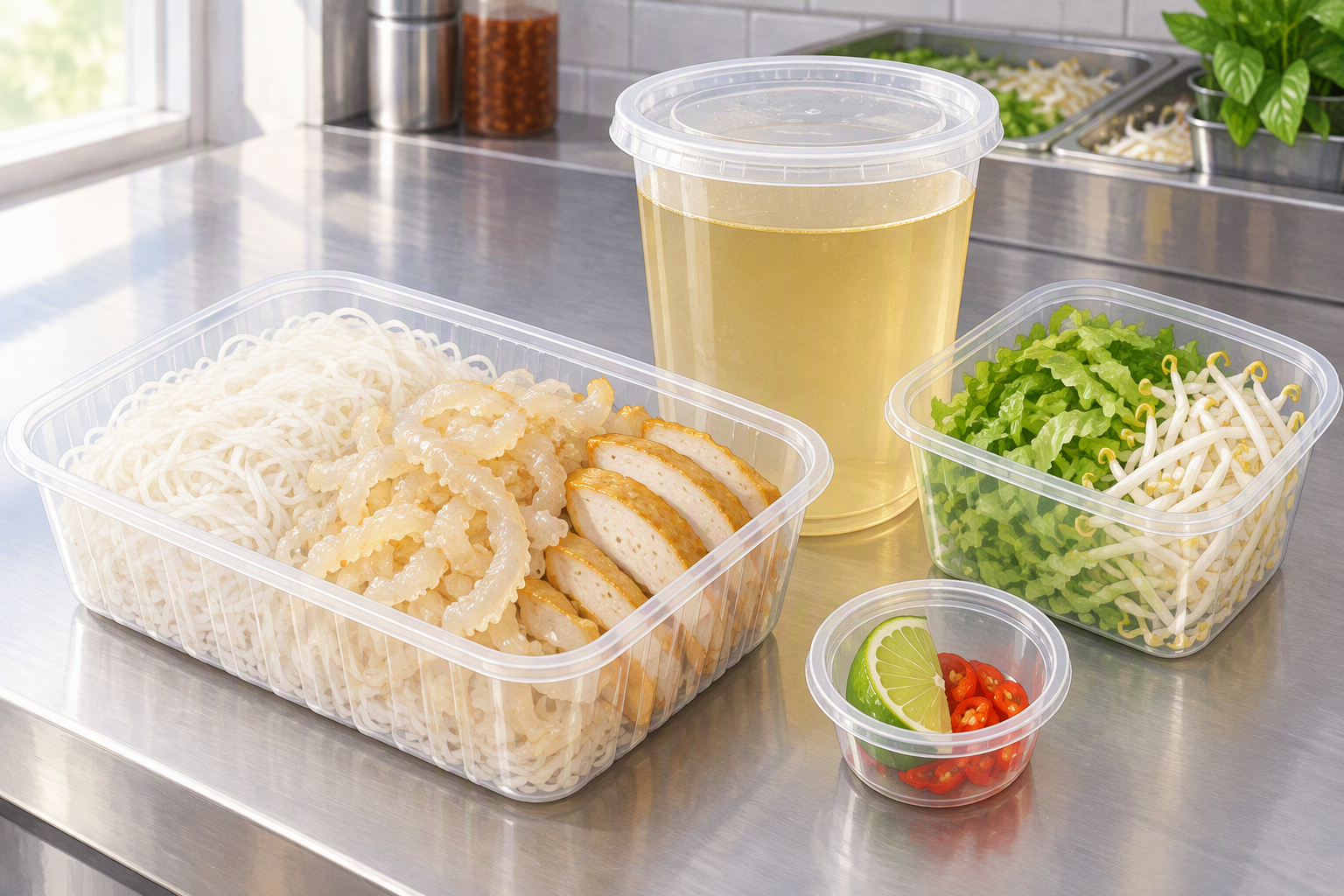
The order: Jellyfish, noodles and fish cake packed separately from the broth, with raw vegetables and condiments in their own containers. Ask whether the shop can do this before paying.
Plan the handoff before ordering
Aim for a direct journey and eat promptly. A 10–20-minute transfer is a planning target, not a food-safety guarantee or a prediction of local traffic. If your next stop is an excursion or several errands away, eating at the shop is the better choice.
Check that you have a bowl, spoon and somewhere stable to assemble the soup. A thin takeaway bag is a transport container, not a safe substitute for a bowl of hot liquid. Keep the broth upright, away from clothing and electronics, and do not balance it loosely on a motorbike footwell.
An intact lid and a separate herb packet matter more than decorative packaging. Ask about any container charge before the order is packed. There is no reliable citywide fee to assume.
Assemble the bowl only when ready to eat
Place the noodles and cooked toppings in the bowl, then add the broth and season to taste. Add herbs at the table rather than leaving them compressed against hot noodles throughout the journey. Separate packing cannot restore a meal that has already sat warm for a long time.
For later consumption, follow standard perishable-food handling: refrigerate promptly, generally within two hours, or one hour above 32°C. Those are maximum handling limits, not recommended storage times in Nha Trang’s heat. A hotel minibar may not maintain a suitable refrigerator temperature. Without reliable refrigeration, order only what you can eat immediately.
Do not turn a takeaway bowl into a jellyfish-preparation experiment
In restaurant jellyfish noodle soup, the jellyfish should already be processed for eating. It is not an invitation to collect a jellyfish from the beach and reproduce the bowl. Only suitable edible species and properly handled products belong in food.
The overview of jellyfish as food explains why processing and species selection matter. Commercial preparation can involve curing, desalting and other treatment; appearance alone cannot establish safety. Buying an assembled meal and preparing raw jellyfish are different tasks.
Expected result: A bowl assembled at its destination with distinguishable textures, rather than noodles steeping in broth through an extended outing.
A restriction in the group: check the jellyfish noodle soup recipe
The brief: Someone avoids pork, needs to avoid an allergen or cannot tolerate much chilli. The group still wants to order this single dish.
The order: Explain the restriction before ordering. Check broth, fish cake, jellyfish preparation, condiments and shared utensils. If the kitchen cannot confirm what is suitable, do not treat a modified bowl as safe by default.
Separate preferences from allergies
Removing fish cake does not remove fish from a fish-based broth. Likewise, leaving out an obvious shrimp topping would not address shrimp paste or dried shrimp used elsewhere. Jellyfish is an animal ingredient, so this is not a vegetarian soup even if all fish cake is omitted.
A pork-free request must cover the stock as well as visible toppings. Published descriptions often emphasise sea-fish broth, while reporting on regional versions documents pork-bone stock in some kitchens. The shop’s actual recipe is what matters.
For a medically significant allergy, communicate the specific ingredient and the seriousness of the restriction. Allergy to one seafood group does not automatically identify all other safe foods. Shared ladles, chopping boards and cooking liquids can create cross-contact. If staff cannot give a clear answer, choose not to order rather than relying on the dish name.
Adjust heat without demanding a different soup
For a chilli preference, ask for no added chilli and put the table condiment aside. Check whether the broth or fish cake is already seasoned with it. A kitchen can omit a garnish more easily than remove an ingredient already cooked into a batch.
For raw-vegetable concerns, ask whether bean sprouts can be blanched and leave raw herbs out if necessary. Contact with warm broth is not equivalent to a controlled cooking step. Neither lime juice nor chilli sterilises the bowl.
Reduced noodles, no raw garnish and separate condiments are practical adjustments when available. A promise of “no fish,” by contrast, conflicts with the usual broth. Keep that distinction clear when deciding whether the shop can meet the request.
Keep the order workable for the kitchen
Give the restriction first, then agree on a bowl the kitchen can actually make. Do not order a standard portion and explain a serious allergy after service. At a small specialist shop, declining the order may be the most responsible answer staff can give.
Expected result: A clearly specified meal when the recipe can be verified—or a decision not to order when it cannot. For jellyfish noodle soup, confidence comes from checking ingredients, not from assuming that a light, clear soup contains only what is visible.