
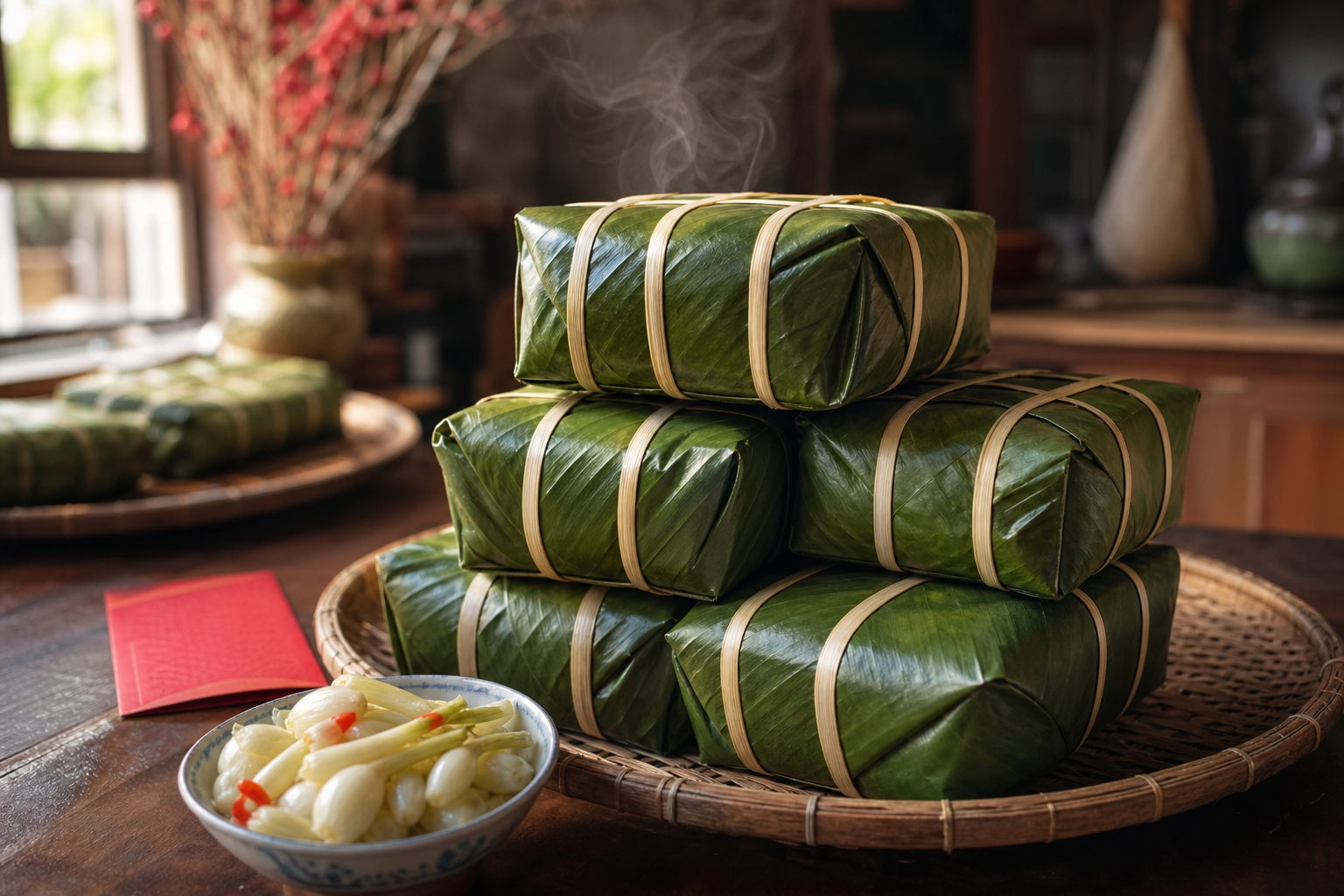
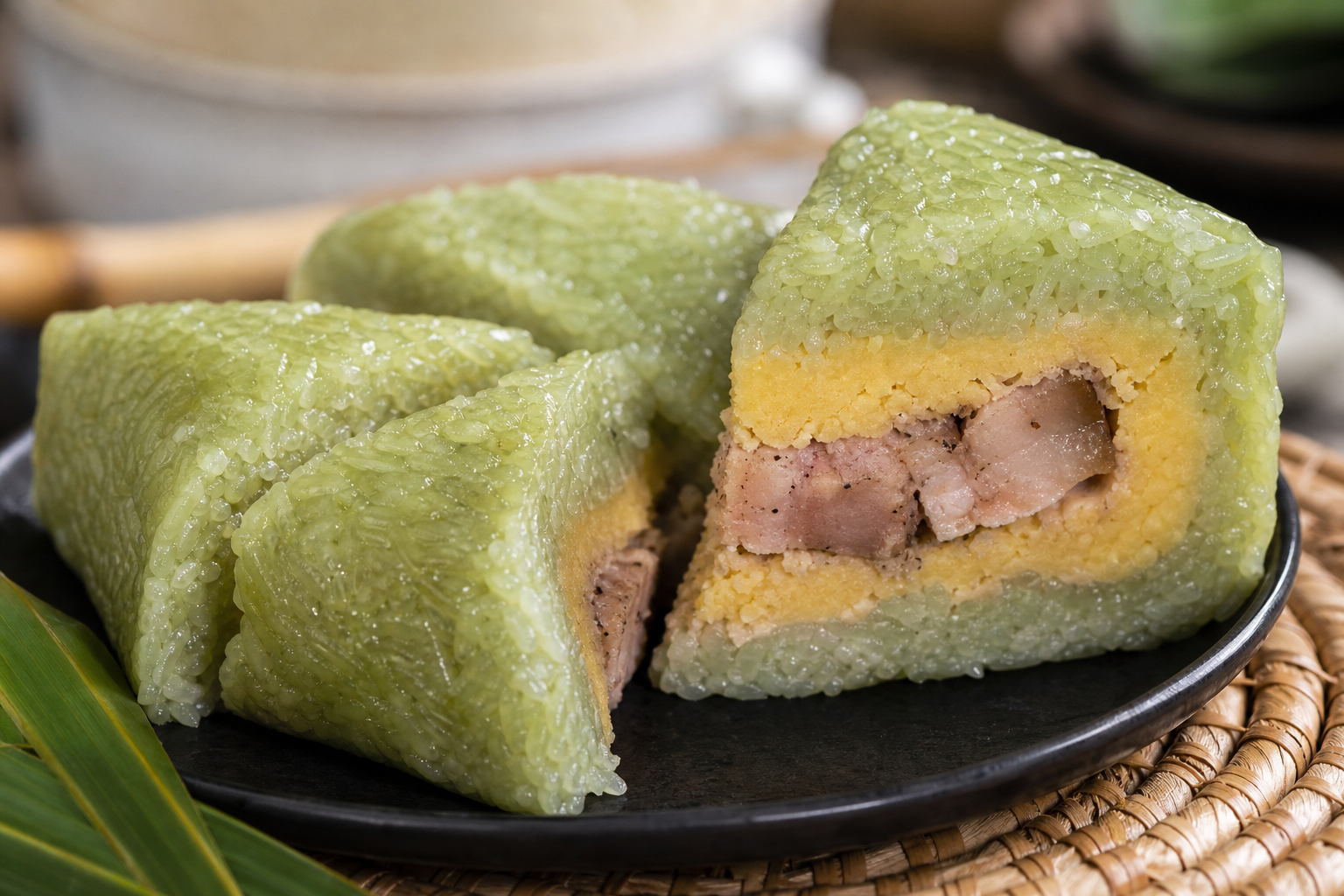
Vietnamese Tet sticky rice cake — known in Vietnam as bánh chưng — is the square parcel of leaf-wrapped rice at the centre of the northern Vietnamese New Year table. Inside are three layers: green-tinted glutinous rice, a slab of mung bean paste, and fatty pork belly seasoned with black pepper. It is folded into dong leaves, bound with split bamboo, and boiled for eight to twelve hours. This guide follows the Vietnamese Tet sticky rice cake era by era, from the legend that explains it to what it costs around Tết 2027.
Vietnamese Tet Sticky Rice Cake, in One Paragraph
Strip away the ceremony and it is a preservation dish. A standard cake weighs about one kilogram (larger ones reach two), measures 15 to 18 cm across, and holds four ingredients: glutinous rice soaked overnight, a paste of split mung bean, pork belly with a thick cap of fat, and seasoning of salt, black pepper and sometimes a little nước mắm or fried shallot. The rice is often tinted pale green by its leaves; some northern versions add gấc fruit to push it toward deep red.
The construction is practical: the square shape stacks and travels, and the leaves stop the rice drying out and the pork spoiling, so a boiled, pressed, unopened cake keeps several days in cool weather. The flavour is mild and savoury rather than salty — the pork fat melts into the mung bean, which absorbs the salt. Cold, the cake is dense and slightly chewy; fried until the edges crisp, it becomes a different dish.
The Hùng King Era: A Prince, a Dream, and Two Cakes
The story behind the cake is set in the time of the Hùng kings, the semi-legendary rulers to whom Vietnamese tradition assigns the country’s founding. One king, choosing a successor, challenged his sons to bring him the most meaningful dish. The poorest prince, Lang Liêu, had no money for rare ingredients, so a spirit came to him in a dream and told him to use the one thing every farmer already had: rice.
He made two cakes. The round one — plain sticky rice pounded smooth and white, called bánh giầy — stood for the sky. The square one he filled with mung bean and pork and declared it stood for the earth, its fillings representing the plants and animals that live on it. The king chose Lang Liêu, and the two cakes entered the country’s founding mythology.
The tale survives in Lĩnh Nam chích quái, a medieval collection of Vietnamese legends, and tradition dates the Hùng kings to the first millennium BCE — dates historians treat as legendary. The exact year matters less than the claim: that the cake is as old as the nation, which is why the Vietnamese Tet sticky rice cake still carries weight each January or February.
The 11th to 15th Centuries: The Cakes Join the New Year
By the time dynasties were ruling from Thăng Long, the forerunner of modern Hanoi, the cakes had fastened themselves to the lunar New Year. The association hardened through the Lý, Trần and Lê dynasties, when both court and village calendar centred on Tết Nguyên Đán, the lunar New Year.
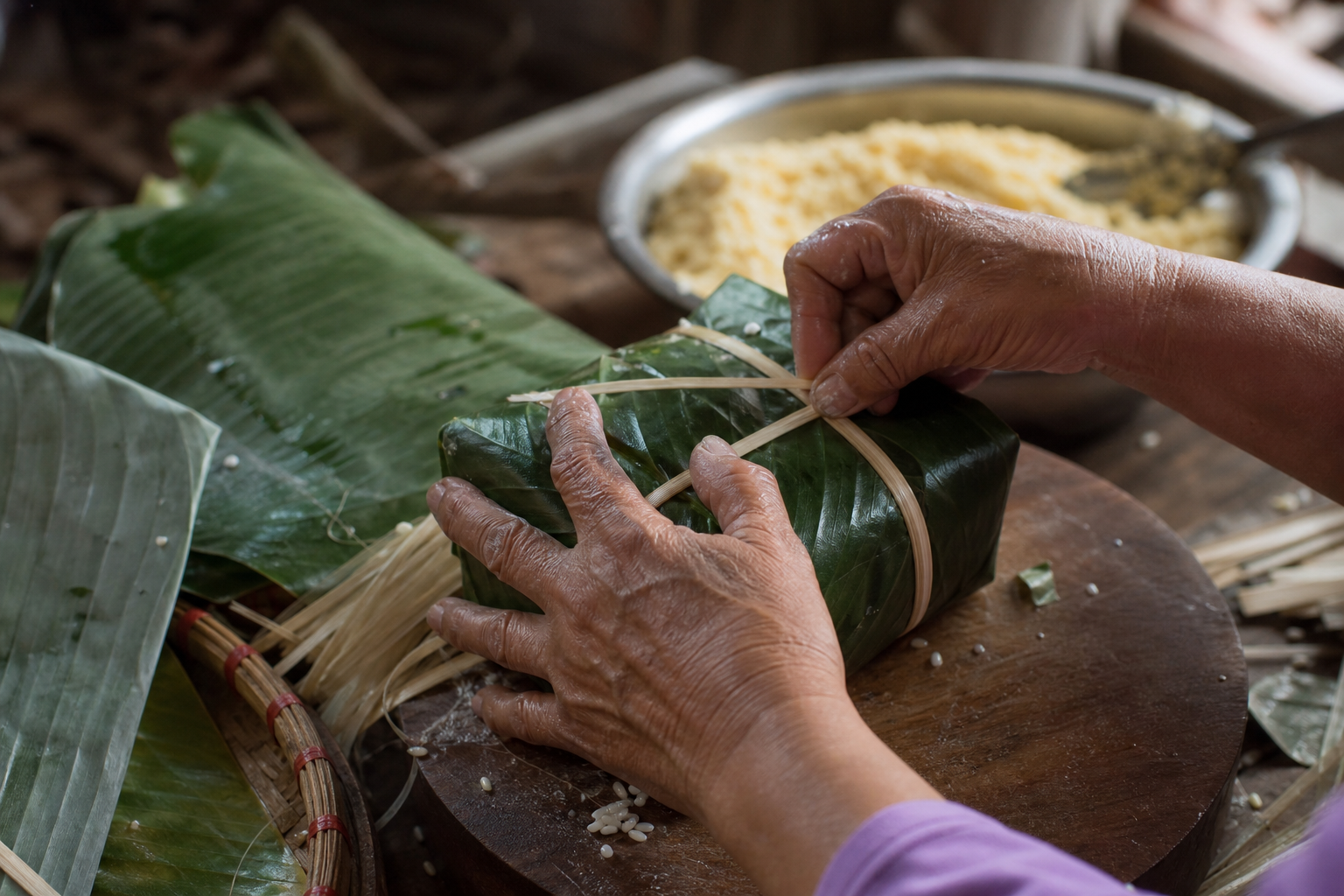
Boiling became part of the ritual. A full pot needed a night on the fire, with someone staying up to watch the flame and top up the water, and the cake was an offering first and food second: it went onto the family altar before anyone cut it open. In many northern homes it is still made in one long overnight session, and the first cakes are still given away rather than eaten.
The 15th to 19th Centuries: Villages Turn It Into a Trade
Making a good cake is slow enough that certain villages turned it into a trade. Tranh Khúc, in what is now Thanh Trì district on the southern edge of Hanoi, has been known for its wrapped cakes for centuries; roughly 120 households still make them, and at peak season a single workshop turns out 300 to 500 a day. The skill later travelled south with migrants.
That trade shaped the standard form: a tight, evenly bound parcel with distinct corner folds, sized to stack in a pot and to carry to a temple. In the north the wrap is lá dong, a broad matte leaf; further south, banana leaf. To watch the process rather than just taste the result, go in the weeks before Tết, when the workshops run flat out — an easy pairing with the food and craft stops on a Vietnam food and culture itinerary.
The Colonial Years and the 20th Century
French colonial rule and the wars of the 20th century did not remove the cake from the table; they changed who could afford how much pork inside it. In the cities it became a market product as well as a home-made one, sold from stacked stalls before the holiday. The recipe stayed fixed through decades of upheaval, which is part of why it carries so much meaning.
1975 to 1990: Rationing, and the Cake That Stayed
The hardest test came after 1975, through the bao cấp years when rice and meat were rationed and a full cake was a luxury. Households improvised: more mung bean, less pork, whatever filling could stretch the paste without ruining the shape, and a properly stuffed cake became a marker of a good year. The market reforms that began in 1986 loosened supply, and through the 1990s it returned to abundance; by the 2000s it was a product sold in any number of sizes and price tiers.
2000 to Today: Tết 2027 and What a Visitor Actually Sees
Tết 2027 falls on Saturday 6 February, the first day of the lunar year. The official holiday runs about five days, but offices, banks and many shops close a week or more, and domestic travel peaks. If you are in Vietnam for the holiday, book long-distance transport weeks ahead, expect many restaurants to shut, and expect to pay more where they stay open. The best time to visit Vietnam month by month explains how February reshapes the country, and a dedicated Vietnam Lunar New Year travel guide covers moving around during Tết.
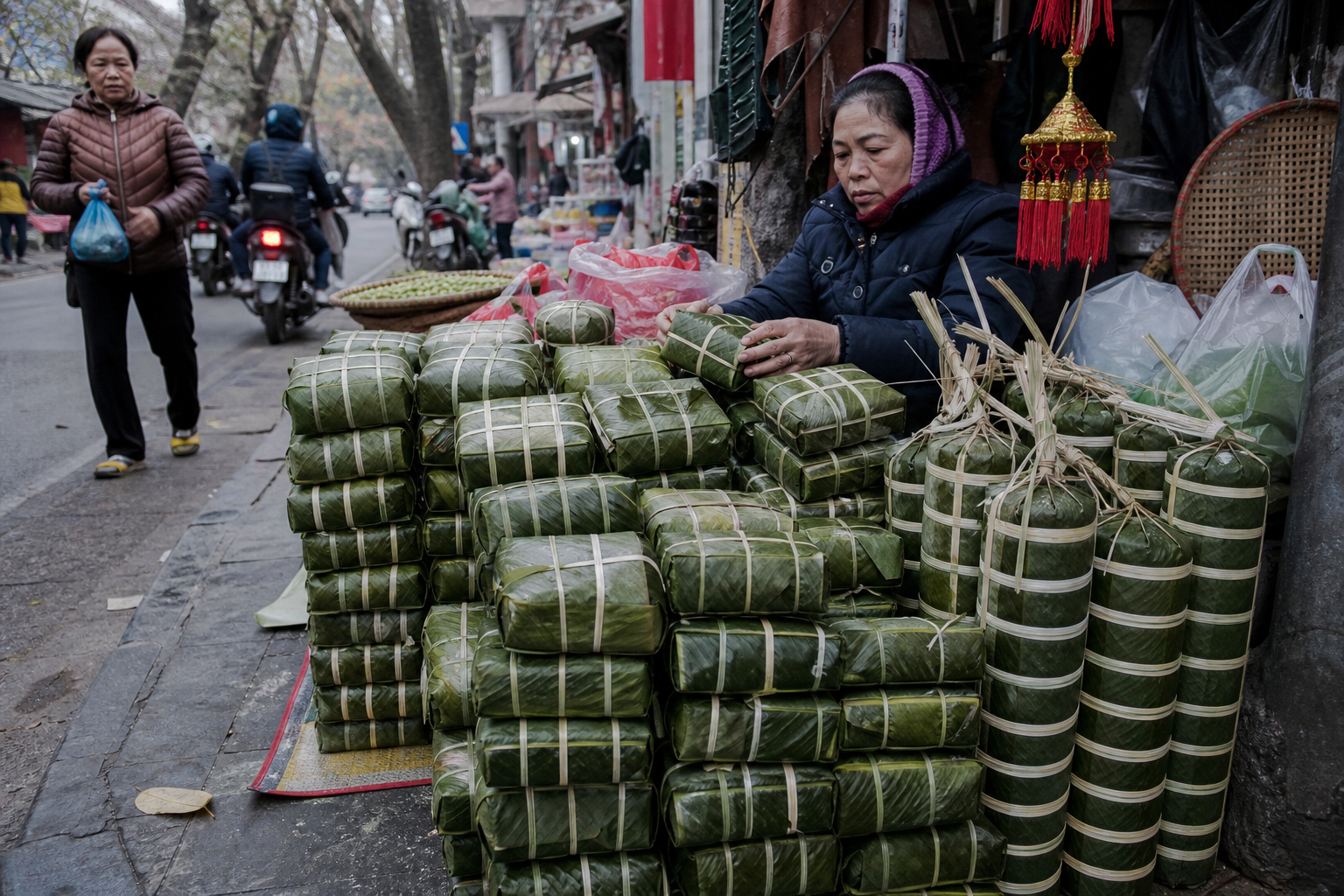
For the cake itself, the ten days before the holiday are the window. Markets fill with towers of wrapped parcels and prices rise as the date nears. In Hanoi, Đồng Xuân market and the Old Quarter streets carry hundreds at a time; in Ho Chi Minh City the Chợ Lớn area does the same. A standard one-kilogram Vietnamese Tet sticky rice cake runs roughly 60,000 to 150,000 đồng (about US$2 to $6) at a market stall, depending on weight and filling; premium, gift-boxed cakes from established producers reach 200,000 to 400,000 đồng (about US$8 to $16). Bring cash — markets are still a cash economy, and the money and payment guide covers what to carry.
North and South on One Table: Square Versus Cylindrical
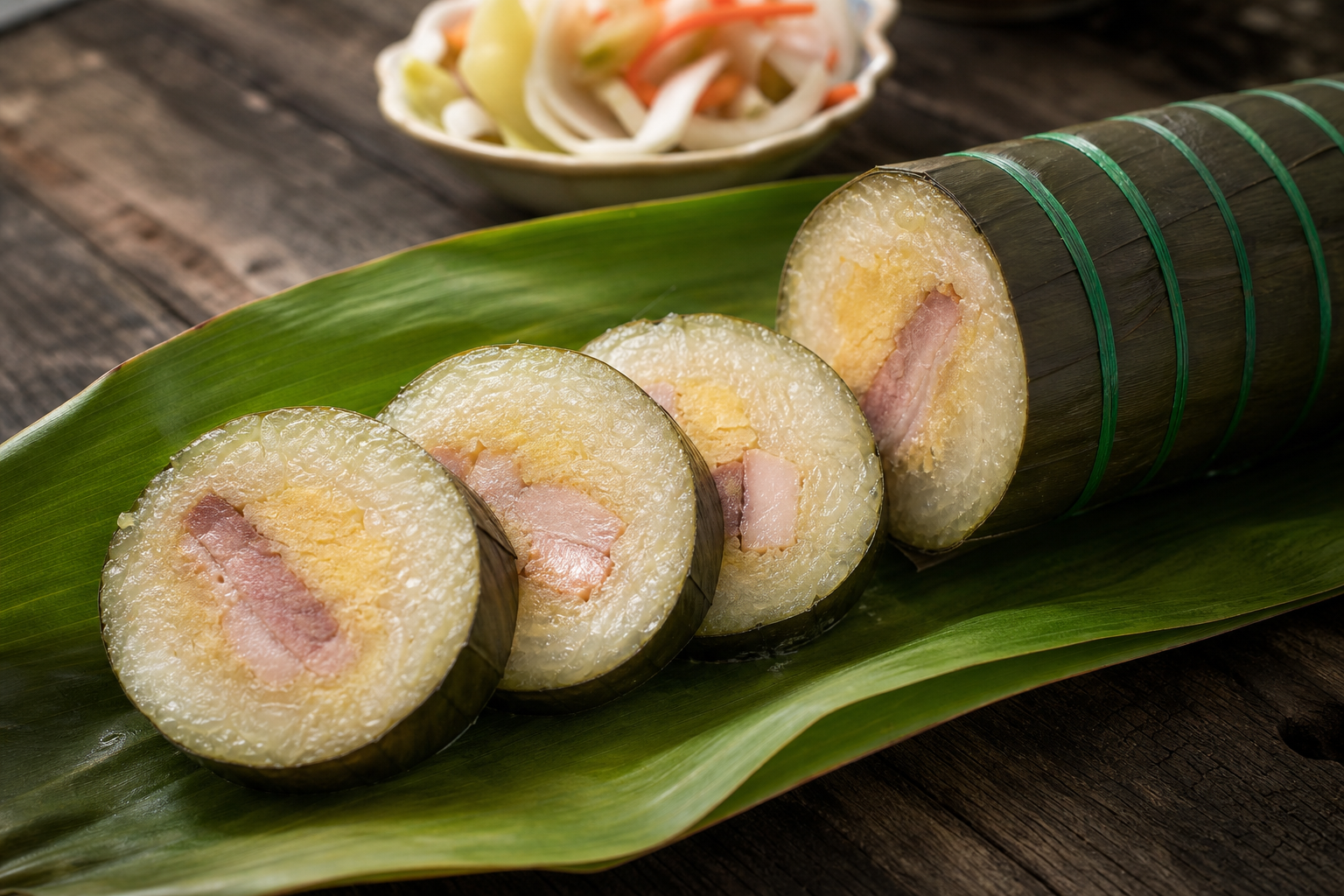
Go south and the cake changes shape. Bánh tét, the central and southern version, is a cylinder rather than a square, wrapped in banana leaf and tied in rings along its length. The filling is much the same — glutinous rice, mung bean, pork — but the log is thinner, so it cooks faster and the slice you cut is a neat round instead of a wedge.
The south also runs more variations: bánh tét with banana, a sweet version with a savoury-sweet balance; bánh tét chay for vegetarian tables; and the striking bánh tét lá cẩm, tinted deep purple with a Mekong Delta leaf, especially associated with An Giang province. In the north, bánh chưng appears in vegetarian form and in a red gấc-tinted version. Both sit beside bánh giầy, the plain round rice cake, and a plate of giò, Vietnamese sausage.
How to Eat Vietnamese Tet Sticky Rice Cake
You do not need a knife. Slip the bamboo string off the cake, then use it to cut straight down — the tension does the work — into eight wedges. It is usually eaten at room temperature alongside củ kiệu (pickled baby leeks), hành muối (pickled shallots) and slices of giò, the pickles cutting the richness of the pork.
Some diners add a sprinkle of sugar or a dip of nước mắm, though both are taste rather than rule. In the days after Tết, leftover slices are pan-fried in oil until the outside crisps, often with an egg, one of the most common breakfasts of the season. The Vietnamese dining etiquette checklist is useful at a family table, and the guide to what to order at every type of eatery helps you read a stall before you sit down.
How to Buy, Check and Store One
Judge a Vietnamese Tet sticky rice cake before you pay. The wrap should be tight and unbroken, the bamboo binding even, the leaf a healthy dark green rather than brown or slimy at the folds. Squeeze it gently: it should feel firm and heavy for its size, not soft or hollow, which usually means it was under-boiled or packed with too little filling. Ask for the weight, since per-kilo price is the honest way to compare stalls.
Once home, keep it wrapped. A boiled, unopened cake holds several days at cool room temperature and a week or more refrigerated; once cut, eat it within two to three days or fry the rest. Prices peak in the final three days before the holiday and drop sharply afterwards, when unsold stock is cleared.
FAQ: Vietnamese Tet Sticky Rice Cake
What does bánh chưng taste like?
Mild and savoury. The dominant notes are the faint earthiness of the leaf, the soft sweetness of glutinous rice, and the richness of mung bean and pork fat. Salt and black pepper carry the seasoning, so it is less salty than it looks.
Is bánh chưng the same as bánh tét?
They are the same dish in two shapes. Bánh chưng is the northern square, wrapped in dong leaves; bánh tét is the central and southern cylinder, wrapped in banana leaf. The core ingredients are nearly identical.
Can you eat bánh chưng if you don’t eat pork?
Yes. Bánh chưng chay is the vegetarian version, with the pork replaced by extra mung bean or a savoury substitute, and it is widely sold at markets and temples. Sweet versions (bánh chưng ngọt) also exist and lean on mung bean and sugar rather than meat.
When is bánh chưng eaten?
Almost entirely around Tết Nguyên Đán. In 2027 that means the last days of January and the first half of February, centred on 6 February. Some shops sell it year-round, but the Vietnamese Tet sticky rice cake is at its most present, and most ceremonial, during the New Year period.
How long does bánh chưng keep?
An unopened, boiled cake keeps several days at cool room temperature and about a week refrigerated. Once cut, treat it like any cooked rice: refrigerate and finish it within a few days, or fry the slices.