
Vietnamese chè is not one dessert. It is a whole category — roughly forty to sixty named varieties in regular circulation — covering iced glasses, hot bowls, thick coconut puddings and thin sweet broths. A chè menu on a wall in Saigon can run to thirty lines with no photos and no English. That is where most visitors stall out and point at whatever the person in front ordered.
This guide is built as a decoder matrix rather than a top-ten list. Each section is a table that maps something you already know — the temperature you want, the region you are in, the type of shop you walk into, the craving you have — onto a specific order. Read the section that matches your situation, take the Vietnamese name, and say it at the counter.
Step 1: Decode the Four Building Blocks
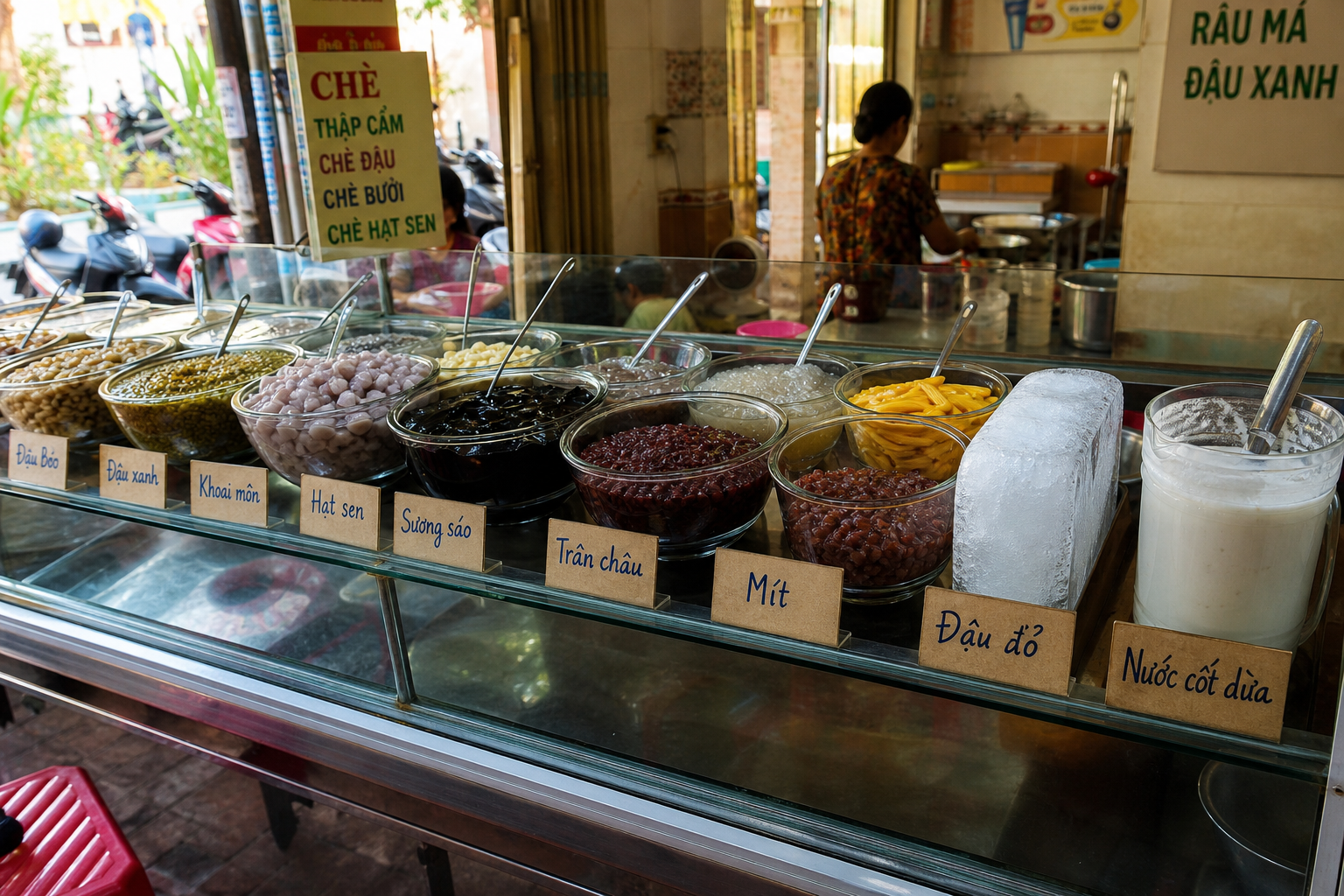
Almost every bowl of Vietnamese chè is a combination of four elements. Once you can name them, an unfamiliar menu line becomes readable rather than random.
| Block | Common components | What it does |
|---|---|---|
| Base starch/legume | mung bean, red bean, black-eyed pea, corn, sticky rice, taro, cassava, lotus seed | Bulk and body; decides whether the bowl is light or filling |
| Chewy element | tapioca pearls, pandan jelly, grass jelly, agar cubes, water chestnut in tapioca | Texture contrast; the reason chè is eaten with a spoon, not drunk |
| Liquid | coconut milk, ginger syrup, plain sugar syrup, condensed-milk-thinned coconut cream | Sets the sweetness and whether the dish is hot or cold |
| Finish | crushed ice, roasted peanuts, toasted sesame, pomelo peel, jackfruit strips | Aroma and crunch, added last |
A menu line like chè đậu xanh nước cốt dừa is simply mung bean + coconut milk. Chè khoai môn is taro. The word chè in front tells you it is sweet; everything after it is the ingredient list.
Step 2: Decode by Temperature
Temperature is the fastest filter on any Vietnamese chè menu, and it is the one most likely to go wrong. Ordering a hot ginger dessert at 34°C in Saigon is a common misfire.
| You want | Ask for | Typical dishes | Where it makes sense |
|---|---|---|---|
| Cold, iced, refreshing | chè lạnh or cho đá (with ice) | chè ba màu, chè thái, chè khúc bạch, chè sương sa hạt lựu | Southern Vietnam year-round; northern summers (May–September) |
| Warm, thick, comforting | chè nóng | chè trôi nước, chè bà cốt, chè bưởi (served warm), chè đậu đen nóng | Hanoi and the north from November to March, when nights drop to 12–17°C |
| Room temperature | no request needed | chè bà ba, chè chuối | Any time; these are often left at ambient in a covered pot |
Most shops can serve the same bean-based chè hot or cold. Jelly-and-fruit varieties are cold only.
Step 3: Decode by Region
Vietnamese chè splits into three regional repertoires, and they are genuinely different. Ordering a southern classic in Hanoi usually works, but the version you get will be less sweet and less coconut-heavy.
| Region | Sweetness and style | Signature orders | Notes |
|---|---|---|---|
| North (Hanoi, Hải Phòng) | Restrained sugar, thinner syrup, less coconut milk | chè đỗ đen (black bean, iced), chè con ong, chè bà cốt (sticky rice in ginger syrup), chè khúc bạch | Hàng Bạc and Hàng Điếu in the Old Quarter have long-running dessert rows |
| Centre (Huế) | Small portions, many varieties eaten as a set | chè hạt sen (lotus seed), chè bột lọc heo quay (roast pork in tapioca), chè đậu ván | Huế’s court-cuisine tradition produces the strangest and most technical varieties |
| South (Saigon, Mekong Delta) | Sweetest, thickest, most coconut milk | chè ba màu, chè bà ba, chè thái, chè chuối, chè bắp (corn) | Khmer and Chinese influence is strongest here; portions are largest |
Huế’s chè bột lọc heo quay — a caramelised pork belly cube inside a tapioca dumpling in clear syrup — is the one that divides people. It is worth ordering once, in a set of three or four small glasses, which is how Huế shops normally sell it.
Step 4: Decode by Venue
The same Vietnamese chè costs three different prices depending on where you buy it, and the ordering method changes too.
| Venue | Price per serving | How ordering works | What to expect |
|---|---|---|---|
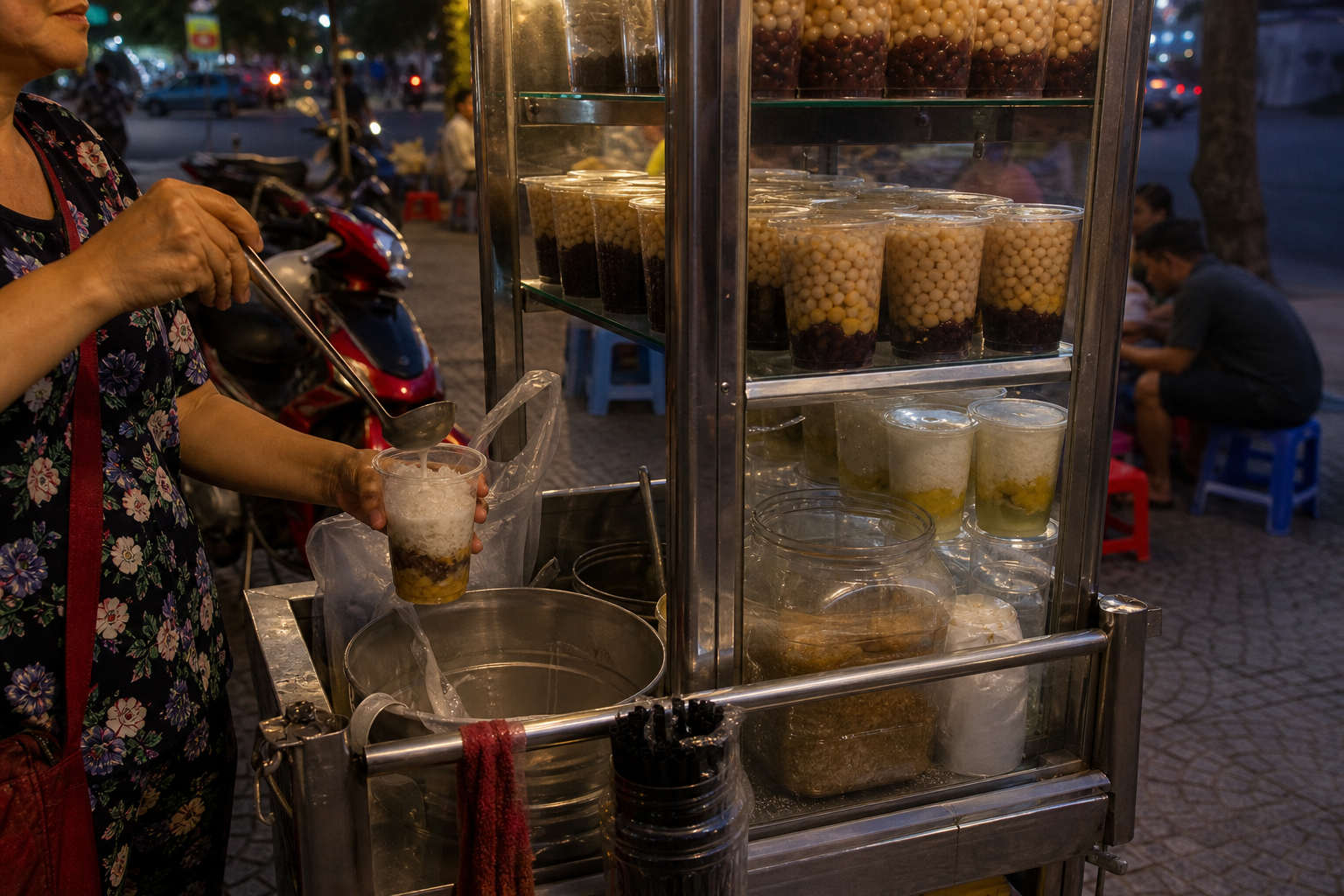
| Sidewalk cart or basket vendor | 10,000–20,000 VND (~$0.40–0.80) | Point at the basin; vendor scoops into a plastic bag or cup | Two or three varieties only; sold out by early evening |
| Neighbourhood chè shop (quán chè) | 15,000–30,000 VND (~$0.60–1.20) | Wall menu, numbered; order at the counter, pay after | The widest selection, 15–30 lines; plastic stools, fans, no English menu |
| Market stall (Bến Thành, Đồng Xuân, Đông Ba) | 25,000–50,000 VND (~$1.00–2.00) | Vendor calls you over; confirm the price before they scoop | Tourist pricing is normal here; portions are generous |
| Air-conditioned dessert chain or café | 40,000–75,000 VND (~$1.60–3.00) | Photo menu, table service, card accepted | Consistent, sweeter, often served in tall parfait glasses |
Prices reflect typical 2026 ranges in Hanoi and Ho Chi Minh City; smaller towns in the Mekong Delta run 20–30% cheaper, and Hội An’s old town runs higher. Carts and neighbourhood shops are cash-only in practice — worth reading up on how payment works at different kinds of food stops in Vietnam before you rely on a QR code.
Step 5: Decode by Craving
This is the working matrix. Find the row that matches what you actually feel like eating.
| Craving | Order this | What arrives | Price band |
|---|---|---|---|
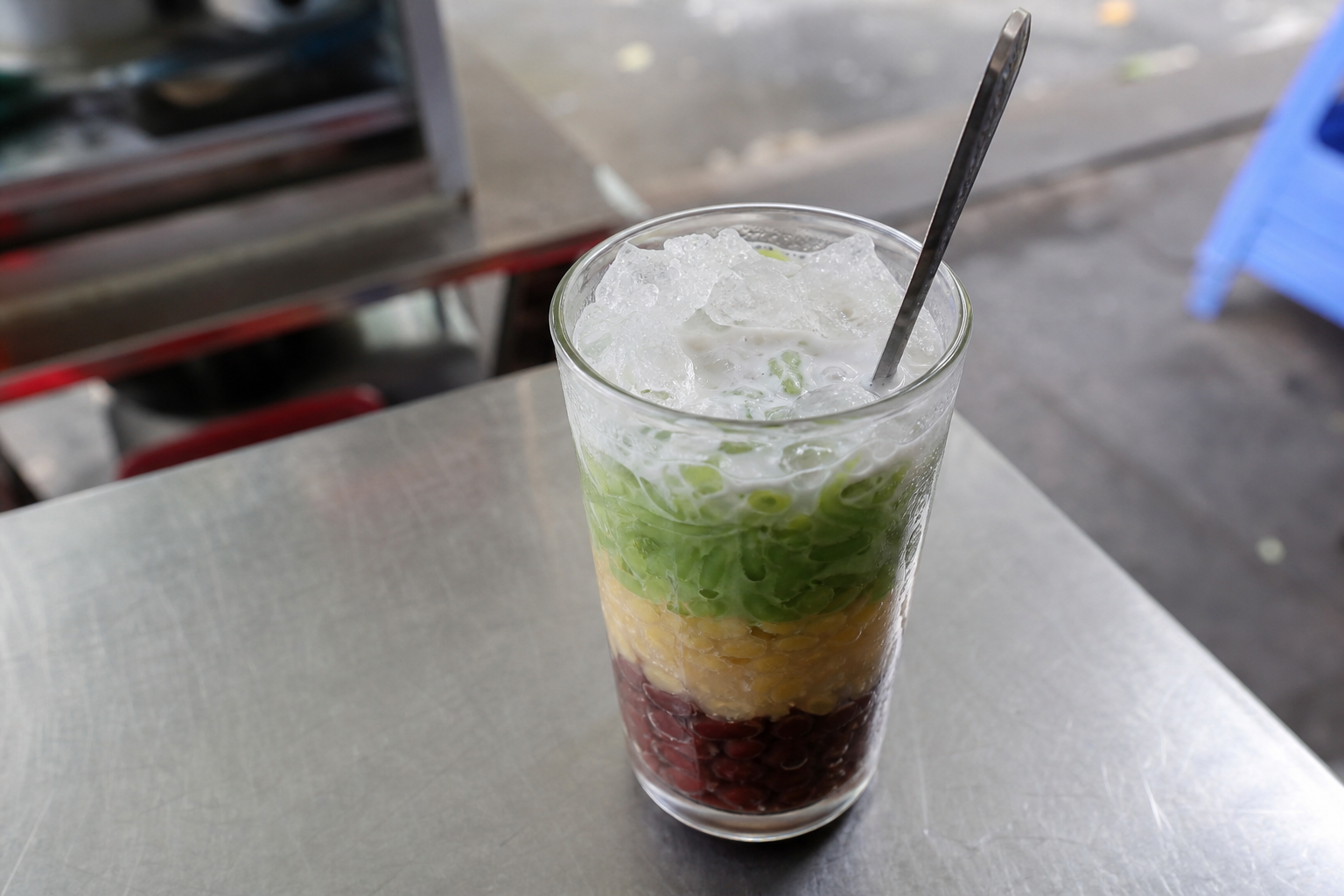
| Cold and colourful, something to photograph | chè ba màu | Layered red bean, mung bean paste and pandan jelly under ice and coconut milk | 20,000–35,000 VND |
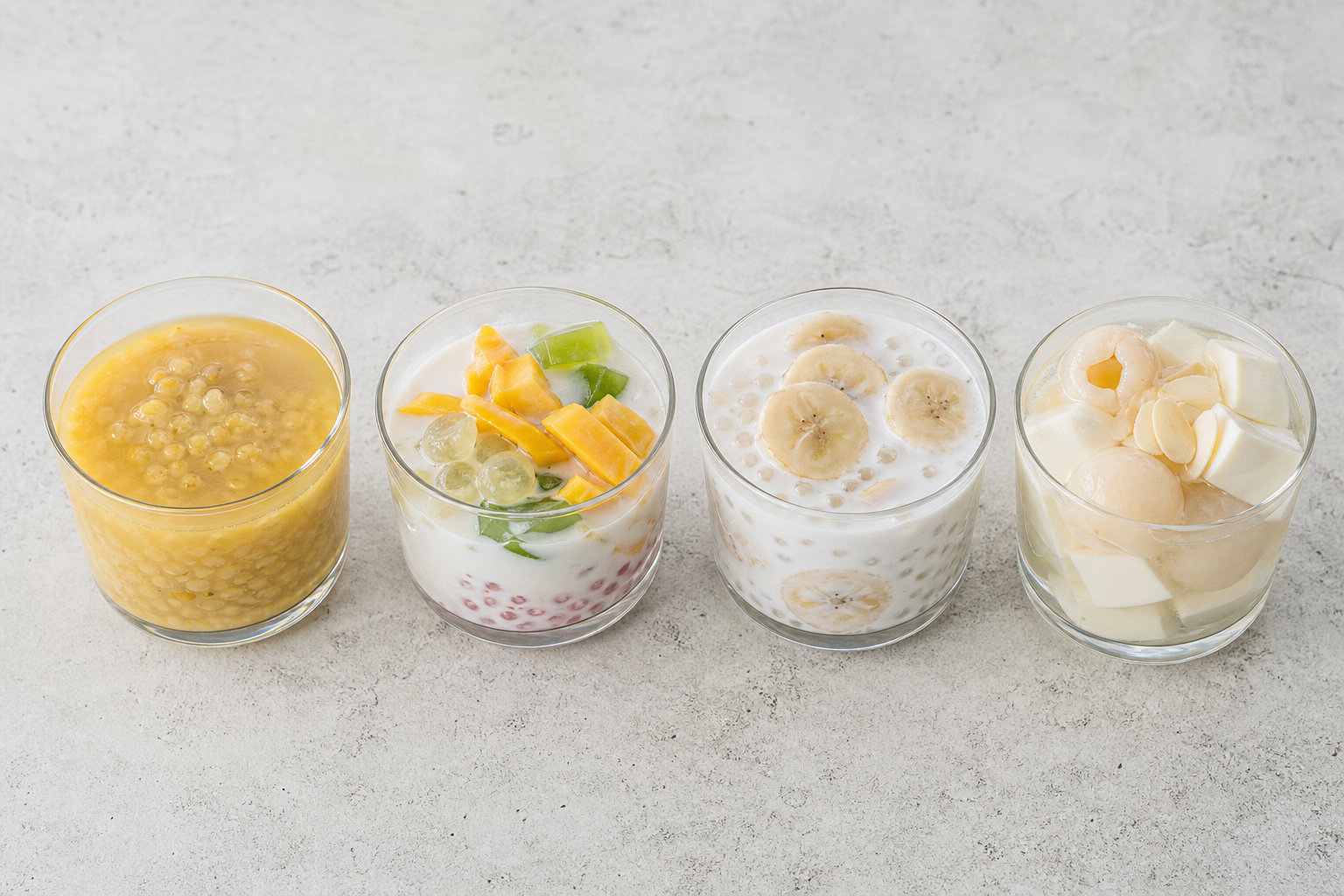
| Creamy, dessert-like, closest to Western pudding | chè khúc bạch | Almond-milk panna cotta cubes with longan, lychee and toasted almond flakes in light syrup | 25,000–45,000 VND |
| Fruit-forward, no beans | chè thái | Jackfruit, lychee, jelly strands and durian in sweetened coconut cream | 30,000–50,000 VND |
| Filling enough to replace a snack meal | chè bà ba | Taro, cassava and sweet potato cubes in thick coconut milk with tapioca | 20,000–35,000 VND |
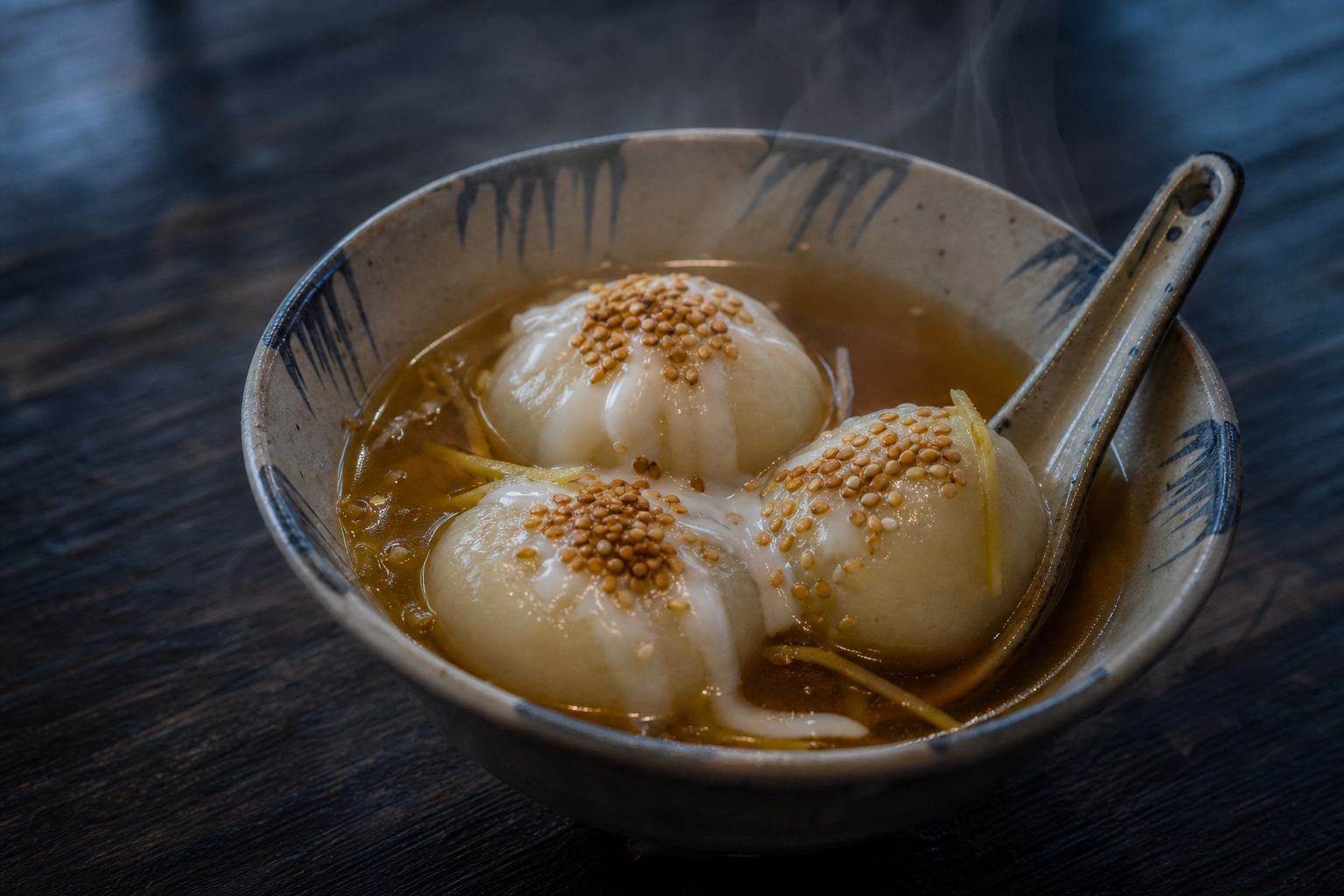
| Warm, gingery, good in cold weather | chè trôi nước | Glutinous rice balls stuffed with mung bean paste in ginger syrup | 15,000–30,000 VND |
| Light, barely sweet, after a heavy meal | chè đỗ đen | Soft black beans in thin syrup over ice | 12,000–25,000 VND |
| Unusual, texture-driven, a talking point | chè bưởi | Candied pomelo peel in tapioca coating with mung bean and coconut milk — crunchy and slightly bitter | 20,000–35,000 VND |
| Something for a child or a cautious eater | chè chuối | Banana simmered in coconut milk with tapioca pearls and peanuts | 15,000–30,000 VND |
Step 6: Decode the Ordering Phrases
Six phrases cover almost every Vietnamese chè transaction. Vietnamese is tonal, so pointing while speaking is normal and expected.
| Phrase | Meaning | When to use |
|---|---|---|
| Cho tôi một ly chè ba màu | One glass of chè ba màu, please | Standard order |
| Ít đường | Less sugar | Southern chè in particular is very sweet |
| Ít đá / nhiều đá | Less ice / more ice | Ice dilutes the coconut milk fast |
| Mang về | Takeaway | Served in a bag or lidded cup with a spoon |
| Ăn ở đây | Eating here | You get a glass and a stool |
| Bao nhiêu tiền? | How much? | Ask at market stalls before they scoop |
For a wider stall vocabulary, the site’s Vietnamese street food phrases guide covers the same structures applied to savoury food.
When Vietnamese Chè Is Actually Eaten
Chè is not a post-dinner course in the Western sense. Timing matters if you want the fresh batch.
- Mid-afternoon, roughly 2–5pm. The core slot. Shops open around midday and toppings are at their best in the first few hours.
- After dinner, 8–10pm. Common in Hanoi’s Old Quarter and around Hồ Con Rùa in District 3, Saigon. Selection is narrower because popular varieties sell out.
- Festivals. Chè trôi nước is tied to Tết Hàn Thực in the third lunar month, and chè kho appears around Tết. These are seasonal, not daily.
- Morning. Rare. A few markets sell chè from 7am, but breakfast in Vietnam is savoury — noodle soup or broken rice territory.
Practical Cautions
Durian is often unlabelled. Chè thái frequently contains durian even when the menu does not say so. Ask có sầu riêng không? if you want to avoid it.
Sweetness is not adjustable after the fact. Say ít đường at the point of order, not when the glass arrives.
Ice is generally fine at established shops. Commercial tube and crushed ice in Vietnam is factory-produced from filtered water. The risk sits with the toppings sitting out uncovered in heat, not the ice itself.
Peanut allergies need a direct question. Roasted peanuts are a default garnish on chè chuối, chè bà ba and several others. Không đậu phộng means no peanuts.
Vietnamese chè portions are small by design. A single glass is 150–250ml. Ordering two varieties is normal and costs less than one dessert at a hotel restaurant.
How Vietnamese Chè Fits the Wider Cuisine
Vietnamese chè sits alongside coffee and fresh fruit as the everyday sweet layer of Vietnamese cuisine, and it borrows heavily from Khmer, Chinese and Thai dessert traditions — the reason a Saigon menu can list chè thái and chè bà ba on the same wall. The historical background and the full list of named varieties are documented on the Wikipedia entry for chè. For the drink side of the same afternoon habit, the Vietnamese coffee decision tree applies the same decoding approach to cà phê menus.
FAQ
Is chè a drink or a dessert? Both, depending on the variety. Iced versions in tall glasses are eaten with a long spoon and sometimes finished through a wide straw; hot versions are bowl-and-spoon desserts. The category covers puddings, sweet soups and drinkable coconut mixes under one word.
What does chè taste like? Most Vietnamese chè is sweet, but the dominant flavour is usually coconut milk, with beans or root vegetables supplying a starchy, mildly savoury background. Northern versions taste noticeably less sweet than southern ones. Very little of it is fruit-sour.
Is Vietnamese chè vegetarian? The great majority is — beans, roots, jellies, coconut milk and sugar. The main exception is Huế’s chè bột lọc heo quay, which contains pork. Condensed milk appears in some southern versions, so strict vegans should ask có sữa không?
How much should one serving cost? Between 10,000 and 35,000 VND (~$0.40–1.40) at carts and neighbourhood shops, and 40,000–75,000 VND (~$1.60–3.00) at air-conditioned chains. Anything above that outside a hotel is tourist pricing.
Which chè should a first-timer order? Chè ba màu in the south and chè đỗ đen or chè khúc bạch in the north. All three are widely available, mild, and use textures that are easy to get on with before moving to pomelo peel or lotus seed.