

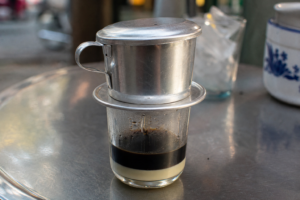
The first Vietnamese coffee I ordered in Hanoi, I got wrong. I pointed at a menu line that said “cà phê sữa” because I recognised the word for milk, then sat on a red plastic stool for eleven minutes wondering why nothing had arrived. When it did, it was hot, in a glass the size of a shot, sitting under a metal filter that was still dripping. I wanted a cold drink. I had ordered a slow one.
That single mistake cost me 15,000 VND and taught me the thing nobody put in a guidebook: ordering Vietnamese coffee is not a matter of taste, it’s a matter of decisions. Hot or cold. Milk or no milk. Filter or jug. Stool or air conditioning. Get the decisions right and every cup lands the way you hoped.
So instead of writing another list of “best cafés,” I’ve laid this out as the decision tree I now run through in my head, in about four seconds, every single morning in Vietnam. Start at Question 1, follow the branch that matches you, and stop when you hit a cup. Each branch ends with what to say, what it costs, and how long you’ll wait.
How to Use This Tree
Five questions, in order. Don’t skip ahead — the answer to Question 1 changes what Question 3 even means. Prices are what I actually paid between March and August 2026, in Vietnamese đồng (25,000 VND was about one US dollar in that window). Where I quote a wait time, I timed it on my phone, because I am that person.
One ground rule before you start: almost every Vietnamese coffee here begins as strong, dark, robusta-heavy drip coffee. That’s the base. Every branch below is a decision about what happens to it after the dripping stops.
Question 1: Are You Here for Caffeine, or for Dessert?
This is the fork that matters most, and the one foreigners get wrong most often. Half the famous Vietnamese coffee drinks are functionally desserts. If you order one at 8am expecting a flat white, you will be disappointed in a drink that did nothing wrong.
Branch A — Caffeine: cà phê sữa đá
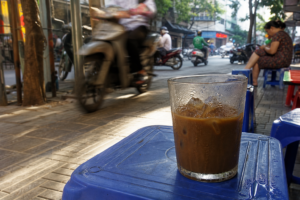
Say: “Cho tôi một cà phê sữa đá.” Iced coffee with condensed milk, the national default. Sweet, bitter, cold, and strong enough that I’ve cut it with a splash of the free iced tea when I over-ordered.
- Street stall or family shop: 12,000–20,000 VND
- Mid-range café with fans and wifi: 30,000–45,000 VND
- Wait: 1–2 minutes if it’s pre-brewed in a jug, 5–7 if they drip it fresh for you
If you want it without milk, that’s cà phê đá — black, iced, and about 3,000 VND cheaper. It is much more bitter than you expect. I drink it now. I did not enjoy it for the first two weeks.
Branch B — Dessert: cà phê trứng, coconut coffee, salt coffee
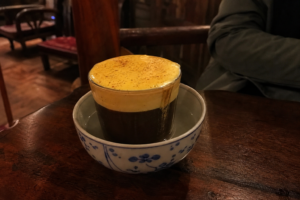
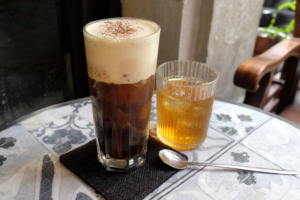
These are the three dessert-leaning Vietnamese coffee drinks that end up on everyone’s camera roll. Cà phê trứng (egg coffee) is egg yolk whipped with condensed milk into a warm custard foam, floated on coffee — it tastes like tiramisu that has been to a bar. Coconut coffee is coffee poured over blended coconut milk ice, closer to a slushie. Cà phê muối (salt coffee) sits between the two camps: salted cream over iced coffee, and the salt makes the bitterness land differently.
Skip to Question 4 if you picked this branch. Dessert coffee needs a chair and twenty minutes; you cannot walk with it.
Question 2: Hot or Iced? (And Why the Answer Isn’t Weather)
The word you need is short. Nóng is hot, đá is iced. Attach it to the end: cà phê sữa nóng, cà phê sữa đá.
I assumed iced was for hot days and hot was for cold ones. Wrong instinct. In Vietnam, hot coffee is for sitting still. It arrives with the phin still on top, so you’re committed to four to seven minutes of watching it drip, then another five of sipping something the size of an espresso. That’s the point — it buys you a chair, a table, and a reason to stay put.
Iced coffee is for movement, for a 6:30am stall before a bus, for the fifteen minutes between two errands. On my first trip I ordered hot coffee at 7am with a train to catch at 7:40. I drank it at scalding temperature, burned my tongue, and tasted nothing for the rest of the morning.
Rule I now use: if I have more than twenty minutes, hot. If not, iced. The thermometer never enters into it.
The one exception: Đà Lạt and the mountains
At 1,500 metres, Đà Lạt mornings sit around 14–16°C and hot coffee stops being a ritual and starts being a necessity. Same in Sa Pa and on the northern passes. Above about 1,000 metres, I default to nóng regardless of my schedule.
Question 3: Milk, or No Milk? (There Is a Third Answer)
Everyone knows sữa (condensed milk) and đen (black). The one I wish someone had told me about earlier is bạc xỉu — much more milk, much less coffee, sometimes with a splash of fresh milk. It’s the drink I hand to friends who say they “don’t really like coffee,” and it converts them roughly eight times out of ten.
- cà phê đen đá — black, iced, bracing, 12,000–18,000 VND
- cà phê sữa đá — the standard, 12,000–20,000 VND
- bạc xỉu đá — milky and mild, 20,000–30,000 VND
A warning about the milk: it’s sweetened condensed, not fresh, and it’s poured with a generous hand. If you want it dialled back, “ít sữa” (less milk) works everywhere. “Không đường” (no sugar) does not help you here, because the sugar is inside the milk. I made that mistake in Huế and got a full-sweetness cup with a confused look attached. If you want more of these phrases before you go, I put the ones I actually use into a separate guide on Vietnamese street food phrases.
Question 4: A Plastic Stool, or Air Conditioning?
The same drink costs three times as much across this branch, and both prices are fair. You’re not buying coffee, you’re buying a place to be.
Sidewalk stool (12,000–25,000 VND)
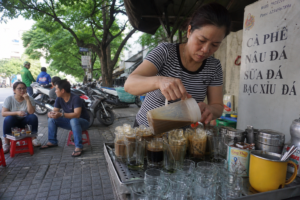
Knee-high plastic furniture, a shared tray of iced tea, and no menu. You point or you say the name. Nobody minds if you sit there an hour on one glass, and nobody will bring you a bill until you ask — “tính tiền” does it. This is where Vietnamese coffee actually lives, and it’s the same rhythm as sidewalk food generally, which I get into in my guide to eating street food in Vietnam without getting sick.
Old-house café (35,000–60,000 VND)
Second floor, wooden stairs, ceiling fan, a balcony over an alley. This is where you go for egg coffee and where you should go if you need ninety minutes and a power socket. In Hanoi they’re stacked all over the Old Quarter — the walking route I use is in my Hanoi Old Quarter travel guide.
Chain café (45,000–70,000 VND)
Highlands, Phúc Long, The Coffee House. Real air conditioning, clean bathrooms, English menus, card payment. I’m not sneering at these — during a 34°C afternoon in Saigon I paid 55,000 VND for a cold Vietnamese coffee and an hour of cold air, and it was the best value purchase of that day.
Question 5: Which City Are You Standing In?
The last branch is geography. Every region put its own spin on Vietnamese coffee, and ordering the local specialty is the difference between a good cup and a memorable one.
Hanoi → cà phê trứng
Hanoi invented egg coffee in the 1940s, reportedly when milk was scarce and someone swapped in egg yolk. Expect 35,000–55,000 VND and a fifteen-minute window before the foam turns grainy. Order it hot, not iced, the first time. The history of egg coffee is worth two minutes of reading while you wait.
Huế → cà phê muối
Salt coffee is Huế’s contribution and it was invented there in 2010, which makes it younger than most people’s phones. 20,000–35,000 VND. Stir it once, not five times — you want to hit the salted cream and the black coffee unevenly. I drank three in one afternoon between temple visits on the day I wrote my Huế Imperial City guide.
Saigon → bạc xỉu, in a bag
Saigon’s street version often comes in a plastic bag with a straw and a rubber band, made to hang off your handlebars. 15,000–25,000 VND. The lids leak. Do not put it in your daypack, as I did, on top of a passport.
The Mekong Delta → coffee with your breakfast, at 5:30am
Delta towns wake up absurdly early and the coffee stalls open before the light does. If you’re on a Cần Thơ floating-market morning, coffee is at 5:30 and it’s non-negotiable.
Where This Vietnamese Coffee Tree Sent Me Wrong
Three honest failures, so you can skip them.
- I ordered egg coffee at 9pm in Hanoi. Two of them, in fact, because they were good. I then lay awake until 3am. Vietnamese coffee is robusta-dominant, and one glass carries a serious caffeine load — Vietnamese iced coffee is not a nightcap.
- I asked for oat milk in a sidewalk shop. There is no oat milk. There is condensed milk. Asking politely does not summon plant milk into existence; chain cafés have it, stools do not.
- I paid 90,000 VND for coconut coffee at a lake-view tourist café two minutes from a stall selling a better version for 25,000. My rule now: if the café has a photo menu in three languages and a doorman, walk one block inland.
The Whole Tree on One Line Each
| If you want… | Say this | Price (VND) | Wait |
|---|---|---|---|
| The default cold cup | cà phê sữa đá | 12,000–20,000 | 1–7 min |
| Strong and bitter | cà phê đen đá | 12,000–18,000 | 1–5 min |
| Mild and milky | bạc xỉu đá | 20,000–30,000 | 2–5 min |
| A chair and a slow hour | cà phê sữa nóng | 15,000–25,000 | 8–12 min |
| Dessert in Hanoi | cà phê trứng | 35,000–55,000 | 5–10 min |
| Dessert in Huế | cà phê muối | 20,000–35,000 | 3–5 min |
| Less sweetness, any branch | add “ít sữa” | same | same |
| The bill | “tính tiền” | — | — |
Frequently Asked Questions
Is Vietnamese coffee stronger than regular coffee?
Usually yes. It leans on robusta beans, which carry roughly double the caffeine of arabica, and the phin brews a small volume very slowly. One 15,000 VND glass hit me harder than a double espresso back home.
What is the most popular Vietnamese coffee order?
Cà phê sữa đá, by a wide margin. If you say nothing else and just sit down at a sidewalk stall in the morning, it’s often what appears in front of you.
Do I tip at a Vietnamese coffee stall?
No. Tipping isn’t expected at stools or family shops. I round up to the nearest 5,000 VND when someone has let me sit for two hours, and that’s it.
Can I drink the free iced tea they bring?
I always do, at busy stalls, and I have never had a problem. It’s usually weak jasmine tea served from a communal jug. If a place looks deserted and the jug looks like it’s been out since morning, I skip it.
How early do coffee stalls open?
Cities: 6am, some at 5:30. Delta towns: before sunrise. Tourist-facing cafés and anywhere serving egg coffee: usually 8am at the earliest.
One Last Thing
The tree gets shorter the longer you stay. By week three I had stopped deciding at all — I’d sit on the same stool on the same corner, the woman running it would look at me, and a cà phê sữa đá would arrive without either of us saying a word. That’s the actual endpoint of every branch above, and it costs 15,000 VND.