

Vietnam is often described as a cash-only country. That stopped being true around 2023, and it has not been true anywhere in the big cities since. Bank-transfer QR codes now sit on the counters of pavement noodle stalls, banh mi carts and one-woman coffee shops. But the shift is uneven, and the tourist-facing version of it is different from the local version — most of those QR codes only work if you hold a Vietnamese bank account.
That gap is the whole problem. Handling money in Vietnam is not about picking one method and sticking with it; it is about matching the method to the venue. A 500,000 note is useless at a 25,000 breakfast cart and perfect at a hotel front desk. A contactless card is fine at a craft beer bar in District 1 and pointless at a market stall in Cho Ben Thanh.
What follows is a matrix rather than a story: venue type by venue type, what to hand over, what it costs, and what tends to go wrong.
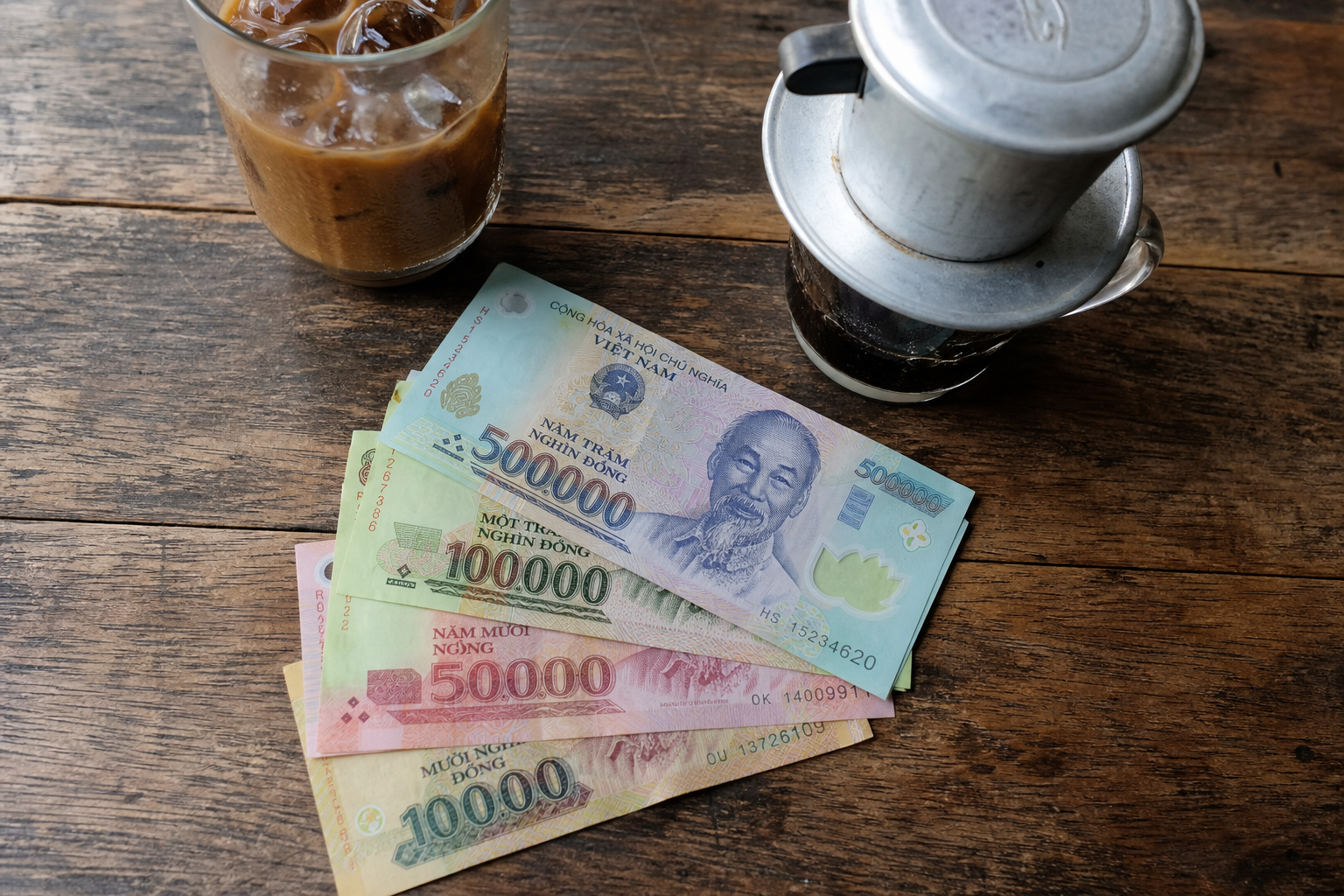
The đồng, in one table
The currency is the Vietnamese đồng, abbreviated VND or written with a trailing “đ”. Prices are quoted in thousands, so a menu listing “45” means 45,000 VND. In early September 2026 the market rate sits near 26,000 VND to 1 USD, which makes the mental shortcut simple: drop three zeros, then divide by 26.
One mix-up costs people real money: the 20,000 and the 500,000 are both blue-toned polymer and similar in size. Check the numerals, not the colour, before handing anything over in low light. The currency is issued by the State Bank of Vietnam, and older 10,000 and 20,000 paper versions have been withdrawn — anything you receive as change should be polymer above 5,000.
Four ways to pay, compared
The practical takeaway for a short trip: cash is your primary instrument for food, and a card is your instrument for accommodation, transport and anything above about 500,000 VND. Treat cross-border QR as a bonus that sometimes works, never as a plan.
Travellers staying several weeks sometimes open a local bank account or use a Vietnamese e-wallet topped up by a resident friend. That unlocks VietQR properly and changes the whole calculation. For anyone on a two- or three-week trip, it is not worth the paperwork.
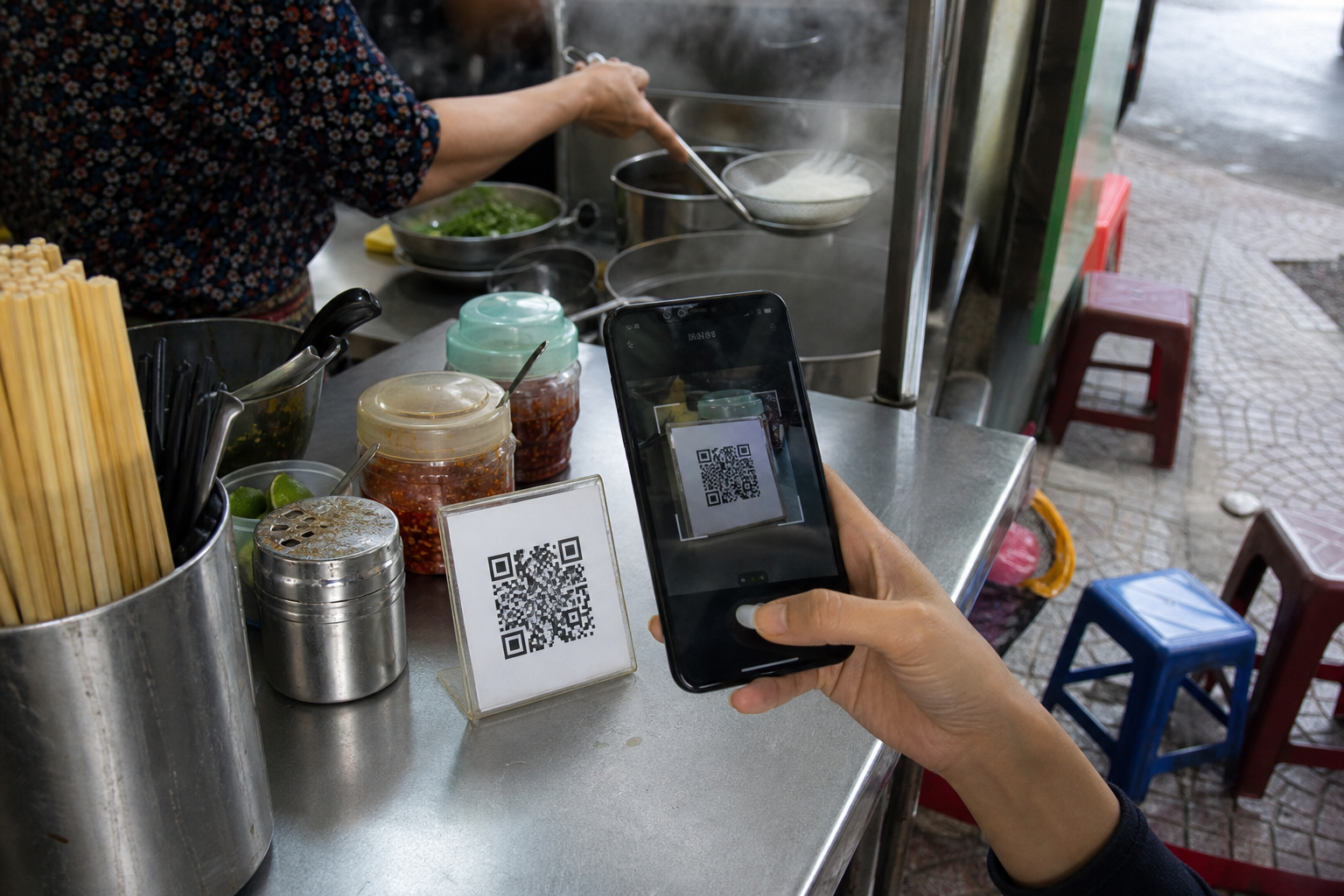
The payment matrix: what to use where
Pavement carts and sidewalk stalls
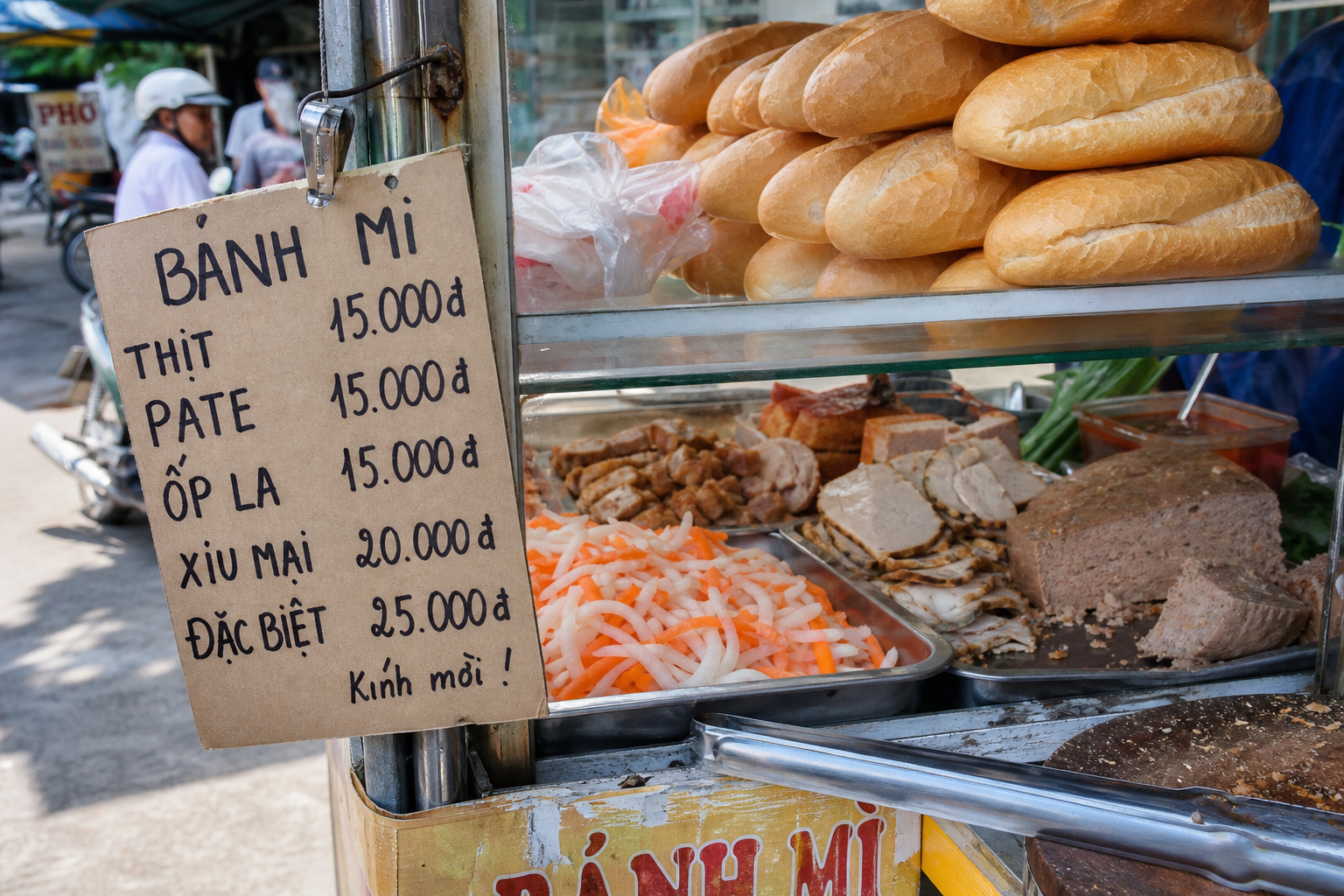
Cash only, in practice. Prices run roughly 20,000–60,000 VND ($0.75–$2.30) for banh mi, xoi, banh cuon or a bowl of noodles. Carry 10,000, 20,000 and 50,000 notes and pay with something close to the exact amount. A vendor turning over 40 portions a morning holds very little float, and breaking a 500,000 note at 6am often means they walk to a neighbour to get change.
Payment usually happens after you eat, not before. If you want the total, “tính tiền” is the phrase — there are more of these in the guide to Vietnamese street food phrases.
Quán and neighbourhood shophouse restaurants
Cash first; QR displayed but usually domestic-only. Expect 50,000–120,000 VND per person for com tam, bun cha or a rice-and-dishes lunch. Cards are rare below the tourist-facing tier and, where accepted, often carry a 2–3% surcharge that is added silently. Ask before you eat if you intend to pay by card.
Wet markets and dry goods markets
Cash, in small notes, and expect to negotiate on non-food goods. Fresh produce, herbs and prepared food inside markets are generally fixed-price for locals but quoted high for foreigners at the tourist-heavy markets — Ben Thanh in Ho Chi Minh City and Dong Xuan in Hanoi being the obvious two. Neighbourhood markets away from those two are far closer to honest first prices.
Cafés
Split roughly by type. Pavement stands and plastic-stool cafés charge 15,000–30,000 VND and want cash. Air-conditioned chains and specialty roasters charge 45,000–90,000 VND and take cards reliably. If you are working out which drink to order at each, the Vietnamese coffee decision tree covers the menu logic.
Mid-range and tourist-facing restaurants
Card works. Anywhere with an English menu, printed bill and table service in the 150,000–500,000 VND per head range will take Visa and Mastercard. Two things to watch: a surcharge line on the bill, and dynamic currency conversion — if the terminal offers to charge you in USD, GBP or EUR, decline and choose VND. Accepting the conversion typically costs 3–6% over your own bank’s rate.
Grab, Be and food delivery apps
Card on file, or cash to the driver. Linking an international card to a ride-hailing app before you arrive removes most daily friction, and it fixes fares in advance. Cash still works for every ride if the card fails. Delivery orders paid in cash need small notes ready, because drivers carry limited change. Route and vehicle choices are broken down in the guide to getting around Vietnam.
Hotels, tours, cooking classes and boats
Card for the booking, cash for the extras. Hotel rooms, Ha Long cruises and multi-day tours take cards or bank transfer at the point of booking. On the ground, tips, drinks on board, entrance fees at smaller sites and motorbike-taxi legs between stops are cash. Budget 200,000–400,000 VND per person per day in loose cash on a tour day.
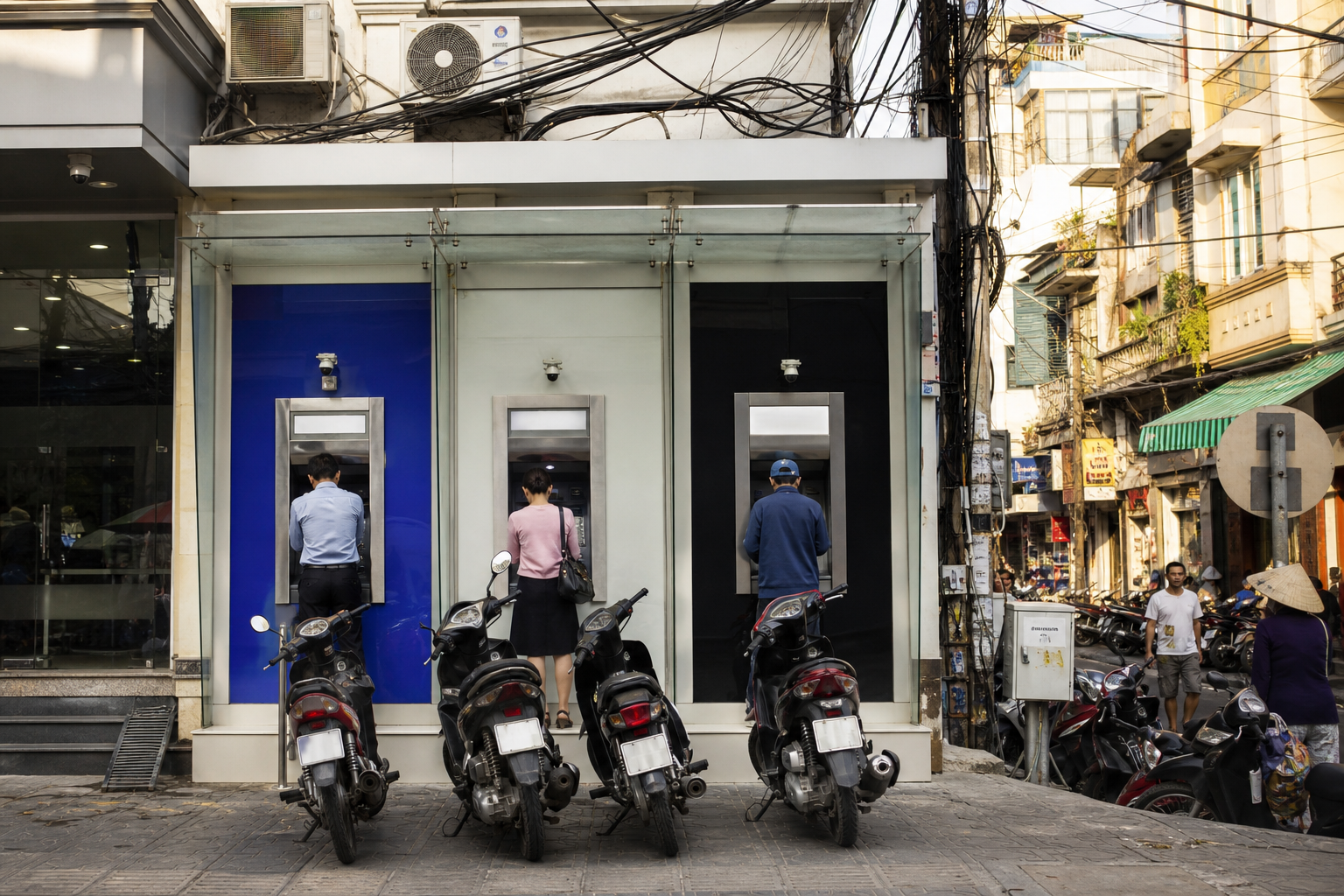
Getting money in Vietnam: ATMs versus exchange counters
ATM withdrawal limits per transaction sit between 2,000,000 and 5,000,000 VND at most local banks, with a handful of banks allowing considerably more. Because the fee is charged per withdrawal rather than per đồng, taking the maximum each time is materially cheaper than four small pulls.
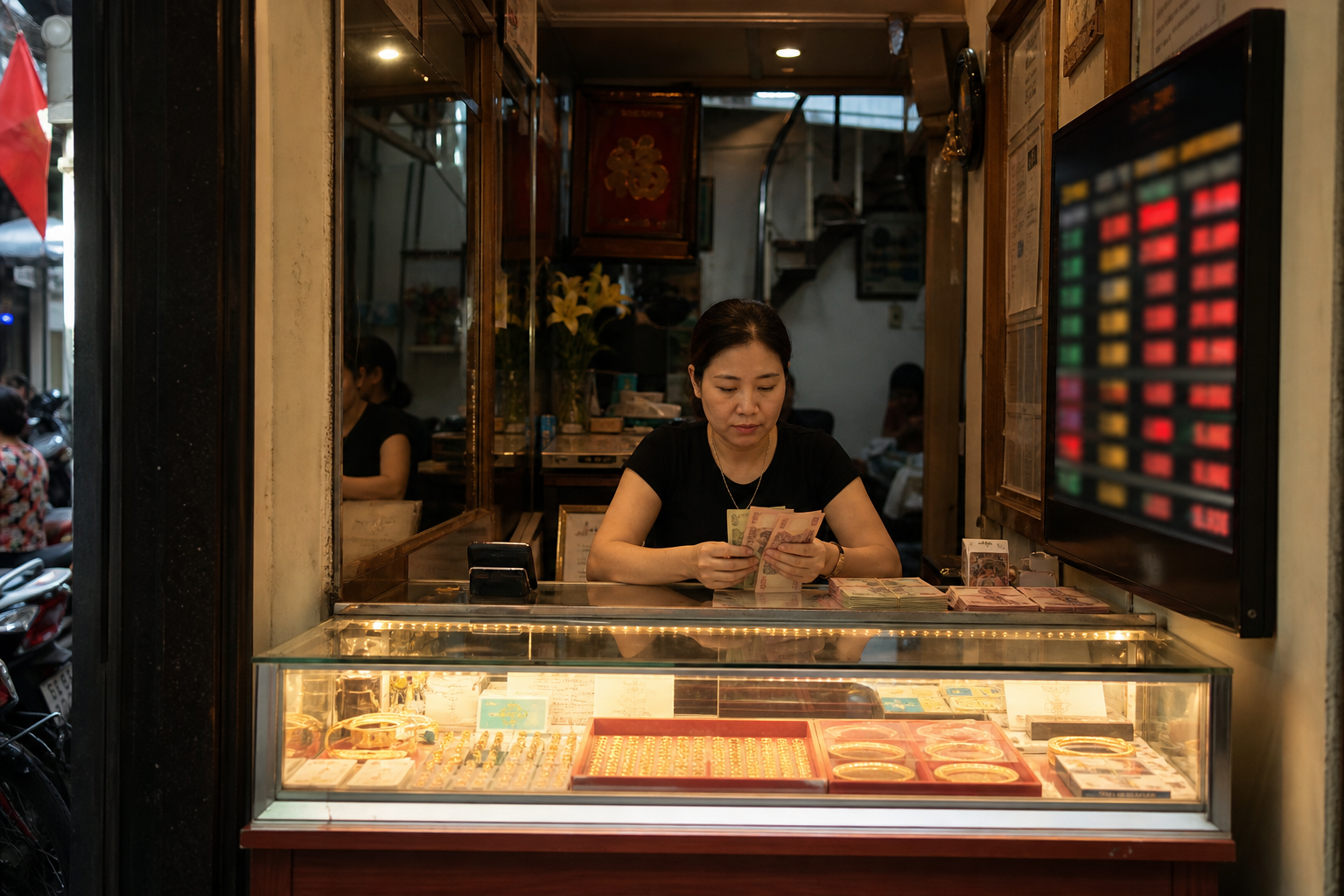
Gold shops trade foreign currency at rates that beat exchange counters, and they are a normal, widely used option — but they only take clean, unmarked notes, and they generally will not touch anything with a tear or a pen mark.
The note mix that actually works
A 2,000,000 VND withdrawal usually dispenses as four 500,000 notes. That is the worst possible shape for a day of eating, and it is the most common way people make money in Vietnam harder than it needs to be.
Break the big notes deliberately. Convenience stores, supermarkets, petrol stations and hotel receptions all take a 500,000 without complaint. Buy water and a snack at a chain store on the way out and you convert one large note into a usable spread.
A workable daily wallet for two people eating street food: two 100,000, four 50,000, five 20,000 and a handful of 10,000. That covers around 500,000 VND, which is a generous eating day. Keep the rest — and one card — separate from the wallet you actually open in public.
Vietnam is low-risk for violent crime and higher-risk for opportunistic bag snatching from passing motorbikes, particularly in Ho Chi Minh City. Counting a thick stack of notes on a busy street corner is the behaviour worth avoiding, not the city itself.
Pass or fail: a pre-departure money check
Most problems with money in Vietnam are created before departure, not during the trip. Run this list before you fly. Each line is pass or fail, with no middle option.
- Bank notified of travel dates, or app-based travel toggle switched on. A blocked card on day one is the single most common money problem.
- At least two cards from different networks, stored in different bags. Visa and Mastercard are both widely accepted; Amex and Discover are not.
- Foreign transaction and ATM fees confirmed in writing. If your card charges 3% plus a flat withdrawal fee, a different card is worth opening.
- Ride-hailing app installed and a card linked before arrival. Doing this on airport wifi with a queue behind you is avoidable.
- $100–200 in clean, unfolded USD notes as backup. Gold shops and hotels accept these; damaged notes get refused.
- PIN is four digits and numeric. Six-digit and alphabetic PINs fail at many Vietnamese ATMs.
- Offline map with bank branches saved. Branch ATMs are safer bets than standalone machines in alleys.
Tipping and haggling: what is normal
Tipping is not built into Vietnamese food culture. Street stalls, quán and local restaurants do not expect it, and leaving change behind is treated as generosity rather than obligation. Rounding a 85,000 bill up to 90,000 is normal and unremarkable.
Where tipping has become customary: tour guides and drivers on multi-day trips (100,000–200,000 VND per person per day is a common range), hotel porters (20,000–50,000), and spa or massage staff (50,000–100,000). Upmarket restaurants may add a 5% service charge plus 8–10% VAT, in which case nothing further is expected.
Haggling belongs to markets, souvenirs and unmetered transport, not to food. Prices at a pho counter are fixed, and pushing on a 45,000 bowl reads as rude. Where a stall has no posted price and quotes you a number that seems high, the useful move is to ask the price before ordering rather than argue after eating — a habit that also appears in the guide to eating street food without getting sick.
FAQ
How much cash should you carry per day in Vietnam? For street food, coffee and short taxi rides, 400,000–600,000 VND ($15–$23) per person per day is comfortable. Add cash for entrance fees on sightseeing days, and keep accommodation and long-distance transport on a card.
Can foreigners use QR code payments in Vietnam? Not with a standard foreign banking app. Domestic VietQR codes settle through Vietnamese bank accounts. Some cross-border QR schemes and specialist wallets work at enrolled merchants, but coverage is inconsistent and should not be relied on for daily meals.
Are US dollars accepted in Vietnam? Rarely, and never at a good rate. A few tour operators and hotels quote in USD, but food vendors, markets and transport all work in đồng. Exchange dollars rather than trying to spend them.
Is it cheaper to exchange currency or withdraw from an ATM? ATMs generally win on rate and lose on fee, so they are cheaper for larger withdrawals. Gold shops in major cities beat airport and hotel counters for cash exchange. The worst option is an airport counter for a large sum.
What happens if an ATM keeps your card? Machines attached to a bank branch will return the card during business hours with your passport. Standalone machines in alleys will not, which is the reason to prefer branch ATMs when withdrawing anything substantial.