Vietnamese dining etiquette changes depending on where you’re eating — a plastic stool on the sidewalk runs on different rules than a family’s dinner table or a business banquet in a private room. Getting it wrong rarely causes offense; Vietnamese hosts are generally forgiving with foreigners. But getting it right changes how you’re treated, and it usually gets you better food, more of it, and a warmer table.
This guide breaks Vietnamese dining etiquette into four settings — street food stalls, family-style local restaurants, someone’s private home, and formal or business meals — with a pass/fail checklist for each. Chopstick handling, toasting, and paying the bill are covered separately at the end, since those parts of Vietnamese dining etiquette apply across all four settings, and the street food phrases guide covers the language side of ordering at a stall.
How to Use This Checklist
Each section lists behaviors as Pass (do this, it’s expected or appreciated under standard Vietnamese dining etiquette) or Fail (avoid this, it reads as rude or careless). Not every rule applies everywhere — a street stall doesn’t care about seating order, but a formal dinner does. Read the section that matches where you’re eating, then check the universal rules at the end that apply no matter what.
Setting 1: Street Food Stalls and Sidewalk Eateries
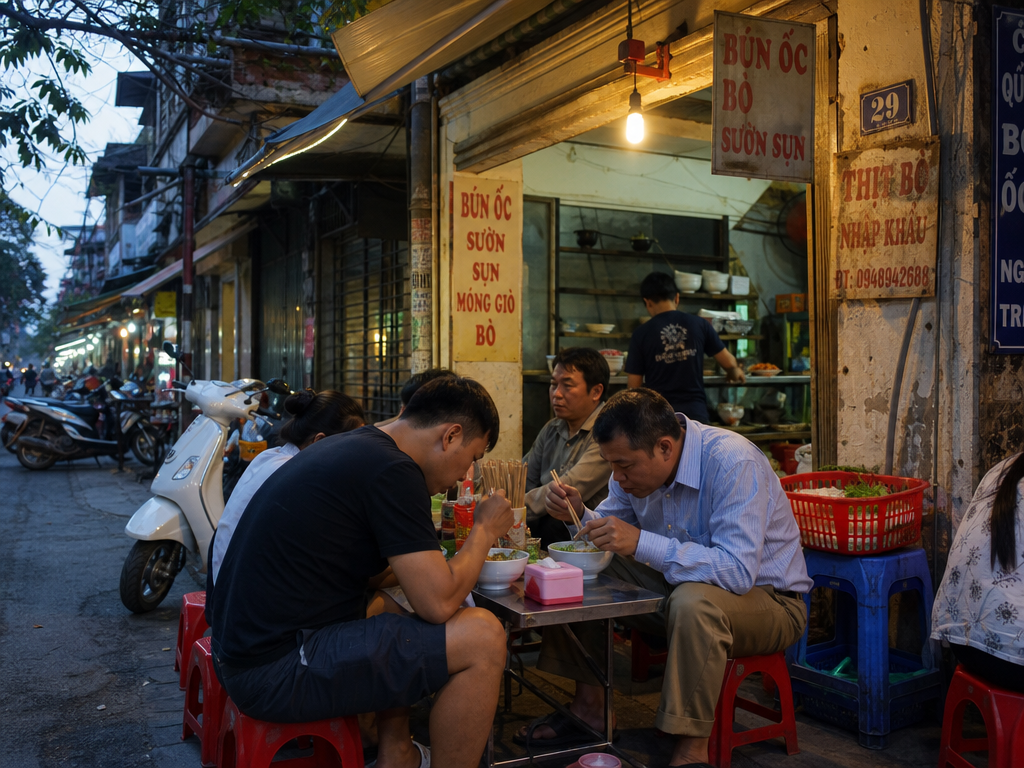
Street-level Vietnamese dining etiquette is the most relaxed of the four settings, and the one most travelers spend the most time in. Low plastic stools, shared tables, quick turnover. The bar is lower, but a few things still matter.
Pass:
- Sitting anywhere there’s a free stool, even next to strangers. Sidewalk stalls don’t reserve seats.
- Pointing at what you want if you don’t know the name, or at someone else’s bowl and saying “like that one” (“giống vậy,” understood even mispronounced).
- Paying at the end, in cash, directly to the vendor. Most stalls don’t run tabs.
- Leaving a bowl half-full if you’re full. Nobody expects you to finish a bowl of phở or bún riêu that turned out bigger than expected.
Fail:
- Asking for substantial menu changes. A phở stall makes phở one way; there’s no kitchen customizing a base recipe for one order.
- Expecting an itemized receipt or card payment. Most street vendors are cash-only, and prices are fixed per bowl.
- Haggling over the price of food. Bargaining is normal for souvenirs and taxis, not for a bowl of noodles.
Setting 2: Family-Style Local Restaurants
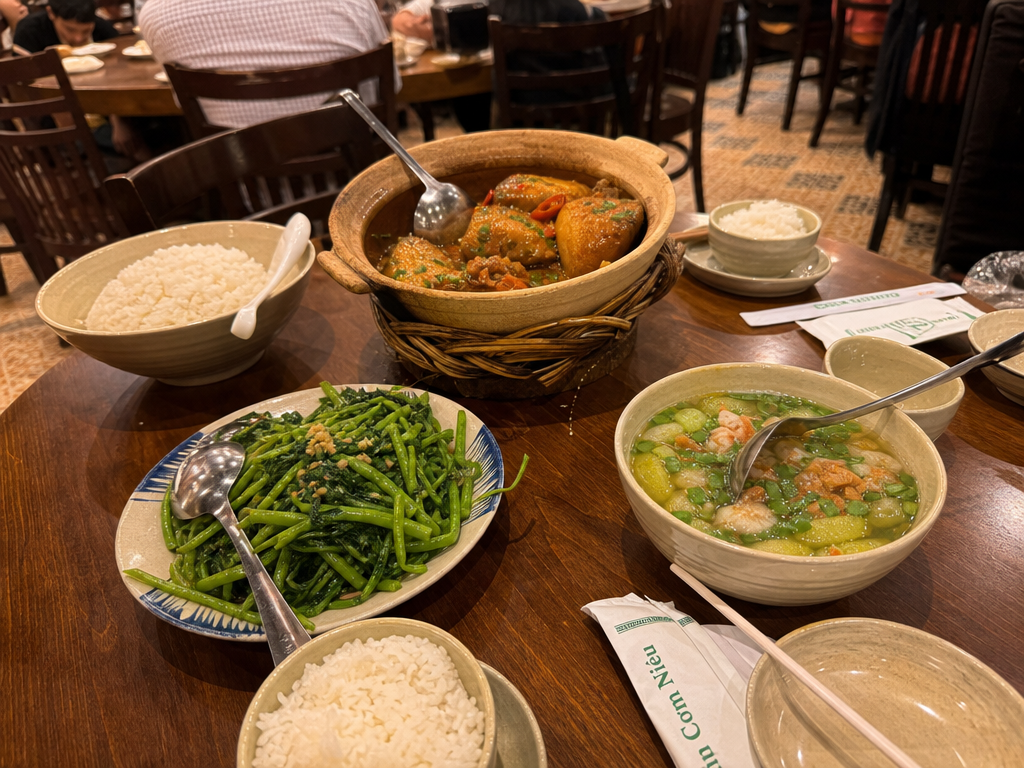
Vietnamese dining etiquette shifts once a group orders together: dishes are shared across the table rather than plated one per person, which is the format most Vietnamese eateries default to once a table has three or more people.
Pass:
- Ordering a spread rather than one dish each: a soup, a stir-fried vegetable, a meat or fish dish, rice, and something fried, scaled to the group. Ordering only for yourself is unusual and can look like you don’t want to share.
- Serving others before serving yourself, especially older guests or a host. Use the serving spoon provided for shared plates, not your own chopsticks.
- Taking modest portions on the first pass and going back for more, rather than piling your plate high before others have had any.
Fail:
- Using your personal chopsticks to take food from a shared plate when a serving spoon is sitting right there.
- Ordering elaborate special requests at a busy family-style spot during peak hours (11:30 a.m.–1 p.m., 6–8 p.m.) — the kitchen is running a tight line and substitutions slow everyone down.
- Splitting the bill item by item at a shared table. In this format, the group usually pays as one bill, often split evenly or covered by whoever invited, not itemized per dish eaten.
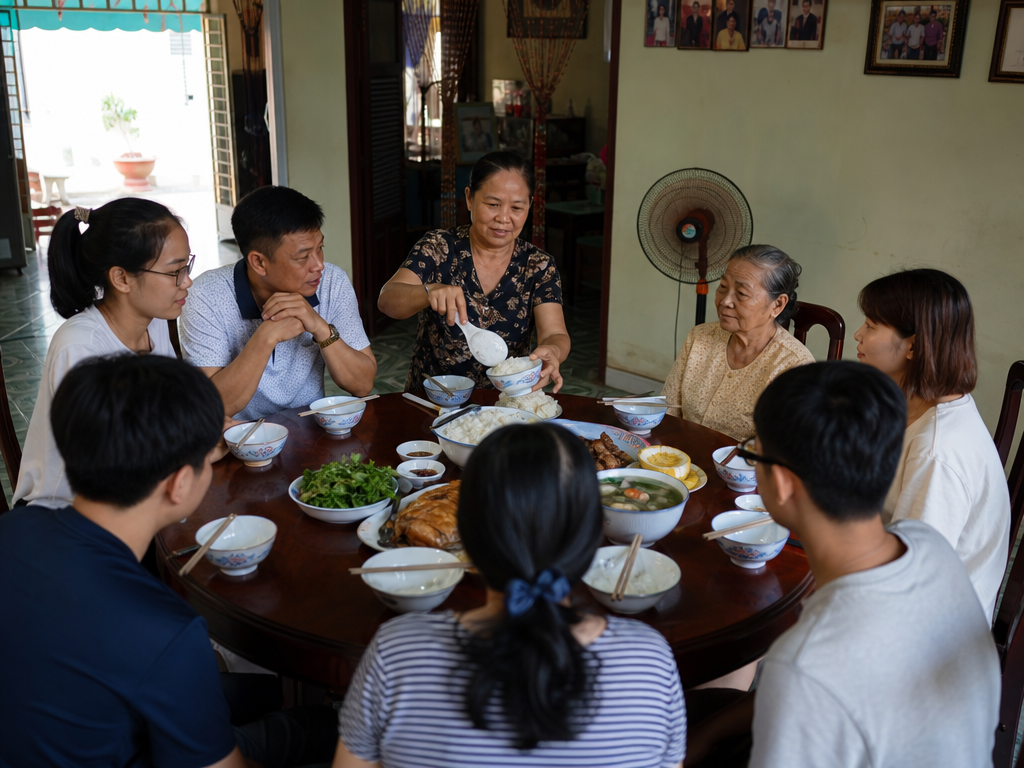
Setting 3: Eating in a Private Vietnamese Home
Home-meal Vietnamese dining etiquette carries the most rules of the four settings, mainly because it’s a family space, not a business transaction. Invitations are common if you spend time with local friends, tour guides, or homestay hosts, particularly outside big cities.
Pass:
- Bringing something when invited — fruit, pastries, or something for the kids. It doesn’t need to be expensive; showing up empty-handed is what gets noticed.
- Waiting for the oldest person to start eating, or at least lift their chopsticks or say “mời” (an invitation to eat), before you dig in.
- Trying a small amount of everything offered, especially if the host made it specifically. Refusing outright can read as rejecting the effort.
- Complimenting the food specifically — naming the dish — rather than a generic “good.”
- Offering to help clear plates at the end, even if the offer is declined.
Fail:
- Starting to eat before the eldest person or host has picked up their utensils.
- Flipping a whole fish over on a shared platter. In fishing communities especially, this carries a superstitious association with a boat capsizing; ask someone to turn it, or take from the top side only.
- Leaving immediately after the meal ends. Ten to fifteen minutes of sitting and talking afterward is the norm.
- Commenting that a dish is unfamiliar in a way that sounds like criticism rather than curiosity.
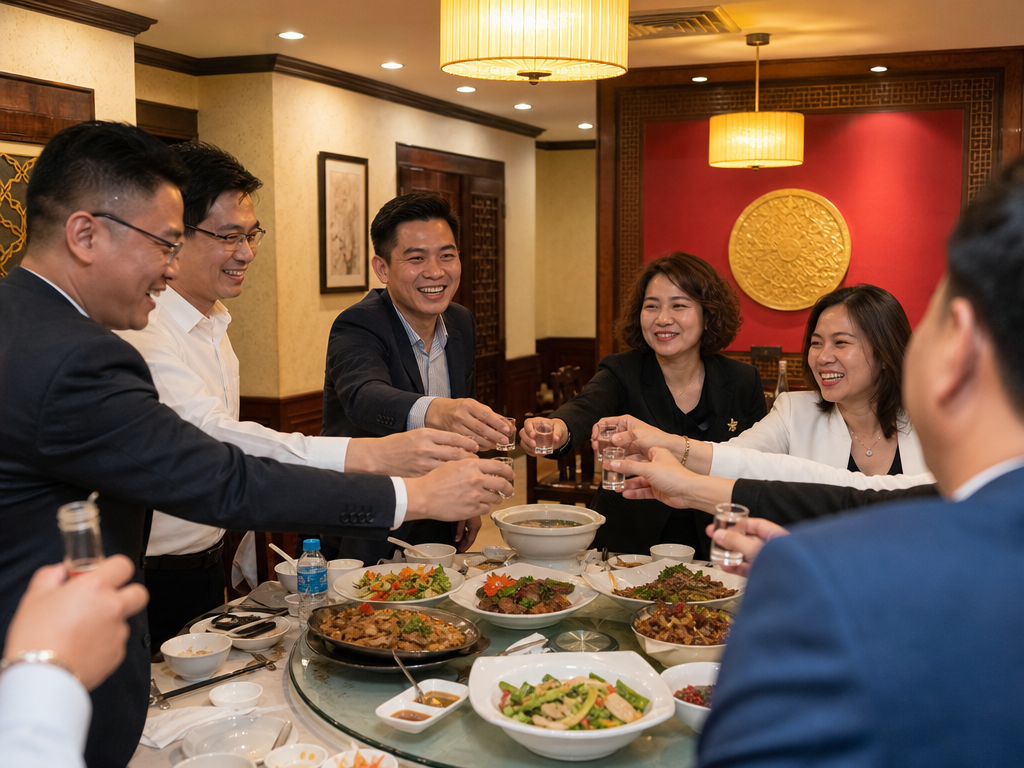
Setting 4: Formal Meals and Business Banquets
Formal Vietnamese dining etiquette covers set-menu dinners in private rooms, meals with a business context, or multi-course meals where seating and toasting are structured — the setting where getting the order of operations wrong is most visible.
Pass:
- Waiting to be shown to a seat rather than picking one. The most senior guest is typically seated facing the door or at the head of the table.
- Standing slightly and using two hands, or your right hand supported by your left at the wrist, when clinking glasses with someone senior — a small gesture noticed even by guests who don’t speak the language.
- Joining group toasts. “Một, hai, ba, dzô!” (“one, two, three, cheers!”) repeats through the meal; nursing one drink through several rounds is fine, but declining every round can look standoffish.
- Letting the host order, or ordering last if asked to choose.
- Thanking the host directly at the end, by name if you know it.
Fail:
- Reaching for your phone at the table during a toast or a formal course. It reads as disengaged in a setting built around the group.
- Leaving before the host signals the meal is over, even if you personally are done eating.
- Refusing every toast outright. A polite way to slow down is to touch the glass to your lips without draining it, rather than declining outright each time.
- Discussing the bill when a host has clearly organized and is covering the meal. Reciprocating with an invitation later is the expected move.
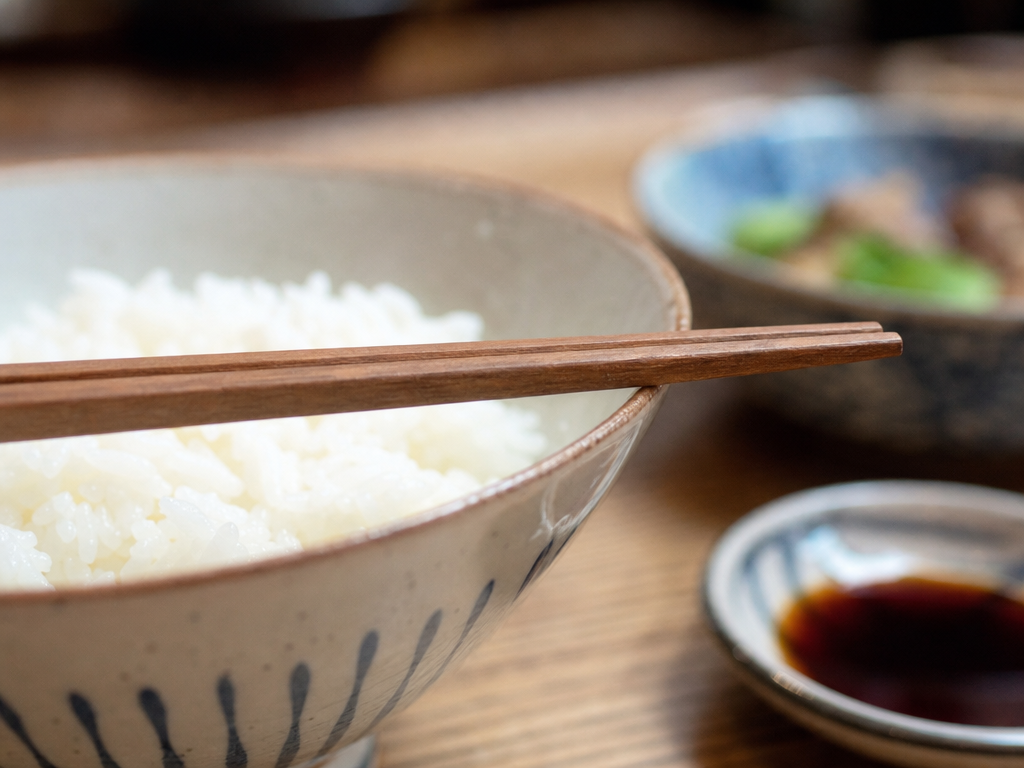
Universal Rules: Chopsticks
These apply in every setting above, from a street stall to a banquet, and are the fastest way to signal you know Vietnamese dining etiquette at the table. Chopsticks carry specific customs across East and Southeast Asia, and the Vietnamese versions below are the ones that come up most often.
Pass:
- Resting your chopsticks across the top of your bowl, or on a chopstick rest if one’s provided, when you pause.
- Using the opposite (thicker) end of your chopsticks to take food from a shared plate, if no serving utensil is provided — this keeps the end that touches your mouth away from communal food.
- Holding your rice bowl close to your mouth with one hand while eating with the other, especially for rice or noodle soups. This isn’t sloppy; it’s standard.
Fail:
- Sticking chopsticks upright in a bowl of rice. This visually echoes incense sticks placed for the dead and is one of the few rules in Vietnamese dining etiquette considered genuinely bad luck, not just impolite.
- Tapping chopsticks against a bowl like drumsticks — associated with beggars signaling for food in older custom, and read as rude regardless of the origin story.
- Passing food chopstick-to-chopstick directly into someone else’s chopsticks, again for the same funeral-association reason as the upright rice bowl.
- Pointing at people with chopsticks while talking.
Universal Rules: Paying and Tipping
Payment customs are covered in more depth in the money and payment guide, but the part of Vietnamese dining etiquette around who pays and whether to tip is worth isolating here.
Pass:
- Assuming cash is the default outside of city-center restaurants, and carrying enough small denominations (VND 10,000–100,000 notes) for a street meal.
- Leaving 5–10% at a mid-range restaurant with table service if a service charge isn’t already added to the bill — check the printed total first, since many restaurants in tourist areas already add 5% service and sometimes 10% VAT on top.
- Letting whoever extended the invitation pay, and offering to cover the next meal rather than splitting that one down the middle.
- Rounding up rather than asking for small change back at a street stall, if the difference is a matter of a few thousand dong (well under $1).
Fail:
- Expecting a tip jar or tip line on a printed bill at a street stall — it doesn’t exist, and street food pricing already reflects the full cost.
- Assuming a large tip is required everywhere. Tipping in Vietnam is appreciated, not obligatory, and locals rarely tip each other outside high-end hotel and tour settings.
- Insisting on splitting a bill exactly by what each person ordered at a shared, family-style table. This format assumes group pooling, not itemized splitting.
- Trying to pay with a large note (VND 500,000) for a VND 30,000–50,000 street meal and expecting exact change instantly.
FAQ: Vietnamese Dining Etiquette Questions
Do Vietnamese restaurants automatically add a service charge? Some do, mainly in cities and at restaurants aimed at tourists or business diners; smaller family-run and street-level places usually don’t. Check the printed bill for a line marked “phí dịch vụ” (service fee) before adding a tip on top.
Is it rude to ask for a fork instead of chopsticks? No. Most restaurants that see foreign visitors keep forks and spoons on hand and will bring them without comment. It’s a practical request, not an etiquette breach.
What do you say before eating with a Vietnamese family? “Mời cô/chú/anh/chị ăn” (roughly, “please eat” addressed to the specific person by their age and gender relative to you) is the polite phrase used before a meal starts, though a simple nod and following the host’s lead works fine for a visitor who doesn’t speak Vietnamese.
Is it okay to eat street food standing up if there are no seats left? It happens, especially at very popular stalls during peak hours, but it’s the exception. Most vendors expect you to wait for a stool to free up rather than eat standing, and vendors with only a few stools will usually clear one quickly for a paying customer.
Do you need to finish everything on your plate? At a family meal in someone’s home, leaving a small amount is traditionally read as a sign there was enough food, not as waste — the opposite of etiquette in some other cultures. Cleaning your plate completely can prompt a host to serve you more, on the assumption you’re still hungry.