

Vietnamese eateries do not work like restaurants in the flexible sense most visitors expect. Each kind of place is built around one job — breakfast, a working lunch, shellfish and beer, a two-hour dinner with friends — with its own menu logic, price band and operating window. Walk into the wrong one at the wrong hour and you will be told, politely, that the kitchen is finished.
This guide sorts Vietnamese eateries by type rather than by city. For each: how the place works, what to order, what it should cost, and the signals that say keep walking. Prices are in Vietnamese đồng with a dollar approximation at roughly 26,000 VND to the US dollar — check the day’s rate before relying on the conversions.
How Vietnamese Eateries Are Named
The word on the signboard tells you the price band before you sit down.
- Quán — a modest shop or stall, the default for street-level eating. Plastic stools, one or two dishes done well.
- Tiệm — a small shop, used mostly for bakeries, bánh mì counters and coffee.
- Nhà hàng — a proper restaurant with table service, air conditioning and printed menus. Two to four times the quán price for the same dish.
- Hàng rong — mobile vending: a bicycle, a shoulder pole, a pushcart. No fixed address, no fixed hours.
A second word names the specialty: quán phở, quán ốc, quán nhậu, quán chè. That pairing is the most reliable menu preview you will get, because most of these places sell one thing and refuse everything else.
The Quick Matrix
Vietnamese eateries sort neatly by time of day, which is the fastest way to decide where to go.
| Type of place | Best for | Typical hours | Spend per person |
|---|---|---|---|
| Quán cơm bình dân | Weekday lunch | 10:00–14:00 | 35,000–60,000 VND (~$1.35–2.30) |
| Single-dish specialist | Breakfast, early dinner | 06:00–10:00, 17:00–20:00 | 40,000–80,000 VND (~$1.55–3.10) |
| Pavement cart | Fast snack, takeaway | 05:00–10:00, 17:00–23:00 | 20,000–45,000 VND (~$0.80–1.75) |
| Quán ốc | Late shellfish and beer | 16:00–23:00 | 150,000–300,000 VND (~$5.75–11.50) |
| Quán nhậu | Long group dinner | 17:00–24:00 | 200,000–400,000 VND (~$7.70–15.40) |
| Lẩu restaurant | Groups of three or more | 17:00–23:00 | 150,000–300,000 VND (~$5.75–11.50) |
| Quán chè | Dessert, afternoon heat | 09:00–22:00 | 15,000–40,000 VND (~$0.60–1.55) |
| Market food court | Grazing, variety | 06:00–15:00 | 25,000–60,000 VND (~$0.95–2.30) |
Quán Cơm Bình Dân: The Everyday Rice Shop
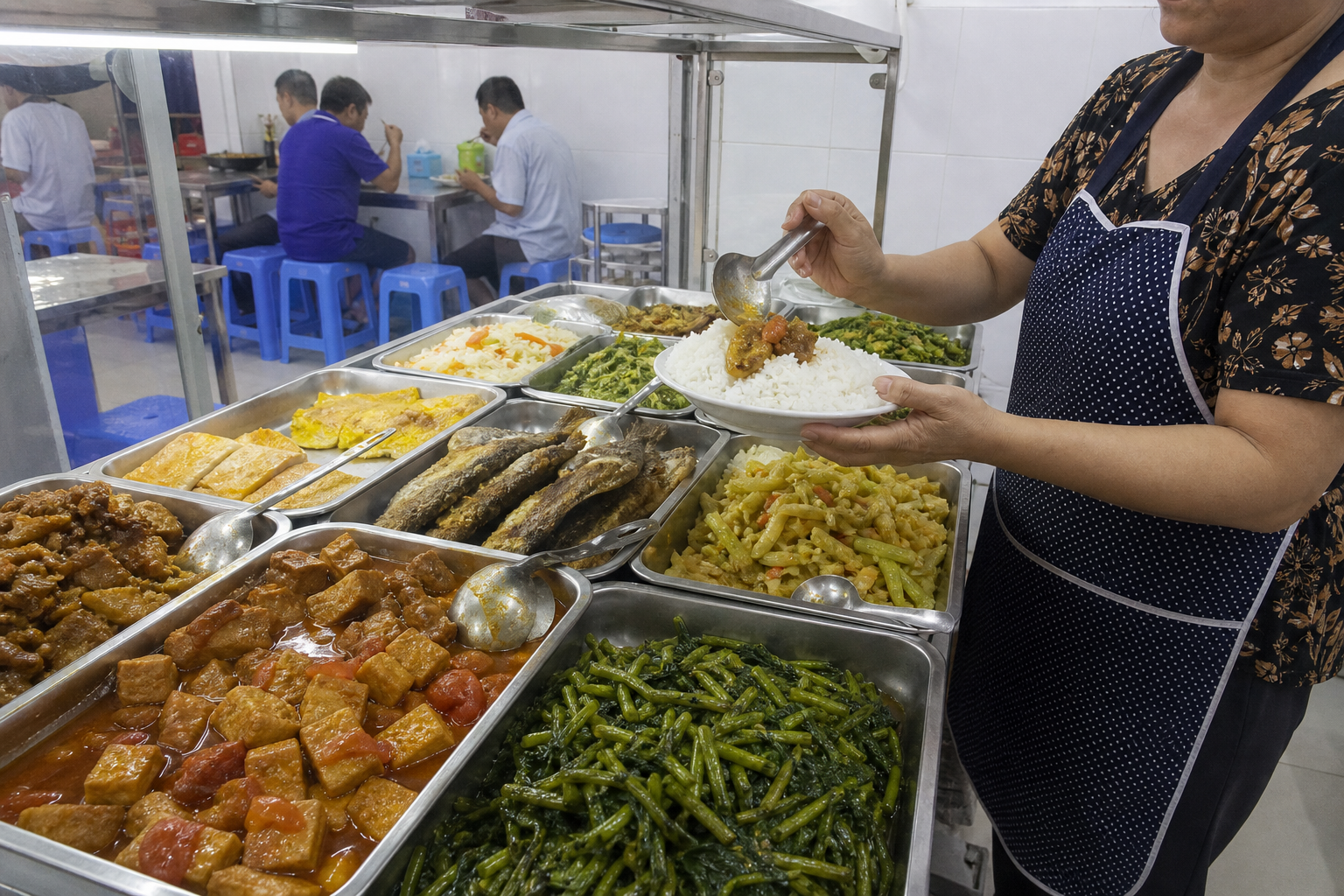
How it works. Everything is pre-cooked and displayed in trays behind glass. You take a plate, point at three or four dishes, and they are spooned over rice. A thin broth with greens arrives free. You pay at the end, and the total depends on what you picked.
What to order. One protein, one vegetable, one egg or tofu dish. Braised pork belly with eggs (thịt kho trứng), fried fish in tomato, stir-fried water spinach with garlic and an omelette is the standard set. Ask for cơm thêm for more rice; it is usually free or a few thousand đồng.
Typical spend. 35,000–60,000 VND (~$1.35–2.30). A whole fish or a large grilled cut pushes it toward 80,000 VND. These are among the cheapest sit-down Vietnamese eateries in the country.
Walk past if. The trays are half-empty at 13:30 and nothing is being refilled. These shops are designed to sell out by early afternoon. Arrive between 11:00 and 12:00 for the best of it.
The Single-Dish Specialist
The backbone of the whole system: a shop that makes one dish, opens for one or two service windows, and closes when the pot is empty. Phở, bún chả, bún bò huế, cơm tấm, mì quảng and bánh cuốn each have dedicated shops.
How it works. You are asked which size or which cut, not which dish. For phở that means tái (rare beef), chín (well-done brisket), or tái nạm for both. For cơm tấm it means which combination of grilled pork chop, shredded pork skin, steamed egg cake and fried egg goes on the rice.
What to order. The dish on the sign, in its standard form, the first time. Variations exist, but the kitchen is optimised for the default. Herbs, chilli, lime and pickled garlic on the table are free — use them.
Typical spend. 40,000–70,000 VND (~$1.55–2.70) in a residential neighbourhood; 70,000–110,000 VND for the same bowl in Hanoi’s Old Quarter or District 1 in Ho Chi Minh City.
Walk past if. One laminated menu advertises phở, bún chả, fried rice and pizza. Vietnamese eateries that specialise do not diversify; nine pages in four languages means a microwave.
Pavement Carts and Baskets
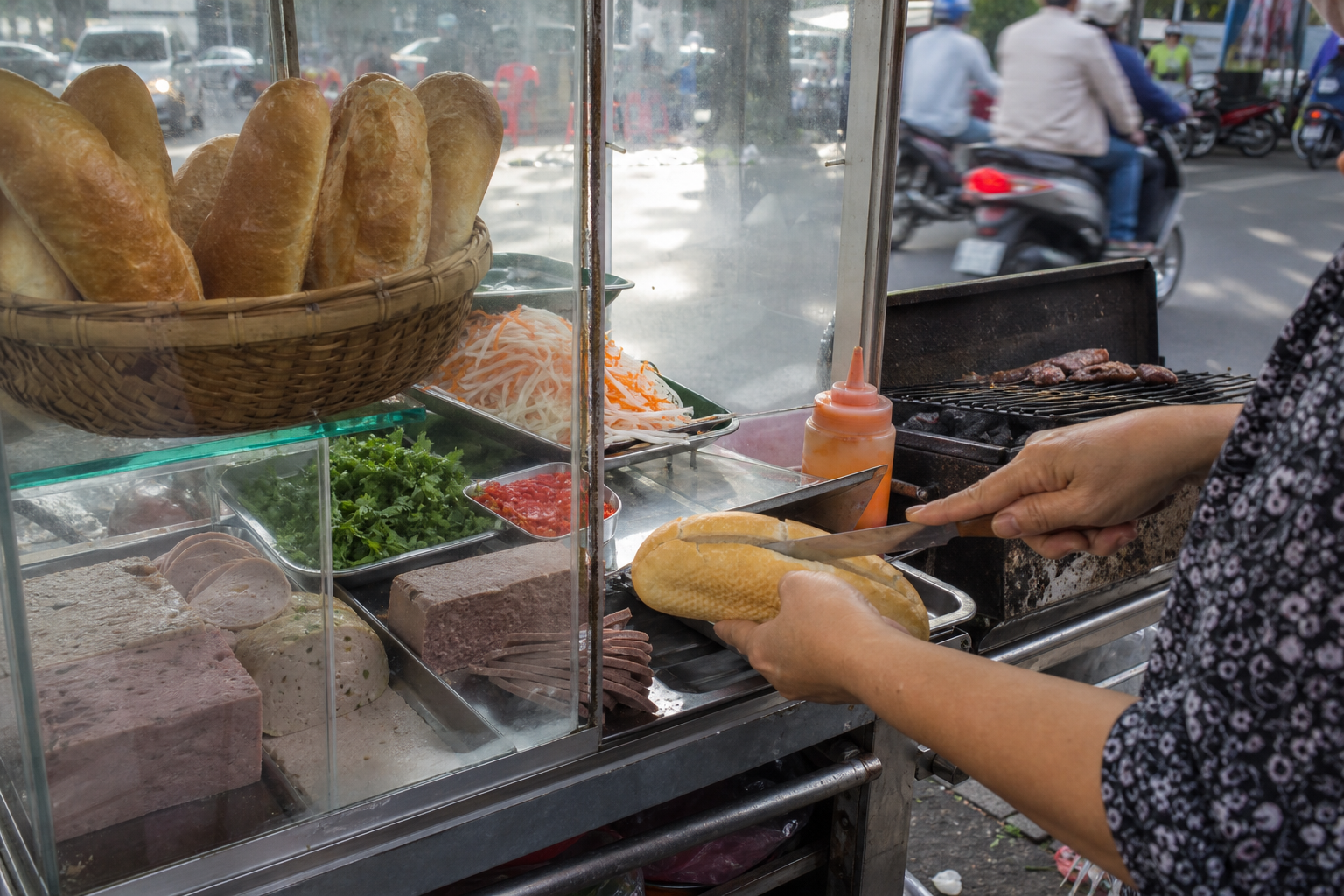
How it works. A glass-sided cart or a bicycle rack, no seating, and a queue that forms and dissolves in minutes. Carts are hyper-local: same corner, same hours, most days of the week. Morning carts sell bánh mì, xôi (sticky rice) and bánh giò. Evening carts sell grilled corn, bánh tráng nướng and skewers.
What to order. At a bánh mì cart the default build is pâté, cold cuts, cucumber, coriander, pickled carrot and daikon, chilli sauce and a spoon of meat juices. Say ít cay for less chilli, không rau mùi to skip the coriander. The bánh mì guide covers what changes between north and south.
Typical spend. 20,000–45,000 VND (~$0.80–1.75) for a filled baguette; 15,000–30,000 VND for a portion of xôi.
Walk past if. There is no queue during the peak window. Carts turn stock over fast, and a slow one is holding fillings longer than it should. Carry small notes — most carts cannot break a 500,000 VND bill, one of several reasons the cash and card situation is worth sorting out early.
Quán Ốc: Shellfish, Ordered by the Plate
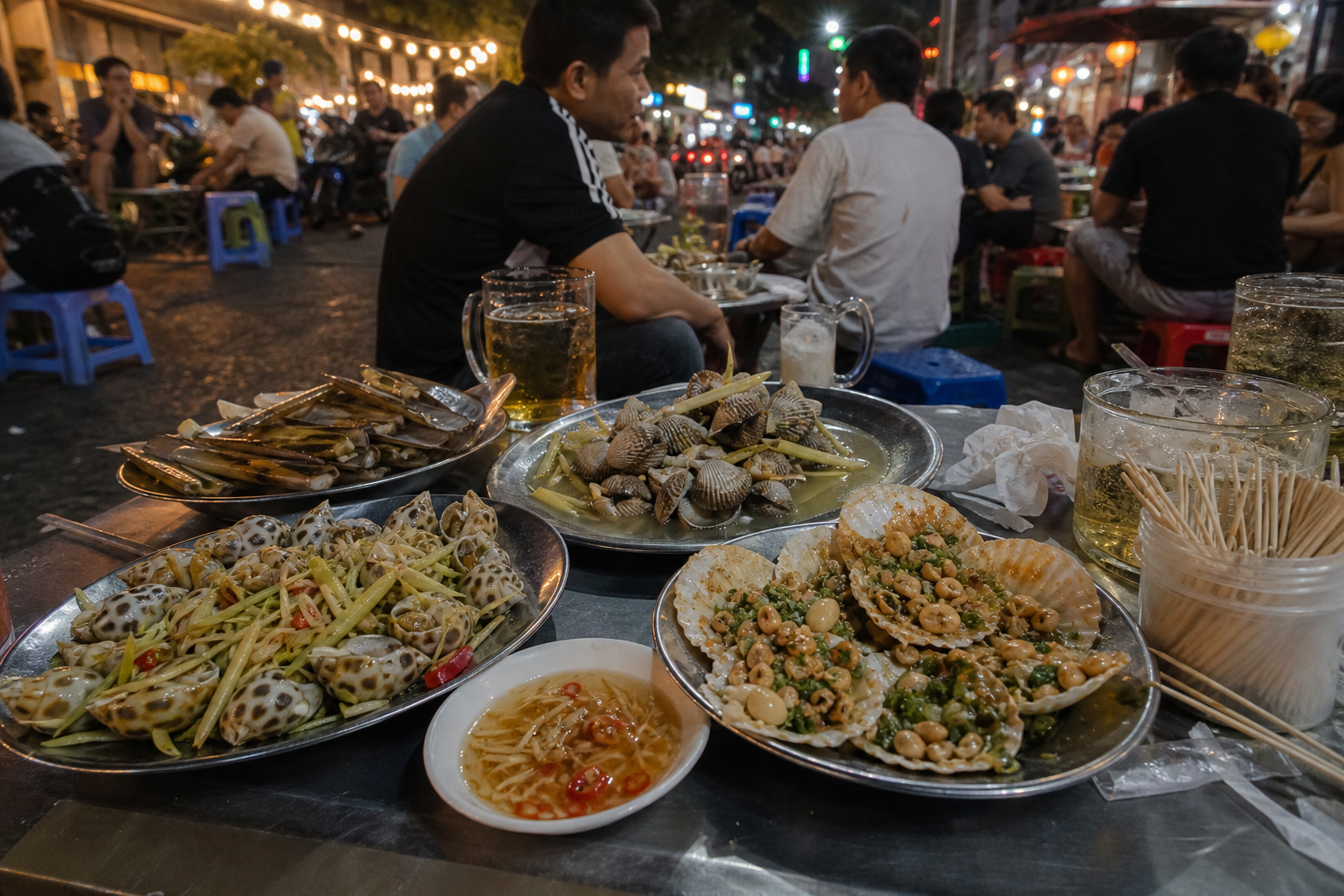
How it works. Ốc shops open in the late afternoon and run into the night. The menu lists species — sea snails, clams, scallops, mantis shrimp — against cooking methods: steamed with lemongrass (hấp sả), grilled with spring onion oil (nướng mỡ hành), stir-fried with tamarind (xào me) or butter and garlic (xào bơ tỏi). You order small plates in rounds.
What to order. Three or four plates for two people, mixing methods. Grilled scallops with peanuts, clams steamed in lemongrass broth and one tamarind-fried snail dish is a reliable spread. Each plate comes with fish sauce, ginger, chilli and lime.
Typical spend. Plates run 45,000–120,000 VND (~$1.75–4.60) depending on species, with mantis shrimp and scallops at the top. Expect 150,000–300,000 VND per person with a couple of beers.
Walk past if. Prices are quoted per kilo with no visible scale. Asking the price of each plate before it is cooked is normal here, not rude.
Quán Nhậu: Food Built Around Drinking
How it works. Nhậu means drinking with food, and these Vietnamese eateries exist to make a case of beer last three hours. Dishes are salty, sour and shareable, and arrive whenever the kitchen finishes them rather than in courses. Tables are loud; that is the point.
What to order. Beef grilled in lá lốt leaves (bò lá lốt), fried spring rolls, salt-and-chilli squid, green mango salad with dried beef (nộm bò khô), and stir-fried morning glory to cut the salt. Beer is ordered by the crate; ask for đá if you want ice.
Typical spend. 200,000–400,000 VND (~$7.70–15.40) per person including drinks. Fresh beer (bia hơi) in Hanoi runs 8,000–15,000 VND a glass; bottled Saigon or Tiger is 20,000–30,000 VND.
Walk past if. You want a quiet meal or you are eating alone. Portions are sized for four and rarely scale down.
Lẩu: Hot Pot at Your Own Table
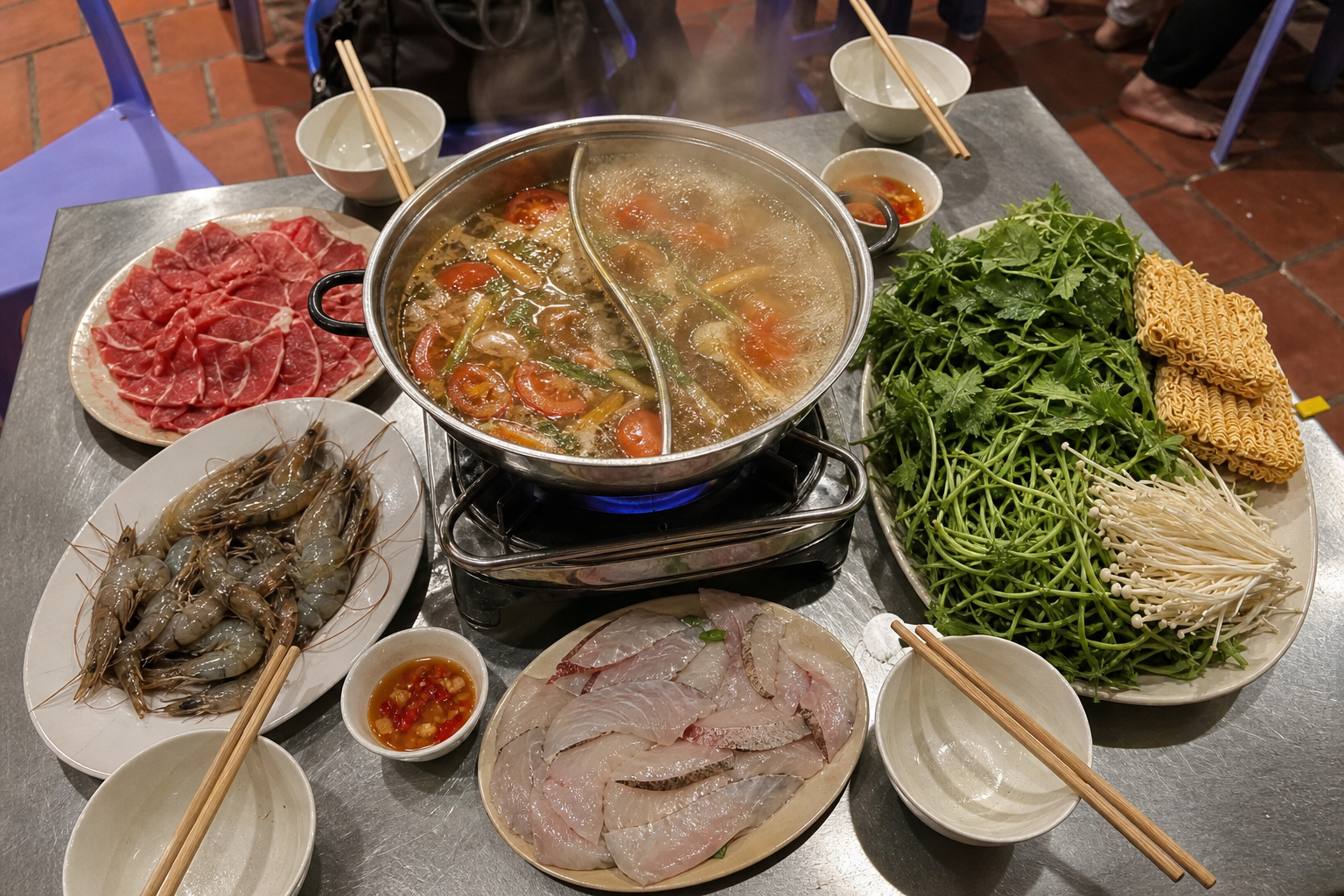
How it works. A gas burner and a pot of broth go in the middle of the table; raw ingredients arrive on platters and you cook them yourself. Broths are ordered by type — sour tomato and pineapple (lẩu thái), fish and dill (lẩu cá), mushroom (lẩu nấm), goat with fermented tofu (lẩu dê). Vietnamese hot pot leans far harder on fresh herbs and leafy greens than its Chinese or Korean relatives.
What to order. One broth, one or two proteins, the standard vegetable platter, and noodles at the end to finish the pot. Cook seafood first while the broth is clean, greens last.
Typical spend. A pot set for two or three runs 250,000–450,000 VND (~$9.60–17.30) total, plus 40,000–70,000 VND per extra protein platter.
Walk past if. There are fewer than three of you. A single pot is more food and more sitting than two people can work through, and most kitchens will not make a half portion.
Quán Chè: The Dessert Counter
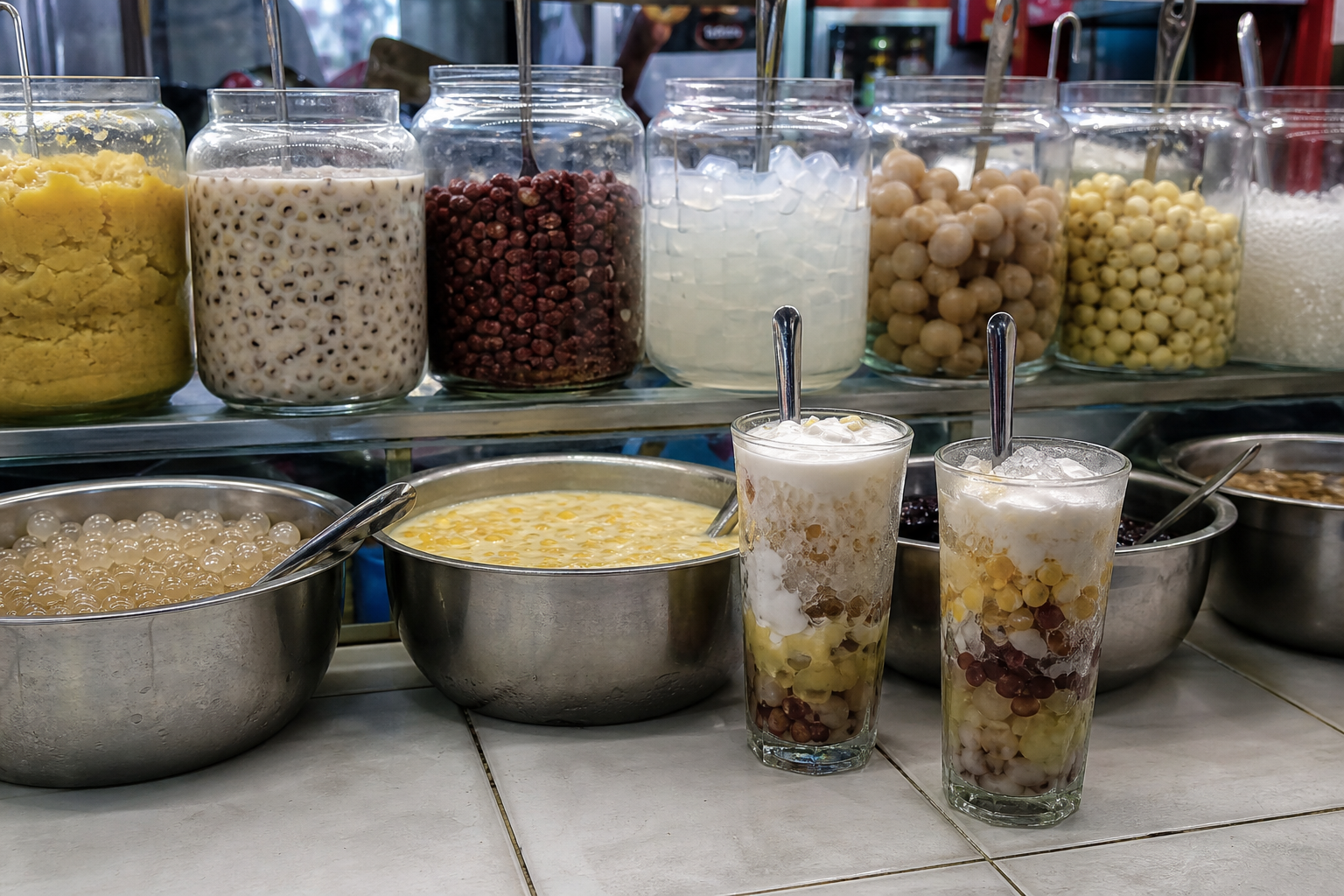
How it works. Chè covers dozens of sweet soups, puddings and layered iced desserts. The components sit in jars and basins on the counter; you either name a standard combination or point at four or five things and have them layered into a glass with crushed ice and coconut cream.
What to order. Chè ba màu — three-colour, with mung bean, red bean and pandan jelly — is the entry point. Chè chuối is banana in warm coconut cream. Chè khúc bạch is almond panna cotta with lychee. In Hue, chè hạt sen (lotus seed) is the local marker.
Typical spend. 15,000–40,000 VND (~$0.60–1.55) a glass. Sit-in shops charge at the top of that range; takeaway bags are cheaper.
Walk past if. Nothing here is a dealbreaker — chè shops are among the lowest-risk Vietnamese eateries, since almost nothing is cooked to order and turnover is high.
Coffee: Kiosk Versus Sit-Down
How it works. Two different businesses share one product. A pavement kiosk sells cà phê sữa đá in a plastic cup in under a minute. A sit-down café sells you a seat for two hours, and the coffee is close to incidental.
What to order. At a kiosk: cà phê sữa đá, or bạc xỉu if you want it milkier. At a café: the same, or a phin brewed at the table if you have twenty minutes. The coffee ordering guide maps the full set against strength and sweetness.
Typical spend. 15,000–30,000 VND (~$0.60–1.15) at a kiosk; 40,000–75,000 VND at an air-conditioned café.
Walk past if. You need Wi-Fi and a table. Kiosks have neither.
Market Food Courts
How it works. Wet markets carry a food section, usually along one aisle or upstairs, with eight to twenty stalls each selling one or two dishes. You sit at a communal bench and order from the stall you face, though most let you order across stalls.
What to order. Whatever is regional. Bún riêu and bánh cuốn in northern markets; bún mắm, bánh xèo and hủ tiếu in the Mekong Delta; bún bò and bánh bèo in Hue. Market stalls are where the narrower regional dishes of Vietnamese cuisine survive that never reach restaurant menus.
Typical spend. 25,000–60,000 VND (~$0.95–2.30) per dish.
Walk past if. It is past 15:00. Market kitchens run on the morning’s produce and wind down early.
A Five-Point Check Before You Sit Down
Most Vietnamese eateries can be judged from the pavement in about ten seconds.
- One dish or many? A short specialised menu beats a long one, almost without exception.
- Is stock moving? Visible turnover beats a full display that nobody is touching.
- Who is eating there? A room of people on their lunch break at 11:45 outranks any review score.
- Are prices posted? A printed board removes the whole question of what you will be charged.
- Is it the right hour? Much of the disappointment visitors report comes from reaching a breakfast shop at 15:00 and being served the last of the pot.
FAQ
Do you need to book a table? Rarely. Nhà hàng and busy lẩu restaurants take weekend reservations, but quán-level Vietnamese eateries run first-come, first-served and turn tables fast.
Is tipping expected? No. Rounding up at a nhà hàng or leaving small change at a quán is fine but not required, and no service charge is added at street level.
Are menus in English? In District 1, the Hanoi Old Quarter and central Hoi An, usually yes. Elsewhere, expect Vietnamese only or a hand-painted board. Translating the sign on your phone works; so does pointing at what the next table has.
Can vegetarians eat at these places? Look for quán chay — dedicated vegetarian shops, often near pagodas, busiest on the first and fifteenth days of the lunar month. At a general quán, most broths and dipping sauces contain fish sauce or pork stock.