

Ho Chi Minh City covers more than 2,000 square kilometers and 24 districts, and no single itinerary fits all of them. The city works less like one destination and more like a cluster of different small cities pushed together — a colonial-era business core, a Chinese quarter that predates the city’s current name, a leafy expat enclave, a backpacker strip, and a grid of quiet residential streets that hold some of the best coffee in southern Vietnam.
Picking the right neighborhood for the right purpose saves more time than any packing list or transport hack. This guide breaks Ho Chi Minh City down block by block: what each area is actually for, what it costs to get there, what to eat, and who should skip it. Distances and travel times below are measured from the Bến Thành Market roundabout in District 1, the city’s most common reference point.
Each section covers the same five things: what the area is known for, how to get there and what that costs, specific things to do, what to eat, and who the area suits. Read the “skip if” line before booking a hotel — the wrong base neighborhood is the most common regret first-time visitors report.
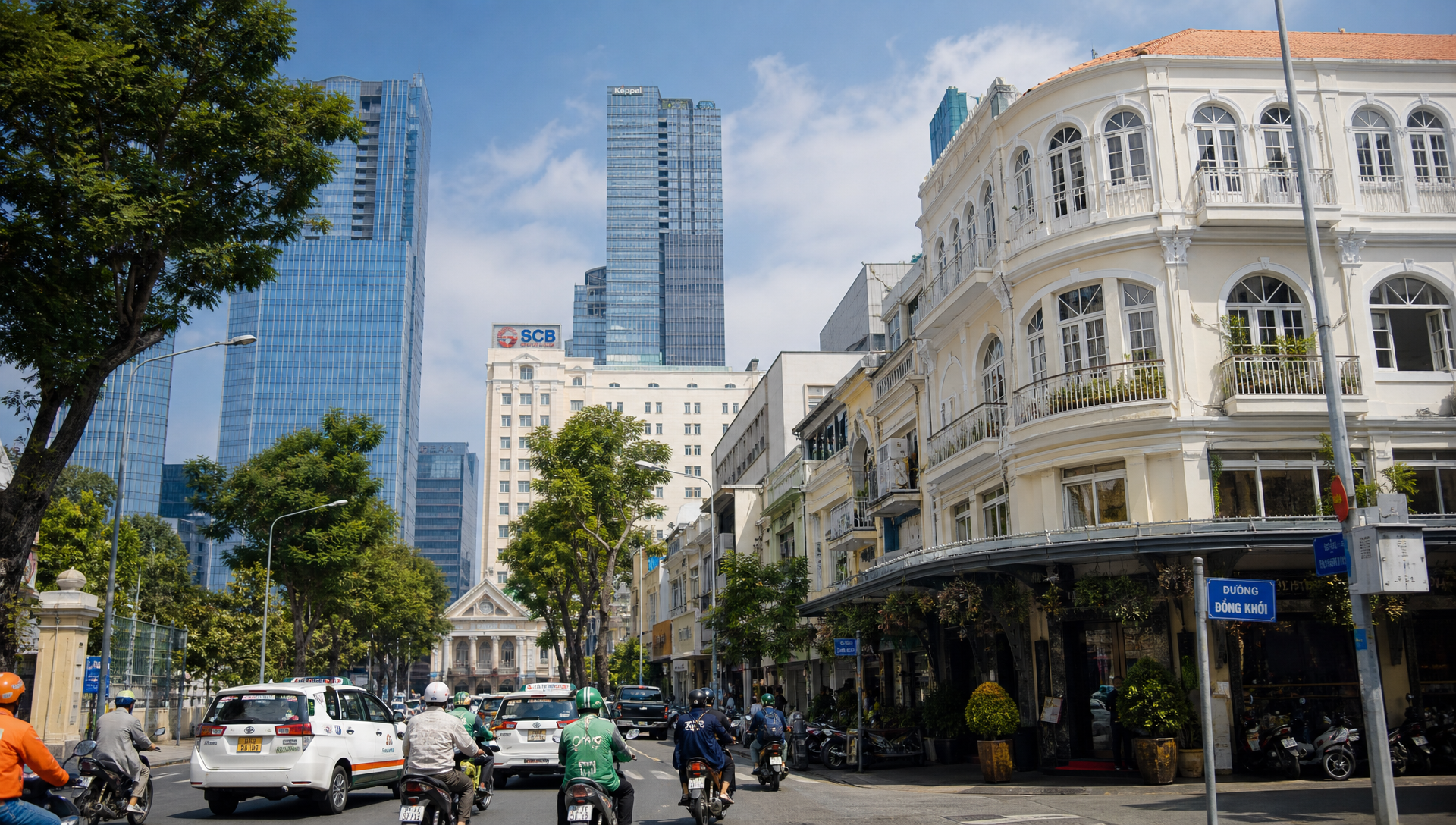
District 1: The Historic and Commercial Core
District 1 is where most visitors land and, for a first two or three nights, where most should stay. It holds the bulk of the colonial-era landmarks — the Notre-Dame Cathedral Basilica, the Central Post Office, the Reunification Palace, and the Municipal Theatre — inside a compact grid that is genuinely walkable, unlike most of the rest of the city.
Getting there: Tan Son Nhat Airport to District 1 is 7-8 km, 25-45 minutes depending on traffic. A metered taxi from the airport stand runs 180,000-220,000 VND (USD 7-9); Grab quotes 120,000-180,000 VND (USD 5-7), cheaper since it skips the airport surcharge.
What to do:
- Walk Dong Khoi Street from the Notre-Dame Cathedral to the Saigon River, past the densest stretch of colonial buildings, boutiques, and rooftop bars in the city.
- Ben Thanh Market (built 1914) for souvenirs, tailoring, and a food court where noodle soup runs 40,000-60,000 VND (USD 1.60-2.40); bargain on non-food goods, typically 30-50% off the first price.
- The War Remnants Museum (7:30am-6pm daily, entry 40,000 VND / USD 1.60) for a serious counterpoint to the market-and-rooftop city.
- A rooftop bar along Dong Khoi or Nguyen Hue for a skyline view without Bitexco Sky Deck’s entry fee, provided you order a drink.
What to eat: Cơm tấm — broken rice with grilled pork, a fried egg, and pickled vegetables — is sold everywhere here, from street carts to sit-down restaurants, typically 35,000-60,000 VND (USD 1.40-2.40).
Skip if: you want quiet. District 1 after dark is loud and bright, with traffic noise carrying into street-facing hotel rooms — ask for an interior room if that matters.
Cho Lon (District 5): Chinatown and the Old Market Trade
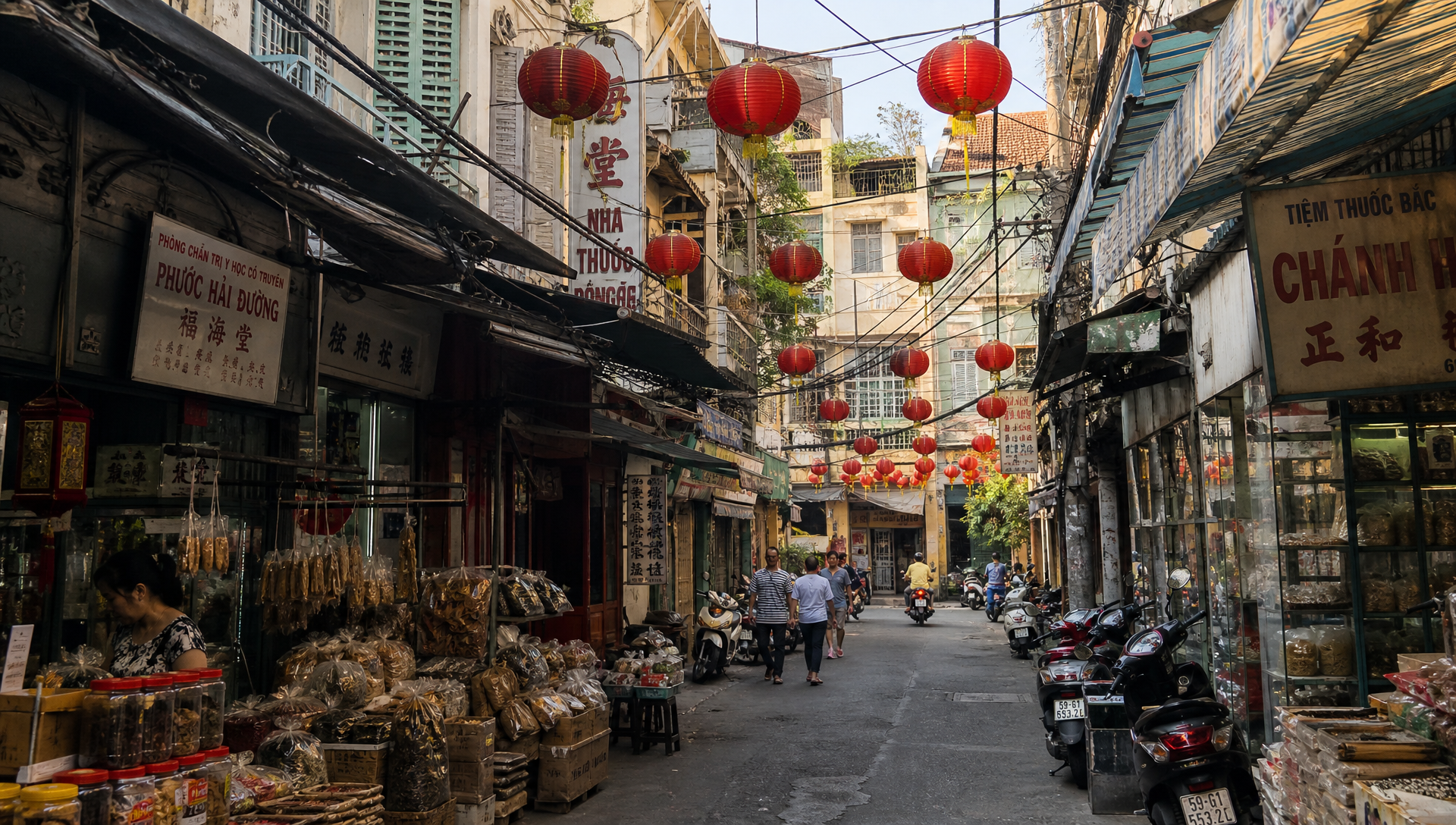
Cho Lon means “big market” in Vietnamese — literally true. It was a separate trading city, settled by Hoa (ethnic Chinese) migrants, before merging with Saigon in 1931, and still runs on a different rhythm. It spreads mainly across District 5, with pockets into Districts 6, 10, and 11.
Getting there: 4-6 km southwest of District 1, a 15-25 minute Grab ride for 40,000-70,000 VND (USD 1.60-2.80) outside peak hours. Traffic on Tran Hung Dao Street roughly doubles that between 5pm and 7pm.
What to do:
- Binh Tay Market, the district’s wholesale hub, built in the 1920s — it’s a working trade market, not a tourist stop, so go for atmosphere and small purchases.
- Thien Hau Pagoda, dedicated to the sea goddess Mazu and built in the early 1800s by the Cantonese community, one of the oldest active temples in the city.
- The narrow lanes around Hai Thuong Lan Ong Street, lined with herbal medicine shops selling dried goods by weight.
What to eat: Cho Lon is the place for Chinese-Vietnamese dishes harder to find elsewhere — roast duck rice, cart-served dim sum in old-school restaurants, and hủ tiếu Nam Vang, a Cambodian-influenced noodle soup, usually 40,000-55,000 VND (USD 1.60-2.20).
Skip if: time only allows one half-day outside District 1 — Cho Lon rewards a slow wander more than a checklist.
District 3: The Coffee and Residential Grid
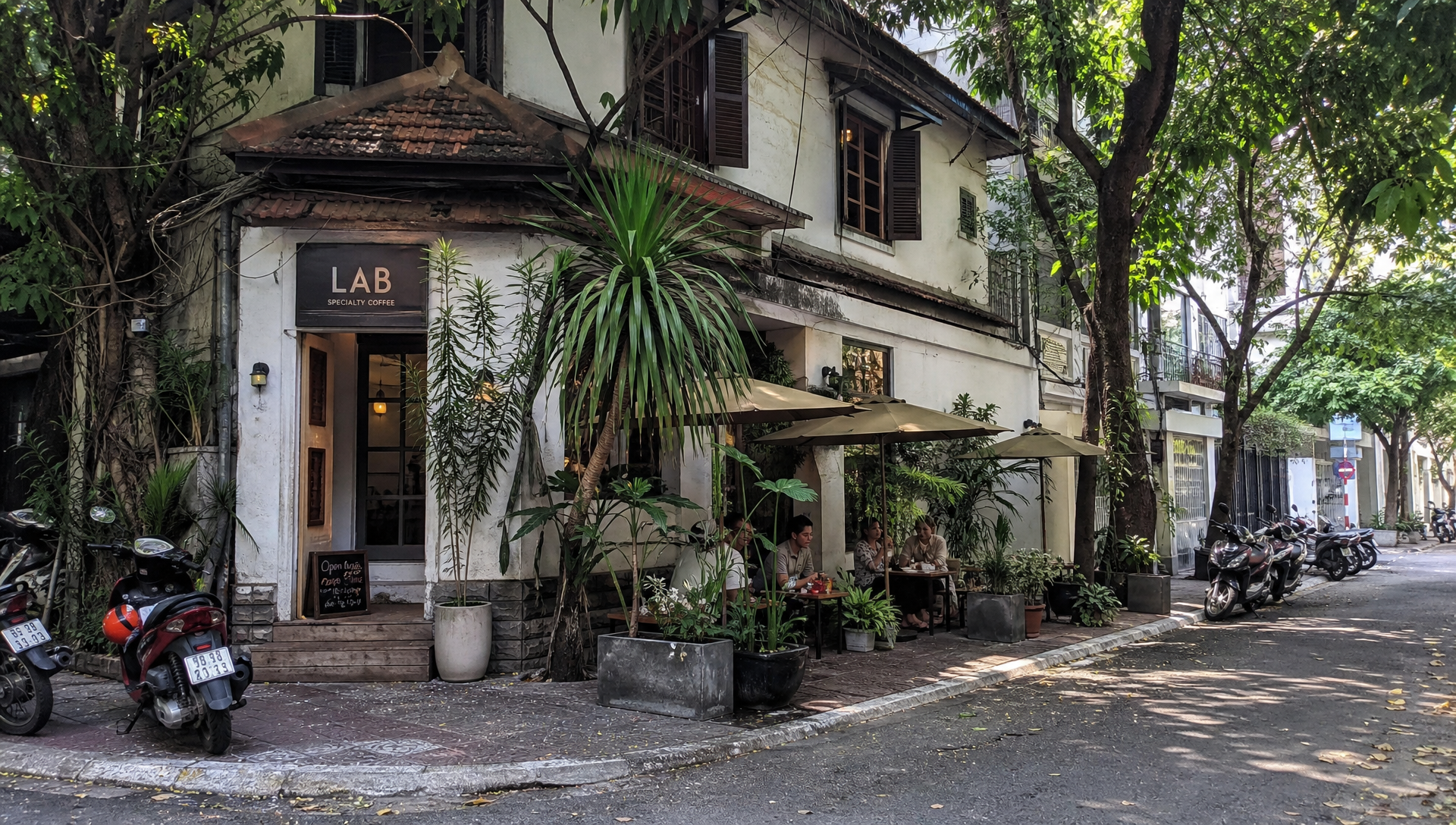
District 3 sits directly south of District 1 and gets skipped by a lot of short-stay itineraries, a mistake for anyone who cares about coffee. It’s mostly residential — quiet streets, low-rise French-period villas, and a disproportionate number of specialty cafés tucked into converted homes.
Getting there: 2-4 km from District 1, walkable for the northern edge or a 10-15 minute Grab ride for 25,000-40,000 VND (USD 1-1.60) for the southern half.
What to do:
- Café-hop through the villa conversions around Vo Van Tan and Tran Quoc Thao streets, sit-down spaces meant for lingering rather than quick takeaway.
- Turtle Lake (Ho Con Rua), a roundabout-turned-gathering spot that’s mostly a local evening hangout.
- Tan Dinh Church, a pink neo-Gothic church built in the 1870s, standing out against otherwise low-key streets.
What to eat: District 3 leans toward specialty coffee over iconic dishes — a Vietnamese-style egg coffee or pour-over runs 35,000-55,000 VND (USD 1.40-2.20), more than a street-stall cà phê sữa đá at 15,000-20,000 VND (USD 0.60-0.80), but in a quieter setting.
Skip if: landmark sightseeing is the goal — District 3 has few standout monuments and works better as a base near District 1’s action without its noise.
Thao Dien (District 2 / Thu Duc City): The Green, Expat-Heavy Side
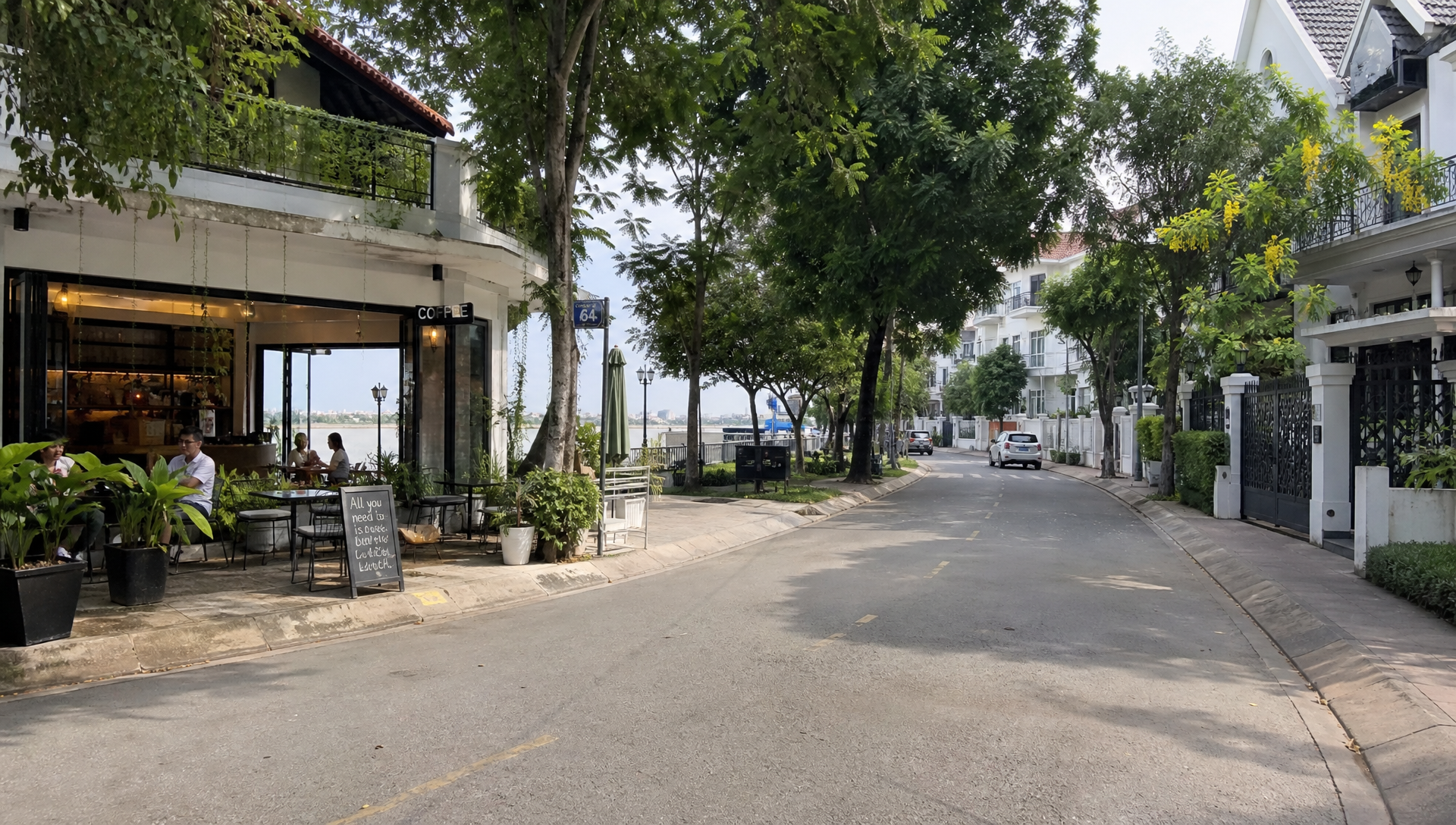
Thao Dien sits across the Saigon River from District 1, technically part of Thu Duc City since a 2020 administrative merger but still referred to locally by its old District 2 name. It reads differently from the rest of the city — wider streets, more greenery, villa compounds, and a concentration of Western-style cafés and international schools built up over the past two decades.
Getting there: 6-8 km from District 1 via the Saigon Bridge or Thu Thiem tunnel, 20-30 minutes by Grab for 60,000-90,000 VND (USD 2.40-3.60). No metro connection exists yet as of 2026, so a car or motorbike is the only option.
What to do:
- Walk the tree-lined streets around Nguyen Van Huong and Thao Dien Street, one of the few parts of the city where walking is genuinely pleasant.
- The Sunday farmers’ market at rotating Thao Dien venues, which draws a mixed expat and local crowd.
- Riverside path sections for a quieter view of the Saigon River, away from the District 1 embankment crowds.
What to eat: this is the district for Western brunch, specialty bakeries, and international cuisine over street-stall food — a full brunch runs 150,000-300,000 VND (USD 6-12), several times the District 1 price. For Vietnamese food, step one street back from the main expat strip.
Skip if: an immersive Vietnamese-city feel is the goal — Thao Dien is comfortable but the least “Vietnamese-feeling” district here, and suits long-term stays more than a short visit.
Bui Vien (Pham Ngu Lao Ward, District 1): The Backpacker Strip
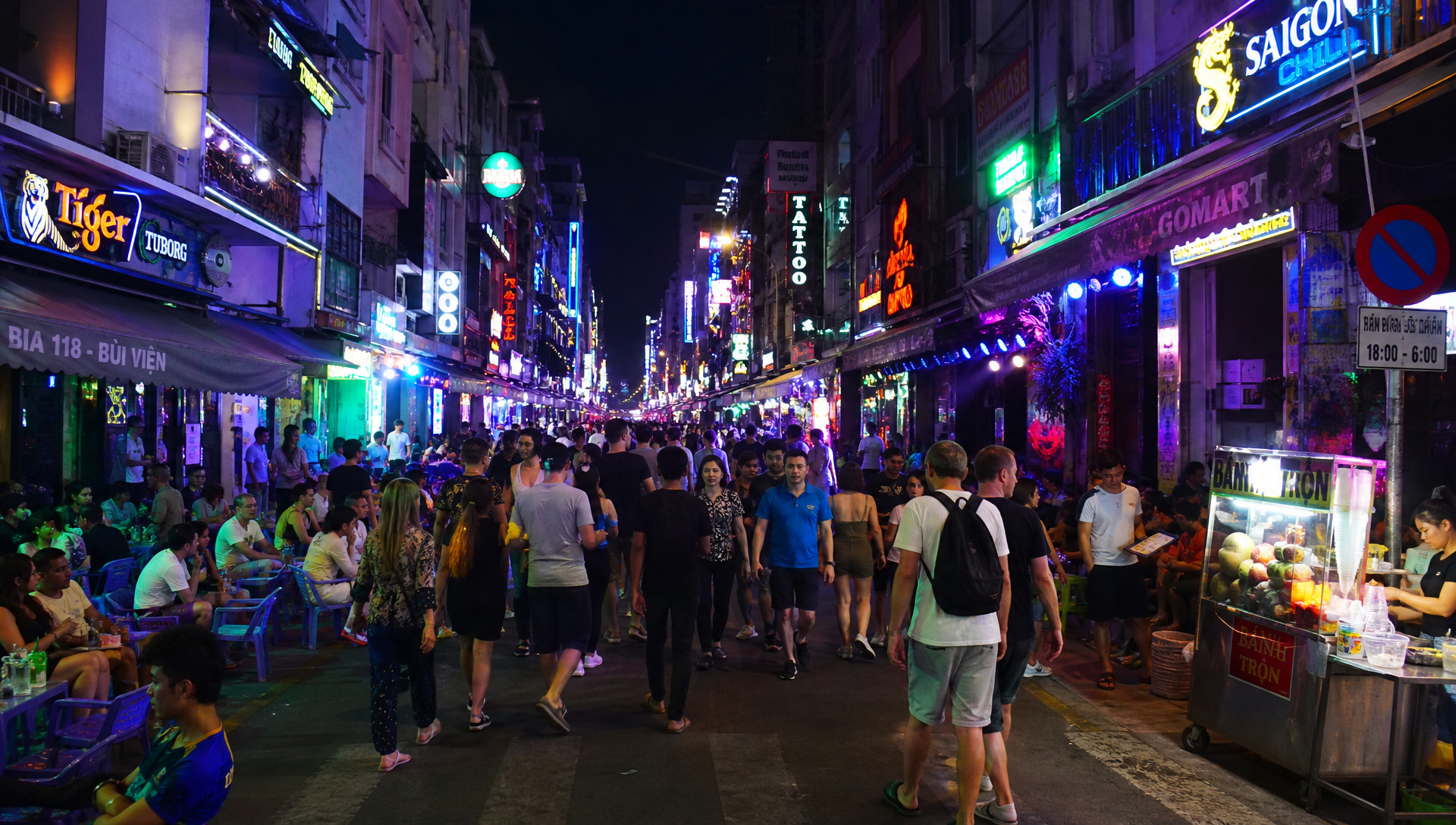
Bui Vien Street runs about 850 meters through the Pham Ngu Lao area, technically still District 1 but functioning as its own zone. It closes to cars on weekend nights and turns into an open-air strip of bars, plastic-stool beer stalls, and street performers.
Getting there: 1 km from Ben Thanh Market, a 10-15 minute walk or a 15,000-25,000 VND (USD 0.60-1) Grab ride.
What to do:
- Walk the street after 8pm, when it’s loudest and busiest, especially Friday and Saturday nights.
- Try fresh draft beer (bia hơi) at a curbside stall for 10,000-15,000 VND (USD 0.40-0.60) a glass, the cheapest alcohol pricing in the city center.
- Side alleys off the main strip hold quieter guesthouses at lower rates than hotels directly on Bui Vien.
What to eat: street carts sell grilled skewers, banh tráng trộn (rice-paper salad), and fried snacks aimed at a late-night crowd, generally 20,000-40,000 VND (USD 0.80-1.60) per item. For a sit-down meal, the surrounding blocks offer more variety.
Skip if: traveling with young kids, wanting an early night, or visiting mainly for food and culture over nightlife — the area is built around drinking and stays loud past midnight.
Ho Chi Minh City Neighborhoods Compared at a Glance
| Neighborhood | Best for | Distance from D1 center | Typical Grab cost from D1 | Noise level after dark |
|---|---|---|---|---|
| District 1 | First-time landmarks, malls, rooftop bars | 0 km (base) | — | High |
| Cho Lon (District 5) | Chinese-Vietnamese history, old markets | 4-6 km | 40,000-70,000 VND | Low-medium |
| District 3 | Specialty coffee, quiet residential streets | 2-4 km | 25,000-40,000 VND | Low |
| Thao Dien (D2/Thu Duc) | Western brunch, greenery, expat life | 6-8 km | 60,000-90,000 VND | Low |
| Bui Vien (D1) | Nightlife, cheap beer, backpacker energy | 1 km | 15,000-25,000 VND | Very high |
Where to Base Yourself, By Trip Length
One or two nights: District 1, ideally a side street off Dong Khoi or Le Thanh Ton rather than directly on Bui Vien, so you can walk to everything.
Three to five nights: split the stay — two nights in District 1, then move to District 3 or Thao Dien for a quieter second half, Grab-ing into the center for meals and sights.
A week or more, or repeat visits: Thao Dien or District 3 work better as a home base, putting you a short ride from the center without District 1’s constant street noise. Either choice still keeps the rest of Ho Chi Minh City within a 20-minute Grab ride.
Getting between these bases, and on day trips beyond the city, is covered in the Vietnam transportation guide; how to pay for any of the above is in the money in Vietnam guide.
Frequently Asked Questions
Is District 1 too touristy to be worth staying in? It’s the most tourist-facing district, but also the most walkable, with the highest concentration of sights — worth it for stays of three nights or less. Longer stays benefit from splitting time with a quieter district.
Which district in Ho Chi Minh City has the best food, overall? There isn’t one answer. District 1 and Cho Lon have the strongest street-food and market food, while District 3 and Thao Dien lean toward café culture and international dining. Matching the district to the meal works better than picking one “best” area.
Is it safe to walk around Bui Vien at night? The street is well-lit, heavily trafficked, and patrolled, though pickpocketing and overcharging at some bars are more common than violent crime. Keeping valuables secured and checking bar tabs before paying covers most of the risk.
Do I need a motorbike to get between these neighborhoods? No. Grab covers every district above reliably, and given traffic density and the learning curve of local traffic patterns, most visitors are better off using Grab or metered taxis for short stays.