
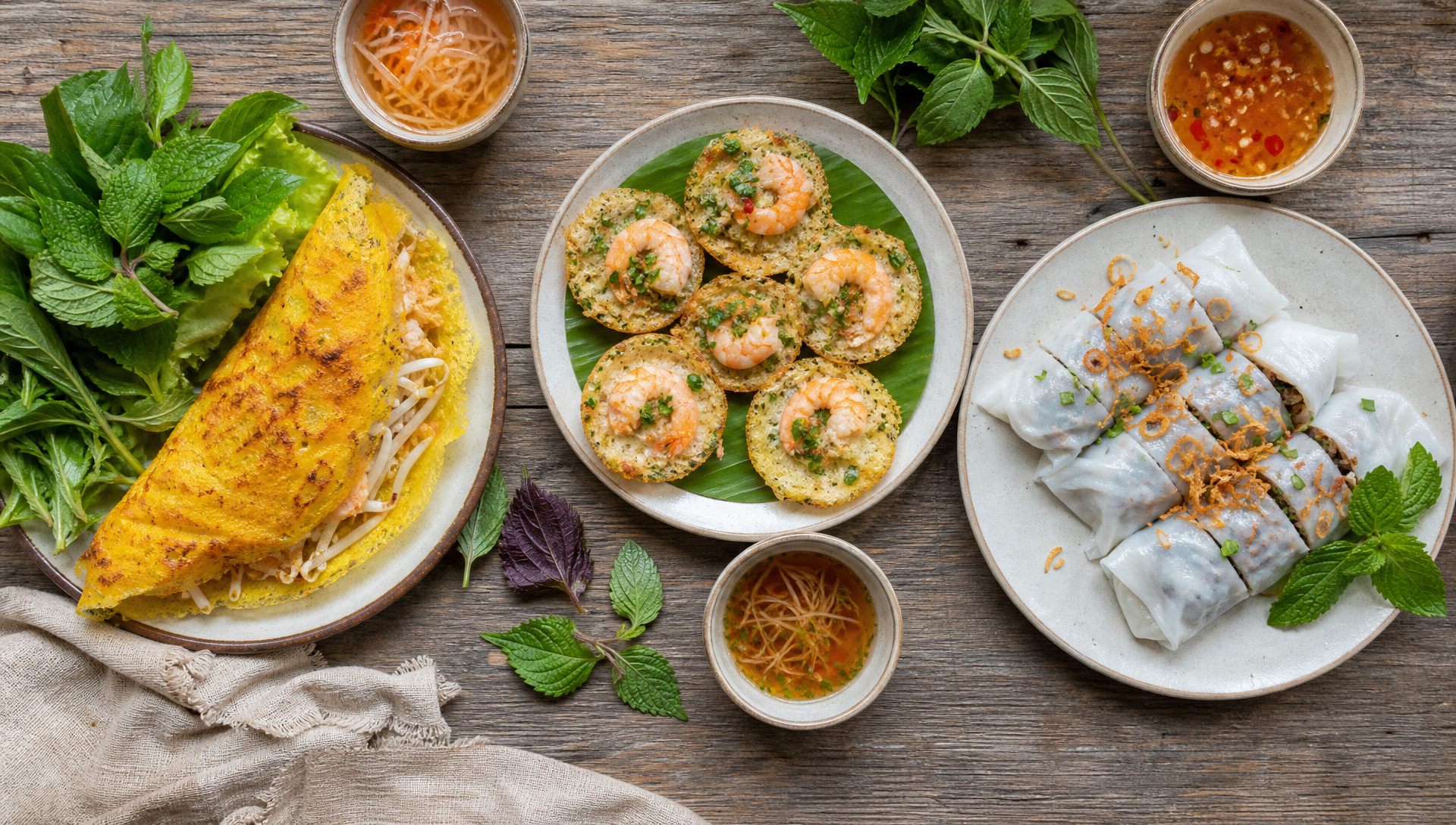
Vietnamese menus group several rice-flour dishes under names that sound almost identical to a first-time visitor: bánh xèo, bánh khọt, bánh cuốn. They share a base — rice flour, water, sometimes coconut milk — but the cooking method, texture, and meal they belong to are completely different.
This guide lines the three up side by side, then breaks each one down: what goes into it, how it’s cooked, where it comes from, what it costs, and how to eat it. It ends with a decision guide based on time of day, appetite, and dietary restrictions.
The Family Resemblance, and Where It Ends
All three dishes start from a rice-flour batter, which is why they get grouped together in translation and confuse first-time diners. From there they split into two cooking families:
- Fried, on a hot pan or griddle: bánh xèo, bánh khọt.
- Steamed, over boiling water: bánh cuốn.
That single difference — fried versus steamed — explains almost every other difference on this list: the texture, the fat content, the typical filling, and even what time of day each one is eaten.
Side-by-Side: The Full Comparison Table
| Bánh Xèo | Bánh Khọt | Bánh Cuốn | |
|---|---|---|---|
| Cooking method | Fried flat, folded in half | Fried in small molds, cast-iron pan | Steamed thin sheet |
| Size | One crepe, 20–30cm | Small discs, 5–7cm each | Thin bite-sized rolls |
| Batter | Rice flour, turmeric, coconut milk/water, often beer or soda | Rice flour, coconut milk, turmeric — richer than bánh xèo | Rice flour and water only, no turmeric |
| Typical filling | Shrimp, pork belly, bean sprouts | Whole or minced shrimp on top | Minced pork, wood-ear mushroom |
| Texture | Crisp lace edges, soft center | Crisp edge, custardy center | Silky, translucent, no crunch |
| Fat content | High — pool of oil | High — oil per mold | Low — no oil used |
| Served as | Torn apart, wrapped by diner | Lifted out with a pick, one at a time | Pre-cut rolls, chopsticks only |
| Dipping sauce | Nước chấm, sometimes sweeter | Nước chấm with papaya/carrot | Thin, mild fish sauce |
| Best eaten | Lunch or dinner | Afternoon snack, light dinner | Breakfast |
| Regional home base | Countrywide; largest in Mekong Delta and Central Vietnam | Vũng Tàu; also common in Saigon | Hanoi and the north, especially Thanh Trì |
| Street price | 25,000–45,000 VND (~$1–$1.80) | 30,000–50,000 VND (~$1.20–$2) for 8–10 pieces | 25,000–40,000 VND (~$1–$1.60) |
| Best found in | Cần Thơ, Mekong Delta | Vũng Tàu, and District 1/3 in Saigon | Thanh Trì village, Hanoi |
A tourist-facing restaurant in central Hanoi or District 1 typically charges 1.5 to 3 times the market-stall price shown here.
Bánh Xèo: The Sizzling Crepe
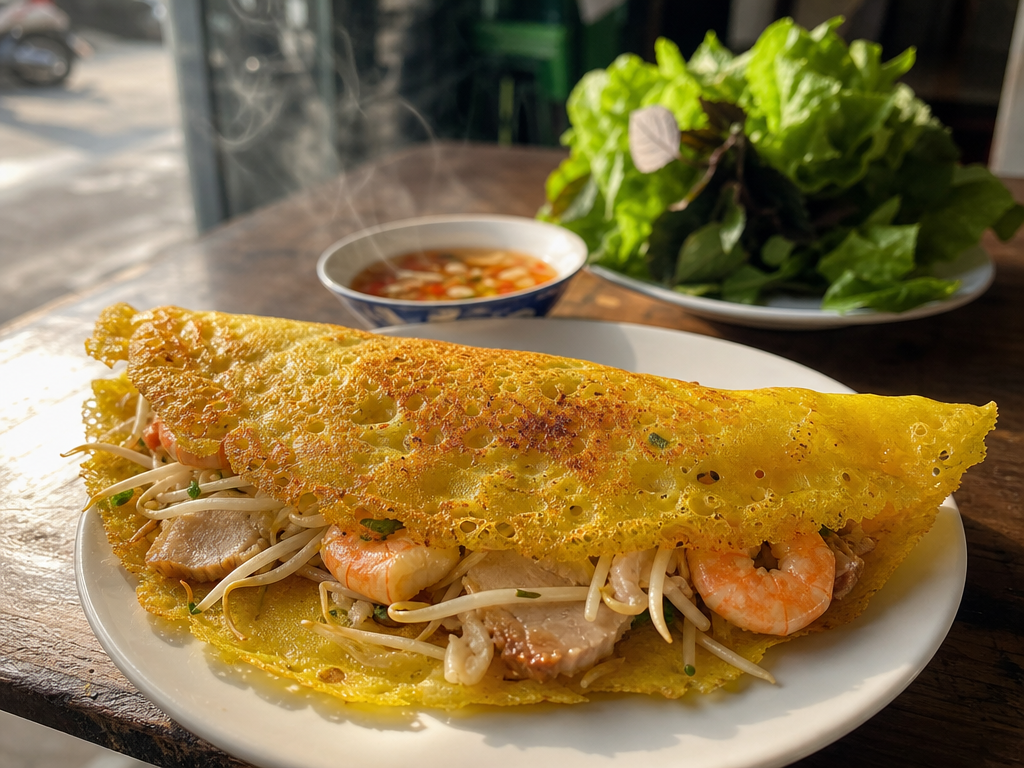
The name literally describes the sound it makes — “xèo” mimics the sizzle of batter hitting a hot pan. That sound is the giveaway for which dish this is when ordering from a stall with no menu in English.
What Goes Into the Batter
The base is rice flour mixed with water or coconut milk, colored bright yellow with turmeric, and often cut with a splash of beer or soda water to crisp the shell. The filling goes in while the batter is still liquid: shrimp, thin-sliced pork belly, bean sprouts, and occasionally mung bean paste. The pan is folded closed once the edges turn golden and lift away from the metal on their own — that lift, not a timer, is the cue that it’s ready.
Regional Differences Worth Knowing
The Mekong Delta version, especially around Cần Thơ, tends to be the largest — sometimes 30cm across, thick with filling, meant to be split between two people. Central Vietnam versions, closer to Huế and Đà Nẵng, run smaller and thinner, served with a wider spread of local herbs. Saigon’s sits in between: medium-sized, generously oiled, usually eaten solo.
How It’s Actually Eaten
The crepe arrives whole and gets torn into pieces at the table, not eaten intact like a folded taco. Each piece is wrapped in a lettuce leaf or rice paper along with fresh herbs — mint, perilla, sometimes a slightly bitter green like mustard leaf — then dipped in nước chấm. Skipping the wrap misses half the point: the herb bitterness is there specifically to cut the oil.
Bánh Khọt: The Mini Version With a Different Home
Bánh khọt looks like a scaled-down bánh xèo and gets mistaken for one on translated menus, but the pan, the batter ratio, and the origin are all different.
The Pan Is the Whole Trick
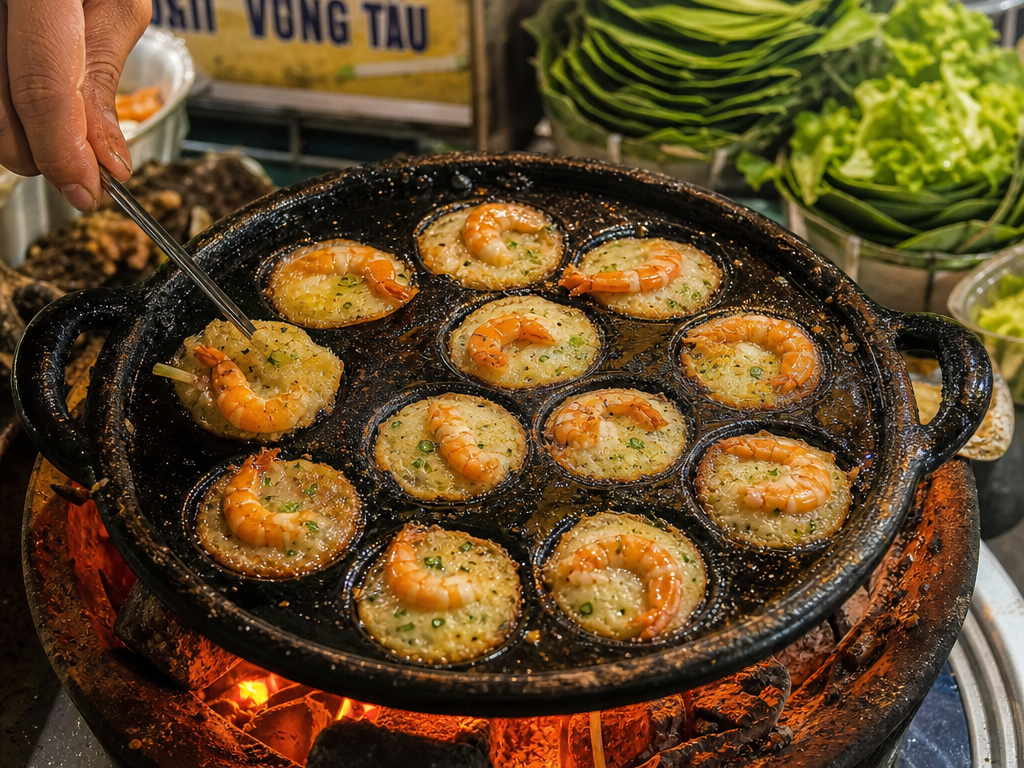
Bánh khọt is cooked in a heavy cast-iron pan with a dozen or more small round molds, each about the size of a shot glass. A ladle of batter goes into each mold, a shrimp sits on top, and a lid goes on for a few minutes so the top steams while the bottom fries. The result is a disc with a crisp base and a soft, custardy top — a texture bánh xèo doesn’t have, because bánh xèo never gets a lid.
Where It Comes From
Bánh khọt is a specialty of Vũng Tàu, the coastal city roughly two and a half hours from Saigon, historically tied to the area’s fishing communities and cheap access to fresh shrimp. It travelled to Saigon decades ago and now has dedicated shops in District 1 and District 3, but the versions closest to the original are still made in Vũng Tàu itself.
Ordering and Eating It
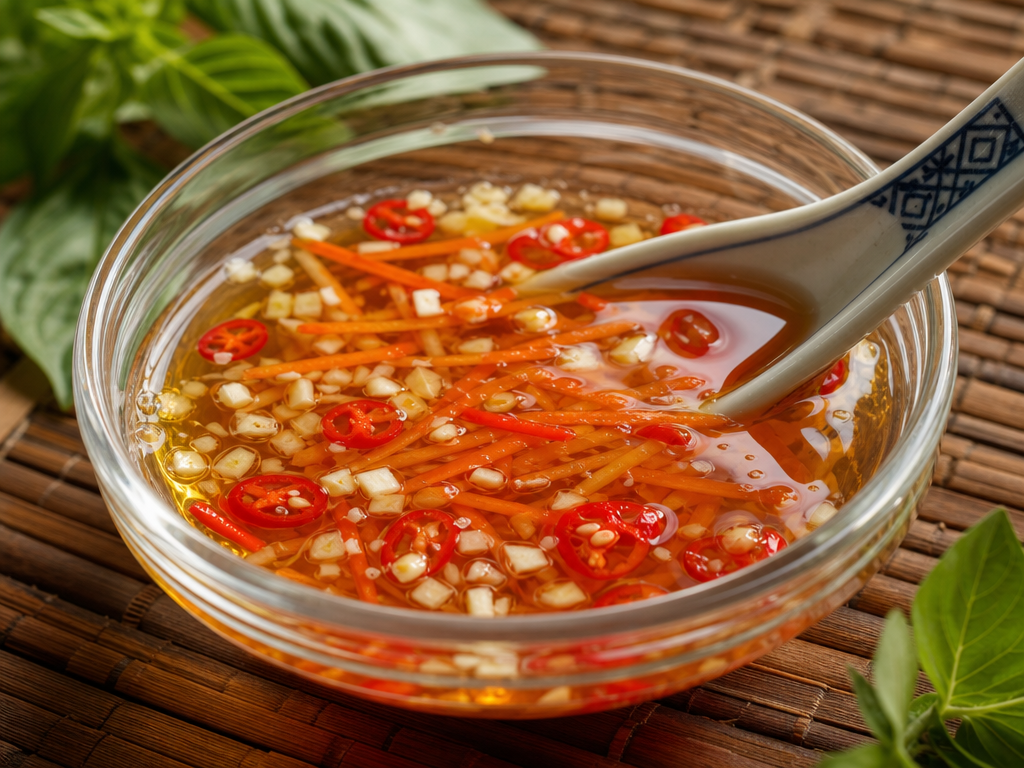
A plate typically comes with 8 to 10 discs, meant as a light meal for one or a snack split between two. Each piece is usually wrapped in lettuce with herbs, dipped in nước chấm often mixed with shredded green papaya or carrot for crunch — an addition bánh xèo’s sauce doesn’t usually include. A full plate tends to be paced out over a slower, more social meal than a bánh xèo, which is finished as a fast, single-course lunch.
Bánh Cuốn: The Steamed, Oil-Free Cousin
Bánh cuốn shares only the rice-flour base with the other two — everything about how it’s cooked, eaten, and when it’s eaten points in a different direction.
No Frying, No Turmeric
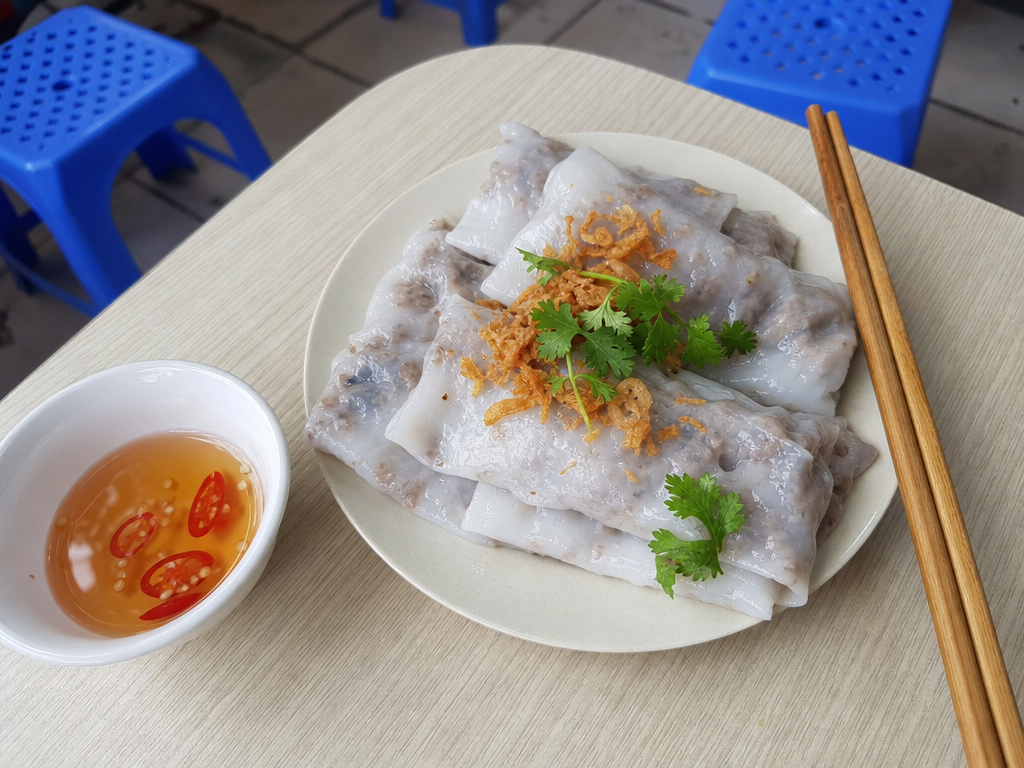
The batter is just rice flour and water, stretched thin and steamed over a piece of cloth pulled tight across boiling water — closer to the technique used for fresh rice-paper sheets than to pancake batter. There’s no turmeric, so the color stays pale and translucent rather than yellow. A thin layer of minced pork and wood-ear mushroom goes onto the sheet on the steamer, then the sheet is rolled over the filling with a bamboo scraper and lifted onto a plate.
Thanh Trì and the Hanoi Breakfast Table
The most cited regional benchmark is Thanh Trì, a village on Hanoi’s southern edge known for the plain, unfilled version of these rice sheets, sold without meat and eaten with fried shallots and a light fish sauce. The filled version — pork and mushroom — is the more common one found across the rest of Hanoi and northern Vietnam, usually as a breakfast dish.
How It’s Served and Eaten
Bánh cuốn comes pre-cut into short rolls, already bite-sized, so no wrapping or folding is needed at the table — just chopsticks. It’s topped with fried shallots and sometimes a few slices of Vietnamese sausage (chả lụa). The dipping sauce is thinner and milder than the fried dishes’ sauces, since the rolls have almost no fat to cut through. It has no crunch by design — the appeal is the opposite: soft, light, easy to eat first thing in the morning.
Which One to Order: A Quick Decision Guide
| Situation | Best pick | Why |
|---|---|---|
| It’s breakfast time (6–9am) | Bánh cuốn | Built as a breakfast item; the other two are heavier and rarely served this early |
| A full, filling single meal | Bánh xèo | Dense enough to be a complete lunch or dinner alone |
| A lighter snack to share | Bánh khọt | Small portions, less oil per piece |
| Avoiding fried food | Bánh cuốn | The only one cooked without oil |
| Shellfish allergy | Ask for pork-only or a plain version | Shrimp is standard in the other two; bánh cuốn adapts more easily |
| In the Mekong Delta or Central Vietnam | Bánh xèo | The regional specialty, easiest to find |
| In Vũng Tàu or coastal Saigon | Bánh khọt | Its home turf |
| In Hanoi’s Old Quarter | Bánh cuốn | Northern Vietnam’s version and home base |
| A group with mixed appetites | All three, split | Crisp, custardy, and silky textures complement rather than repeat |
Common Mix-Ups and How to Avoid Them
Assuming they’re interchangeable on a menu. English translations sometimes list all three as “Vietnamese pancake,” erasing the difference in cooking method. If the Vietnamese name is printed next to the English one, use it.
Eating bánh xèo unwrapped. It’s built to be torn and wrapped in lettuce or rice paper with herbs before dipping. Eaten straight off the plate, it reads as greasier than intended — the herbs are what offsets the oil.
Expecting bánh khọt to taste like a smaller bánh xèo. The lidded, steam-fry method gives it a custardy top a flat-pan crepe never develops.
Ordering bánh cuốn expecting crunch. It has none by design. If crispness is the goal, bánh xèo or bánh khọt is the better order.
For more on how Vietnamese menus categorize dishes by eatery type — since not every restaurant serves all three — see the guide to what to order at different Vietnamese eateries. Useful phrases for ordering any of these three at a stall with no English menu are covered in the Vietnamese street food phrases guide.
According to the Wikipedia entry on Vietnamese cuisine, the use of rice flour as a base across dozens of regional dishes — sweet and savory, fried and steamed — is one of the defining structural features that separates it from the wheat-heavy cooking of neighboring countries. The Wikipedia page on bánh xèo also documents its regional variation across Central Vietnam, the south, and Cambodia’s related banh chao, which shares the same rice-and-turmeric batter.
FAQ
Is bánh khọt just a mini bánh xèo? No. Both are fried with a turmeric rice batter, but bánh khọt cooks in lidded molds that trap steam, giving it a custardy top bánh xèo doesn’t have. It also comes from a different region — Vũng Tàu, not the Mekong Delta.
Which is safest for someone avoiding fried food? Bánh cuốn — steamed, not fried, no oil in the process. Bánh xèo and bánh khọt are both cooked in a pool of oil.
Can any of these be made without shrimp? Bánh cuốn most easily — northern stalls often serve it with just pork and mushroom. Bánh xèo and bánh khọt are harder without shrimp, though a pork-only version is usually understood.
What time of day should each be ordered? Bánh cuốn is breakfast. Bánh xèo works for lunch or dinner. Bánh khọt sits in between as an afternoon snack or light dinner.
Do all three use the same dipping sauce? The base nước chấm is the same, but each version is adjusted: thicker and sweeter for bánh xèo, mixed with papaya or carrot for bánh khọt, thinned and milder for bánh cuốn.