

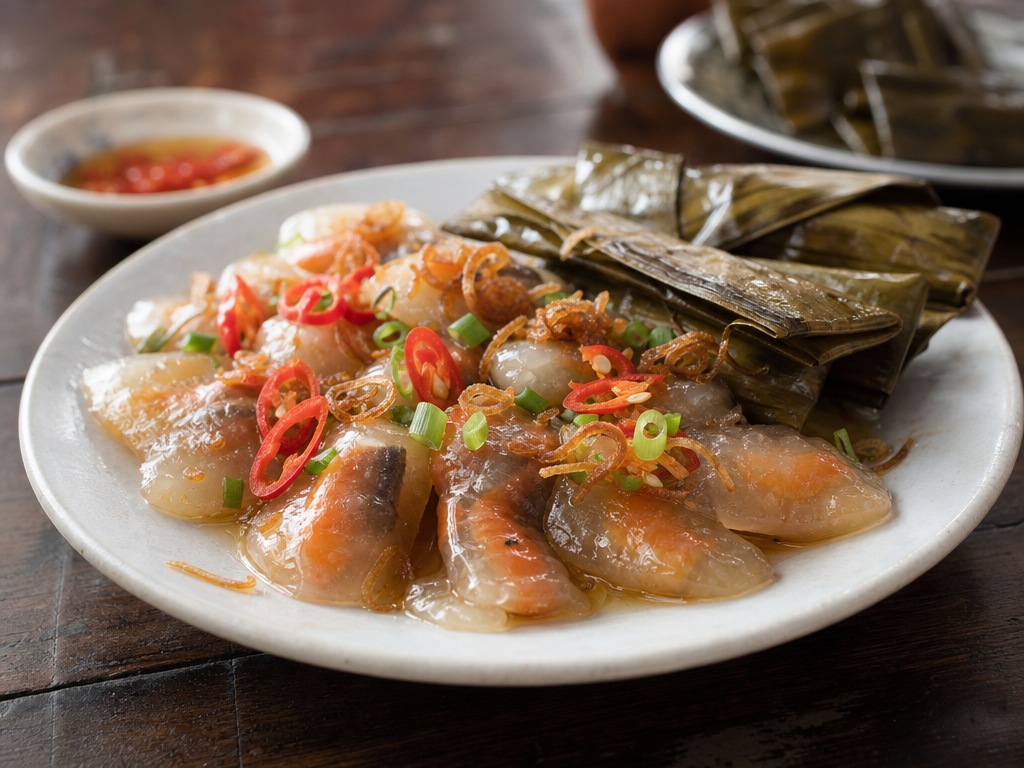
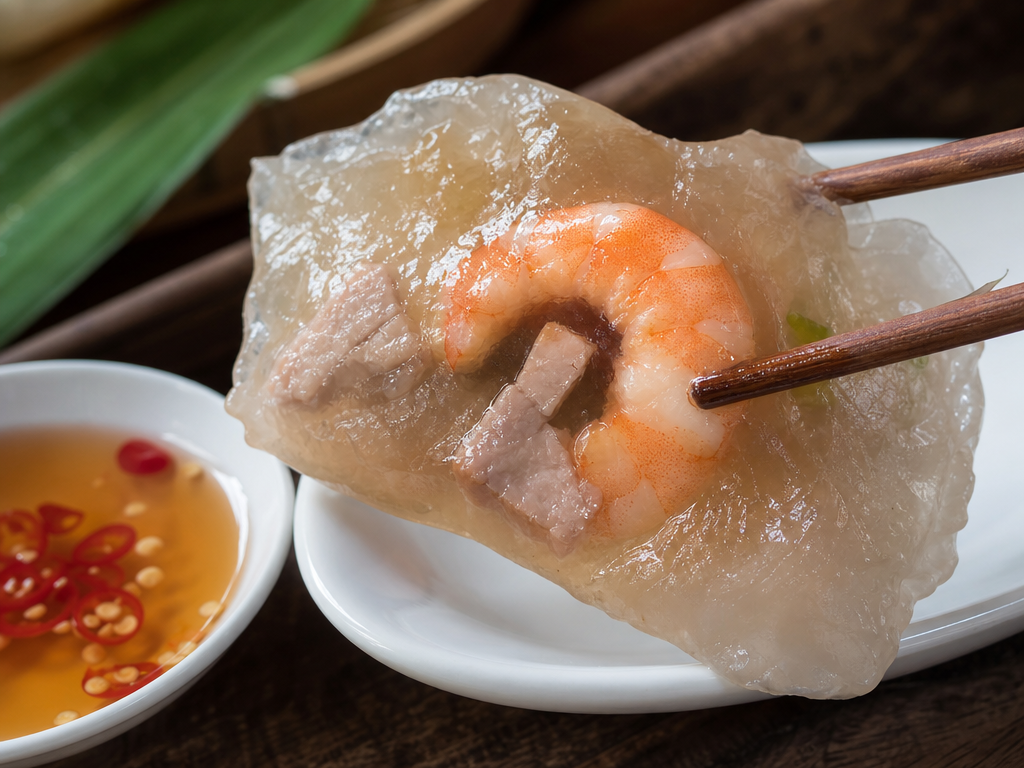
Bánh bột lọc is one of the smallest dishes in Vietnamese street food and easy to walk past without noticing. It looks like a clear, greyish-amber pebble, sometimes wrapped in a rectangle of dark green banana leaf, sold from a tray at a stall with no sign at all. There’s no sizzle, no steam cloud, no theatrical assembly at the table — what’s inside is worth stopping for: a translucent tapioca shell wrapped around a shrimp and a sliver of pork belly, dressed in sweet-savory fish sauce and crisp fried shallots.
This is a Huế dish first. It travelled south into Đà Nẵng, Hội An, and Sài Gòn, picking up small changes at each stop, but the technique barely changes — built the same way, stage by stage, whether made in a home kitchen in Huế or a street cart in District 1. Knowing those stages is the fastest way to understand what’s on the plate, why two versions can look different, and what to order.
What Bánh Bột Lọc Is, in One Paragraph
Bánh bột lọc translates roughly to “filtered flour cake” — “lọc” refers to filtering tapioca starch out of water to get a pure flour with no grit. That starch is cooked into a stretchy, glass-like dough, wrapped around shrimp and pork belly, then steamed in banana leaf or boiled bare, depending on the style. It’s eaten as a snack or light meal, usually in a set of several pieces, with a small dish of nước mắm chua ngọt (sweet-sour fish sauce) on the side. It sits in the same rough family as bánh cuốn and other Vietnamese steamed starch cakes, but the tapioca base gives it a chewier, more elastic bite than rice flour produces.
Stage 1: The Dough
Tapioca starch (bột năng) is mixed with hot — not boiling — water, roughly a 2:1 to 3:1 ratio of starch to water depending on humidity and the starch’s age. The hot water partially gelatinizes the starch on contact, so mixing happens fast, in small additions, with constant folding. Water too hot or added too slowly and the dough turns lumpy; too cool and it stays crumbly and never turns glassy.
The finished dough is smooth, slightly sticky, and translucent enough to see a shadow through a thin sheet. It’s kneaded briefly with oiled hands, then divided into portions of roughly 10 to 15 grams — about the size of a large marble — before it cools and firms up too much to shape.
This stage also decides the two serving styles:
- Bánh bột lọc lá — dough flattened into a thin oval, filled, folded, and wrapped in banana leaf before steaming. The leaf gives a faint grassy aroma and a firmer, more set texture.
- Bánh bột lọc trần — “trần” means bare. Same dough and filling, but boiled with no leaf. Comes out looser, softer, and glossier, served loose on a plate.
Both are the same dish at heart; the split happens here and in the next stage.
Stage 2: The Filling
The filling stays deliberately minimal, since the tapioca shell is the real star:
- One whole small-to-medium shrimp, peeled, sometimes minced for a more even bite
- A thin sliver of pork belly, simmered first in fish sauce, sugar, and pepper so it’s already seasoned and lightly caramelized
- Occasionally a few strands of wood-ear mushroom or a pinch of fried shallot mixed in, more common in home cooking than street stalls
The pork glaze matters — it’s what gives the filling its savory-sweet backbone once sealed inside the neutral tapioca shell. Shrimp goes in raw and cooks fully during steaming or boiling.
Stage 3: Wrapping
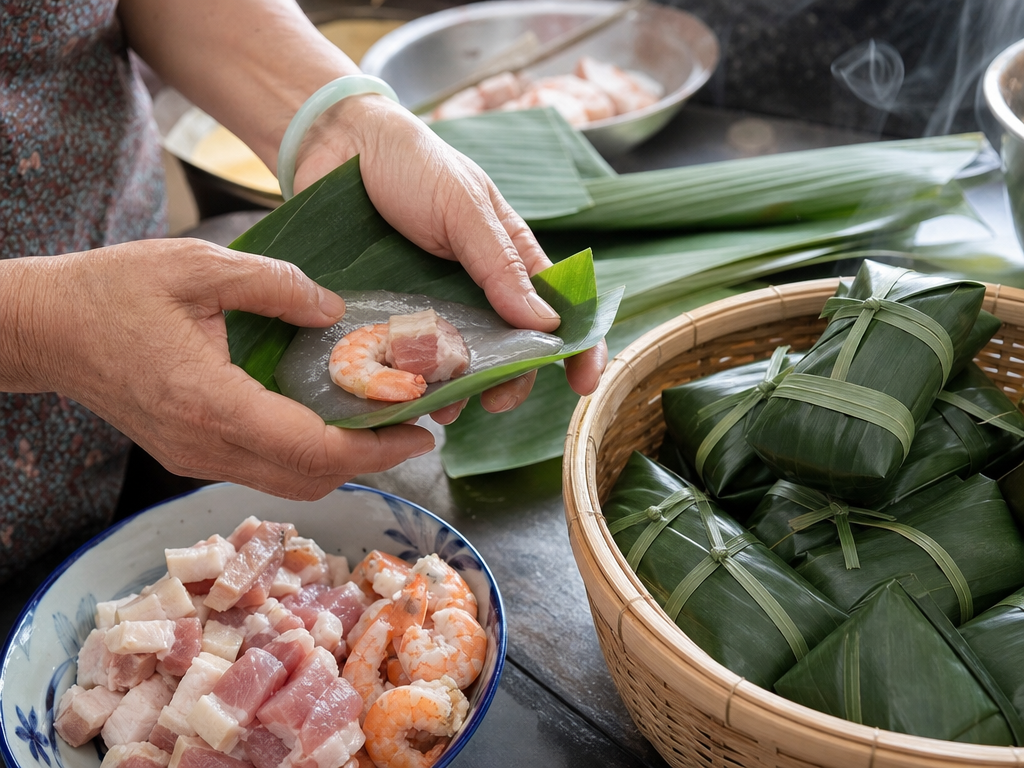
For the leaf-wrapped version, a piece of banana leaf about 10 to 12 centimeters long is passed briefly over a flame or into hot water to soften it. A portion of dough is pressed flat on the leaf, filled, and folded over, then pressed at the edges to seal it fully — any gap and water gets into the parcel during steaming, leaving it waterlogged instead of chewy. The leaf is then folded around it and the ends tucked or tied.
The trần version skips the leaf entirely. The dough is shaped directly around the filling into a small teardrop, sealed the same way, and set aside on an oiled tray so pieces don’t stick together before cooking.
This stage is manual and repetitive — one reason the dish is bought from a stall or a home cook making large batches rather than cooked to order. A single serving runs 8 to 12 pieces, each wrapped one at a time.
Stage 4: Cooking
- Steaming (lá style): wrapped parcels go into a bamboo or metal steamer for roughly 15 to 20 minutes, until the dough turns from opaque white to glassy and translucent. Underdone dough stays cloudy and gritty; overdone dough turns soft and can fall apart when unwrapped.
- Boiling (trần style): bare dumplings go into gently boiling water for about 8 to 10 minutes and are done when they float and turn clear, then lifted out with a slotted spoon and drained.
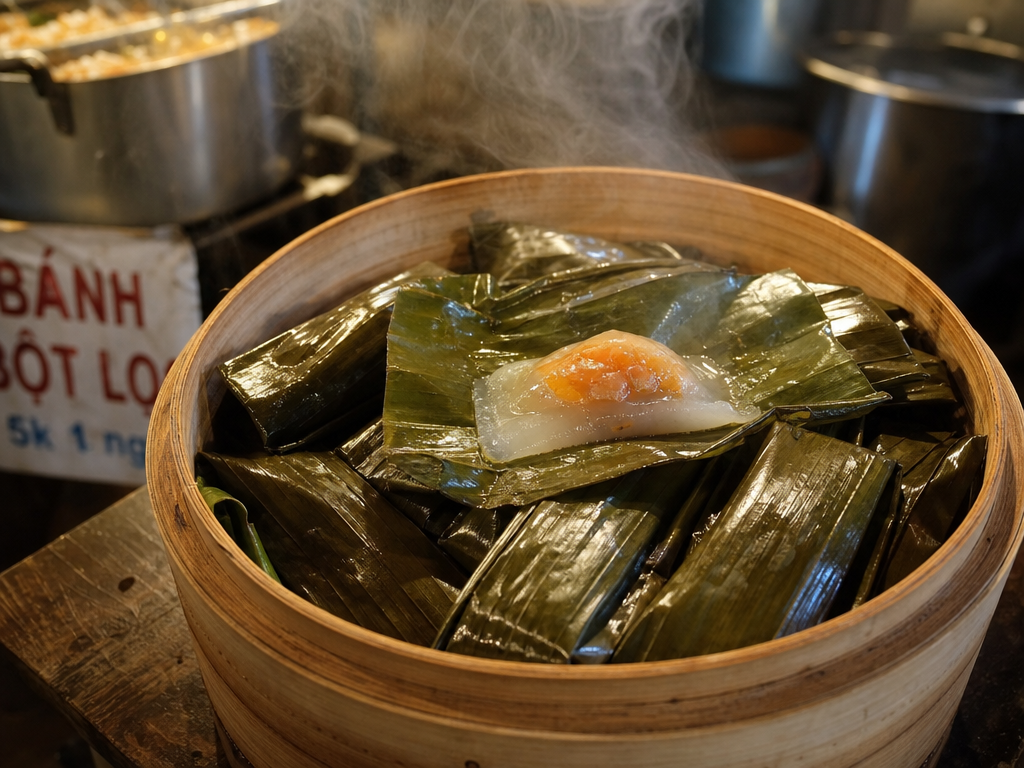
Translucency is the reliable readiness test for both versions — it’s also why you can usually make out the pink of the shrimp and the darker pork sliver through the skin before the first bite.
Stage 5: The Sauce and Toppings
Bánh bột lọc without its dipping sauce tastes fairly plain; the sauce is where most of the flavor sits. The standard version is nước mắm chua ngọt — fish sauce diluted with water, sugar, and lime or vinegar, with garlic and thin chili rings stirred through. It’s noticeably lighter and sweeter than the sauce served with grilled meats, since the dumpling itself carries almost no salt or sugar on its own.
On top, most versions add fried shallots (hành phi) for crunch, a spoonful of scallion oil (more common in Huế), and fresh chili slices on the side. At a sit-down plate, the dumplings — unwrapped if that’s the style — are arranged in a single layer, doused with sauce, and topped just before serving so the shallots stay crisp.
Regional and Stall Variations
The dish is Huế in origin, often sold alongside other small Huế cakes as a shared “combo” plate. Moving south, a few consistent differences show up:
| Where | What tends to change |
|---|---|
| Huế | Smaller, more delicate pieces; scallion oil more common; often part of a mixed plate |
| Đà Nẵng / Hội An | Similar to Huế but slightly larger; fried shallots more prominent than scallion oil |
| Sài Gòn (Hồ Chí Minh City) | Trần style more common than lá; sauce often sweeter and thicker; sold more as a standalone street snack |
| Diaspora restaurants abroad | Both styles listed side by side as “tapioca dumplings,” portions standardized to 8 or 10 pieces |
These aren’t strict rules — a stall’s recipe depends on the cook’s own background more than the city — but they’re a reasonable guide to what to expect on a menu.
Ordering It: What to Ask For and What to Expect to Pay
Bánh bột lọc is priced by the piece or by a fixed plate, not by weight, which makes it easier to budget for than most street dishes:
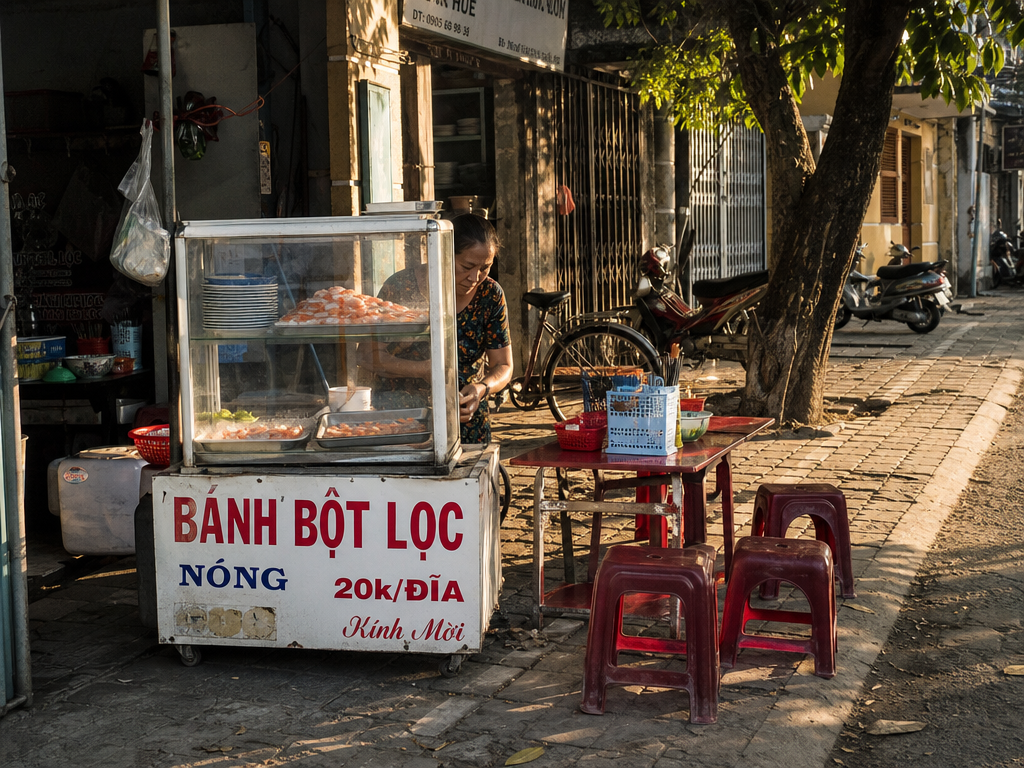
- Street stalls and market vendors: roughly 3,000–5,000 VND per piece (about US$0.12–0.20), typically sold in sets of 5 or 10
- Sit-down local eateries: a plate of 8–12 pieces usually runs 25,000–45,000 VND (about US$1–1.80)
- Tourist-facing restaurants or hotel menus: the same plate can run 60,000–90,000 VND (about US$2.40–3.60), reflecting service and location rather than a different dish
Prices vary with the shrimp market rate and whether it’s sold alone or as part of a mixed Huế snack platter with bánh nậm or bánh ram ít — expect the higher end in central Huế’s busiest streets and the lower end at neighborhood markets. If a menu doesn’t specify lá or trần, it’s worth asking, since the two textures are different enough to be a real preference.
How to Eat It
- Unwrap before dipping, if it’s the lá style — the leaf isn’t edible; biting into it is a common first-timer mistake, not a choice.
- Eat it in one or two bites. Pieces are small by design; cutting one with chopsticks just squeezes the filling out.
- Order a full plate. A single piece is a bite, not a meal — pair it with gỏi cuốn or another light dish.
Where It Fits on a Trip
Huế is the obvious base for trying this dish in its original form, pairing naturally with a stop at Huế’s Imperial City sites, since most small-cake specialists operate near the old citadel and the Perfume River’s market streets. Outside Huế, it shows up on menus that group several Vietnamese snack dishes together, worth knowing when deciding what to order at a given type of eatery rather than assuming every stall carries it.
Since it’s typically bought from small stalls rather than restaurants with printed menus, the general guidance on paying at Vietnamese food stops and on eating street food safely both apply — cash in small denominations is the norm, and the usual freshness checks matter here as with any street dish.
FAQ
Is bánh bột lọc the same as bánh bột lọc lá? No — bánh bột lọc is the dish overall; lá and trần are its two serving styles, wrapped in banana leaf or boiled bare.
Does bánh bột lọc contain gluten? The dough is made purely from tapioca starch (from cassava), so the base itself is gluten-free. Cross-contamination and the fish sauce’s other ingredients would need separate checking for anyone avoiding gluten strictly.
Can bánh bột lọc be eaten cold? It’s usually served warm, since the tapioca shell firms up and turns rubbery as it cools. A brief reheat in a steamer restores most of the texture; microwaving tends to make it unevenly chewy.
What’s the difference between bánh bột lọc and bánh nậm? Bánh nậm is a related Huế snack made with rice flour instead of tapioca starch, giving a soft, flat, sheet-like texture rather than a chewy, translucent one. The two are often sold together on the same platter.