

Vietnamese sour soup — canh chua — belongs to a rice meal, and that single fact explains most first-order confusion. It is not a noodle bowl, not a starter, and not something you can judge from the price alone: the same dish runs from a 35,000 VND bowl at a roadside quán to a 300,000 VND fish-head pot in a restaurant. Here is the dish in nine counts: the words on the menu, the souring agents, the fish, the vegetables, the herbs, the price bands, the cooking times, the season, and the parts of the order nobody prints.
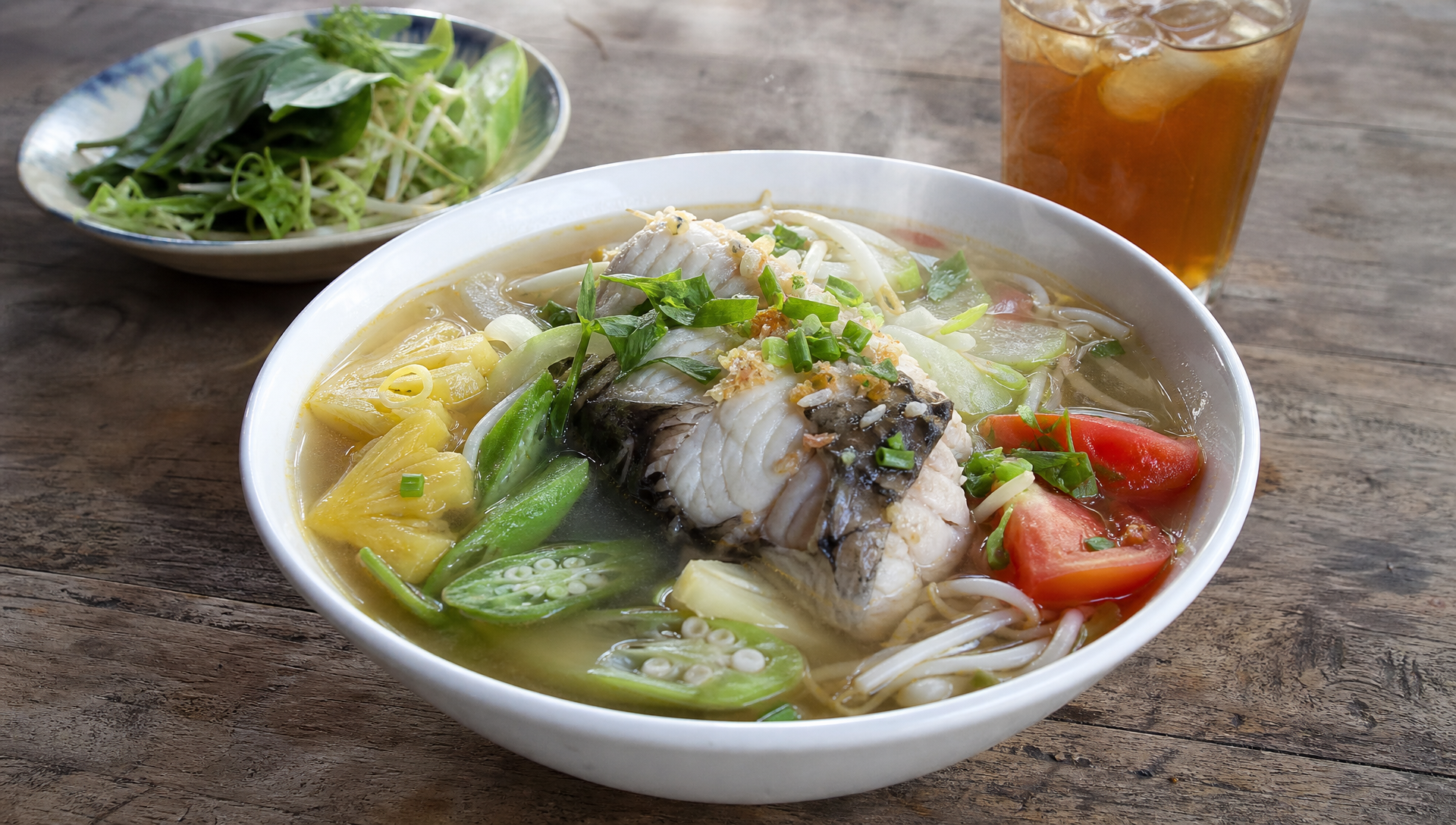
One Vietnamese sour soup, three words on the menu
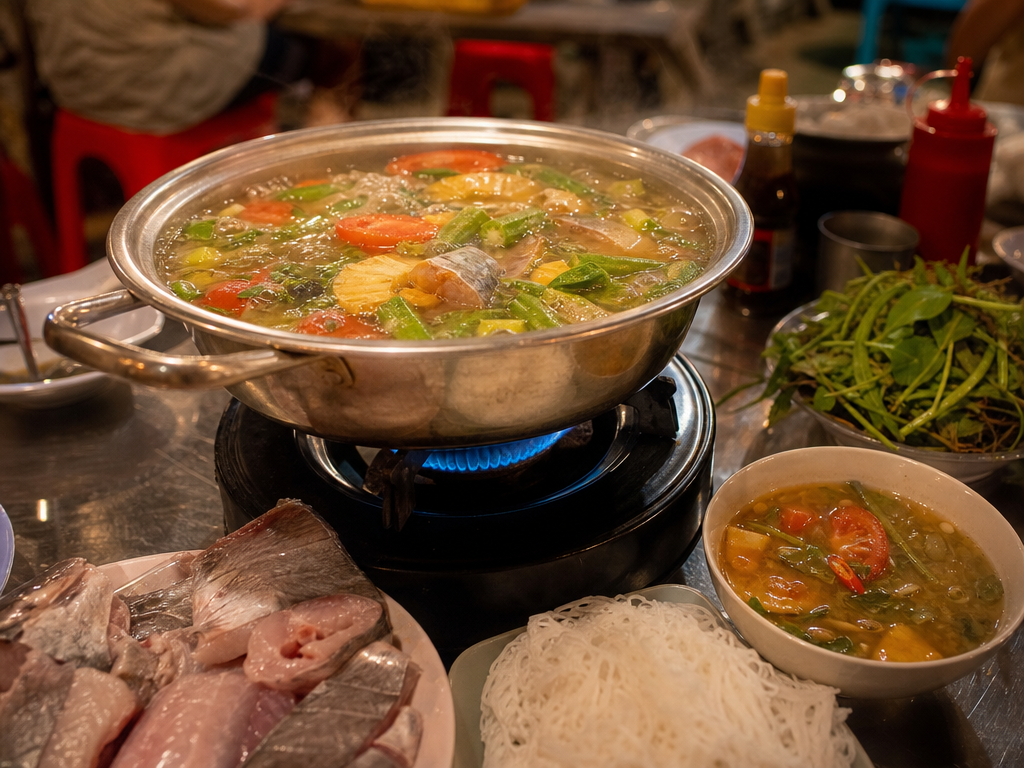
The name is a formula. Canh is the soup course beside rice in an everyday meal — rice, one soup, one braised dish, one stir-fry. Chua means sour. Everything after that names the protein, so a menu carries five or six lines rather than one: cá lóc (snakehead), cá trê and cá basa (catfish), tôm (prawn), đầu cá (fish head), chay (vegetarian), and in the evening often lẩu canh chua, the same soup as a table-top hot pot.
Two things follow. The gap between the cheapest and dearest line on one menu is routinely three to five times, and the fish sets it, not the cooking. And the soup is built for rice rather than for eating alone — unlike a one-bowl dish such as phở. It is documented as indigenous to the Mekong Delta, the region that supplies both the river fish and the tamarind; central Vietnam has its own sour soups, and northern cooks use seasonally sour fruit instead. The same naming and pricing pattern runs through the rest of a Vietnamese eatery’s menu.
Two souring systems, and they do not taste alike
A Vietnamese sour soup base is built one of two ways, and a spoonful tells you which.
Tamarind (me) is the southern standard and what nearly every restaurant bowl uses. Pods are soaked in hot water, the pulp is worked loose and strained, and the liquid goes in — roughly 30–50 g of pulp per litre of broth. It reads round, faintly sweet and slightly thick, and tamarind is why the dish tastes sweet-and-sour rather than simply sour.
Fermented rice (cơm mẻ) gives a sharper, thinner, faintly beery sourness. It is common in home kitchens and central versions, and it makes two bowls of the same dish feel like different soups. Northern summer cooking uses sấu fruit or vinegar; the delta uses lá giang leaves for a green, tannic sourness that suits small fish.
Read the broth and you can name the kitchen: flat and sweet means undersoured tamarind, vinegar-sharp means a shortcut, yeasty means mẻ.
Three fish, three textures — and most of the price
Cá lóc (snakehead) is the premium default: firm white flesh that holds its shape, usually one 600–800 g fish cut into 2–3 cm steaks, with bones concentrated toward the head.
Cá trê and cá basa (catfish) are softer, oilier and cheaper — usually the cheapest line on the menu by a clear margin. Farmed basa is mild; when the fish is not fresh, this is where the muddy complaint starts.
Cá kèo (mudskipper) is a hot-pot fish: small, sweet, dropped in whole by the diner, fine-boned and numerous.
Above those sit salmon (cá hồi) on hotel menus, plus cá lăng and cá bông lau, the prized Mekong catfish. Cheapest to dearest: basa, trê, lóc, bông lau and lăng, hồi. A Vietnamese sour soup is priced by the species in the pot far more than by the neighbourhood it is served in.
Four vegetables that decide the texture
Four vegetables decide the texture of a Vietnamese sour soup, and each has a narrow window in the pot.
Bạc hà / dọc mùng (elephant ear stem) is the one foreigners rarely recognise. The fibrous outer skin is peeled off and the stem sliced diagonally into 3–4 mm pieces that stay crunchy and faintly bitter. It is bạc hà in the south and dọc mùng in the north.
Đậu bắp (okra) goes in for the last three to four minutes, sliced on the diagonal. Its slight thickening gives the broth body, and overcooked okra is why some bowls turn gluey.
Giá đỗ (bean sprouts) cook for under a minute, or are dropped raw into a hot bowl at the table so they keep their snap.
Dứa (pineapple) and cà chua (tomato) cook longest, eight to ten minutes, and carry the sweetness that stops tamarind reading harsh. Around these, the seasons swap in măng chua (pickled bamboo) during the wet months and bông súng (water lily stem) in the delta.
Five herbs on the side plate
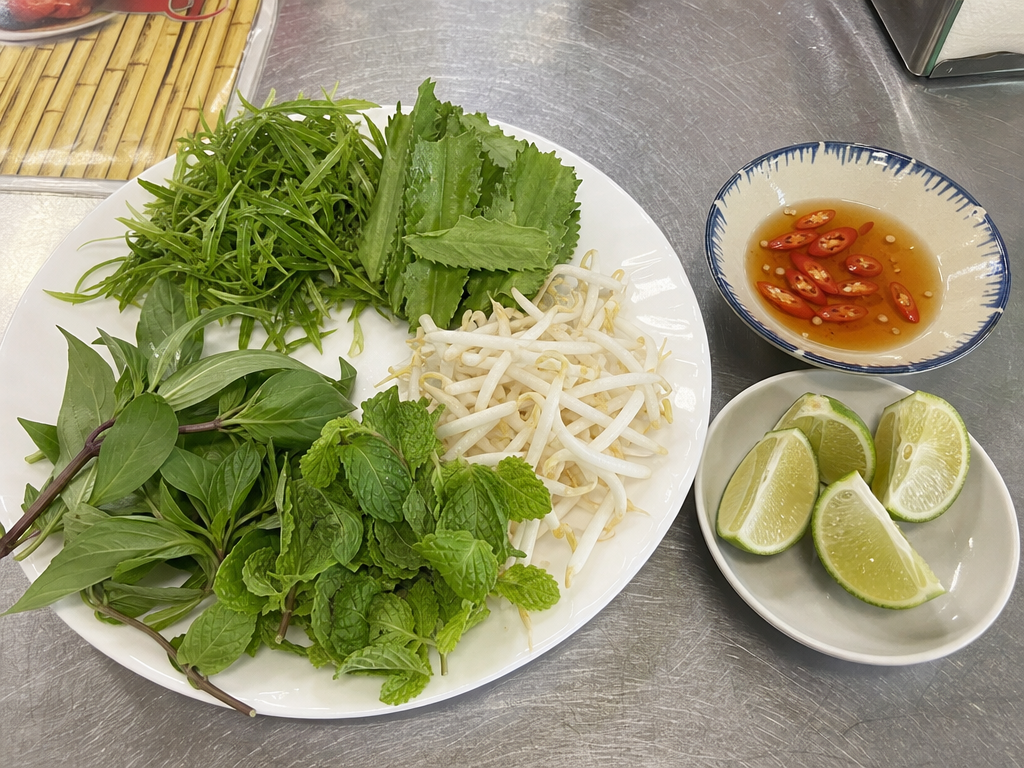
The herb plate that comes with a Vietnamese sour soup arrives after the bowl and is yours to use, not a garnish the kitchen has already applied. The southern core set is five.
- Ngò om — rau ngổ in the north, rice paddy herb in English. Fine green leaves, citrus with a hint of cumin; this is the scent people remember from the dish.
- Ngò gai (culantro) — sawtooth leaves, strong and slightly medicinal; tear rather than chop.
- Húng quế (Thai basil) — sweet and anise-leaning, added at the last moment.
- Rau răm (Vietnamese coriander) — peppery and hot; use sparingly.
- Diếp cá (fish mint) — divisive; the leaves smell faintly of fish and taste of lime.
In flood season the plate widens to kèo nèo and bông so đũa (sesbania flowers), both briefly available. A generous handful per bowl is normal, stalks included, and refills cost nothing — ask for thêm rau.
Six price bands, from 35,000 to 450,000 VND
Conversions use roughly 26,000 VND to the dollar, the rate through late September 2026.
- Street quán and cơm bình dân, single serving: 35,000–60,000 VND ($1.35–2.30); at rice shops the soup is often a 10,000–15,000 VND add-on to a plate.
- Mid-range restaurant, one bowl of canh chua cá lóc to share: 70,000–130,000 VND ($2.70–5.00).
- Fish head (đầu cá), large bowl: 150,000–280,000 VND ($5.80–10.80). Heads are priced by weight and often cost more than fillet.
- Salmon or specialty catfish: 180,000–350,000 VND ($6.90–13.50).
- Hot pot (lẩu canh chua cá kèo) for two to four people: 220,000–450,000 VND ($8.50–17.30).
- Tourist-hub restaurants in District 1, Hoi An’s old town or hotel dining rooms: 1.5× to 2.5× the local price.
What moves a Vietnamese sour soup between bands: the species, how many people share one order, whether the venue specialises in fish, and whether you are in a river town or a city. Sit-down restaurants add 5–10% VAT and sometimes service, while street quán do not; tips are not expected and card machines are patchy outside the cities, so the payment rules that apply elsewhere in Vietnam apply here too.
Seven minutes in the pot, and why a Vietnamese sour soup keeps cooking
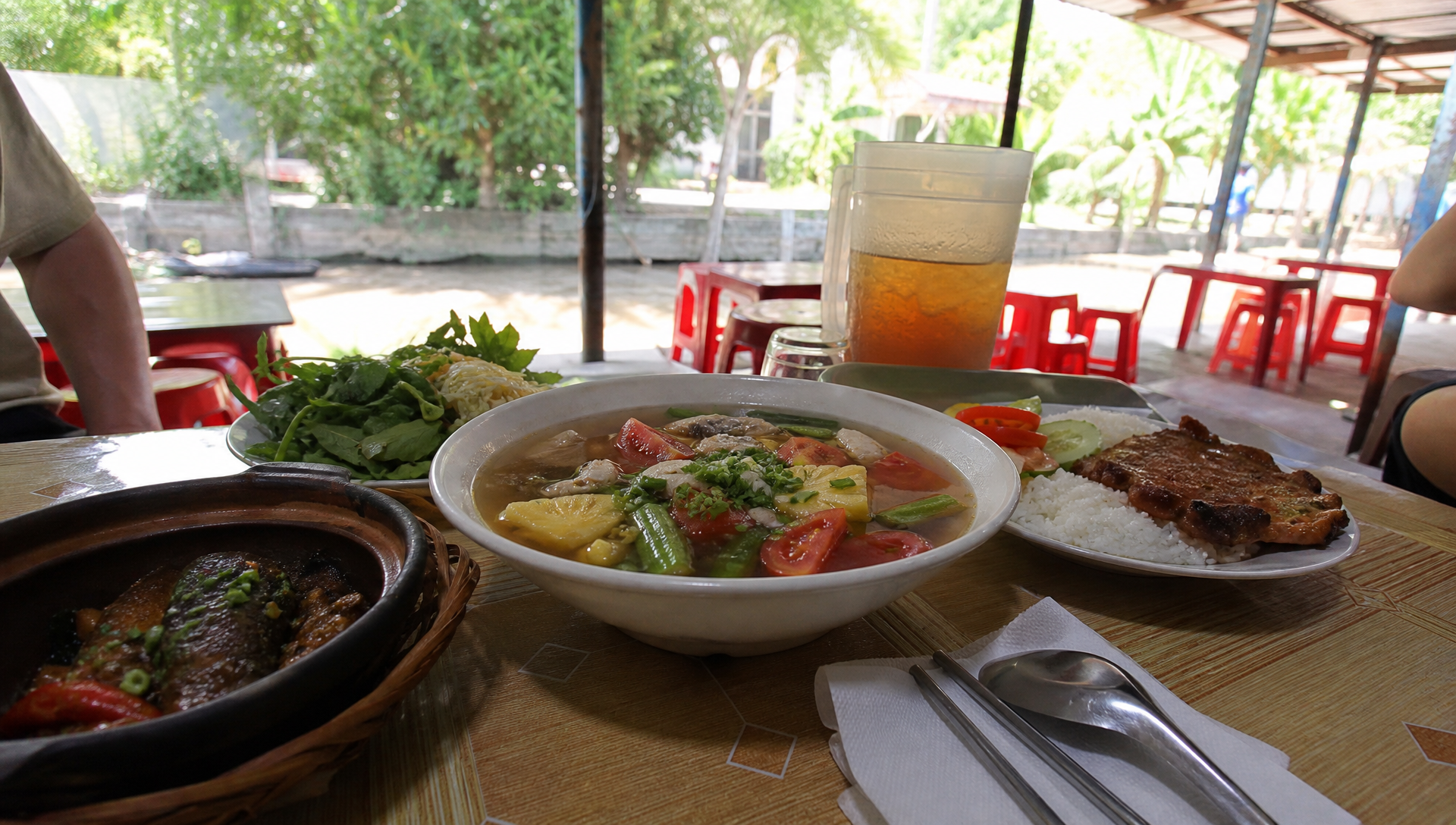
Most of the work happens before you order. Tamarind liquid, pineapple and tomato simmer into a base, sometimes for half an hour, and many kitchens hold it through service. The fish is poached to order — six to eight minutes for a snakehead steak — with the vegetables two to four minutes behind it.
So the wait is short, five to twelve minutes in a busy quán, but the broth lands close to boiling and the fish keeps cooking in the bowl. Take it out early rather than late; twenty minutes of sitting turns firm flesh flaky and soft catfish mushy. At a hot-pot table the order reverses: five to ten minutes for the broth to come up, then you set the pace for everything you drop in.
Eight weeks a year when the bowl is a different dish
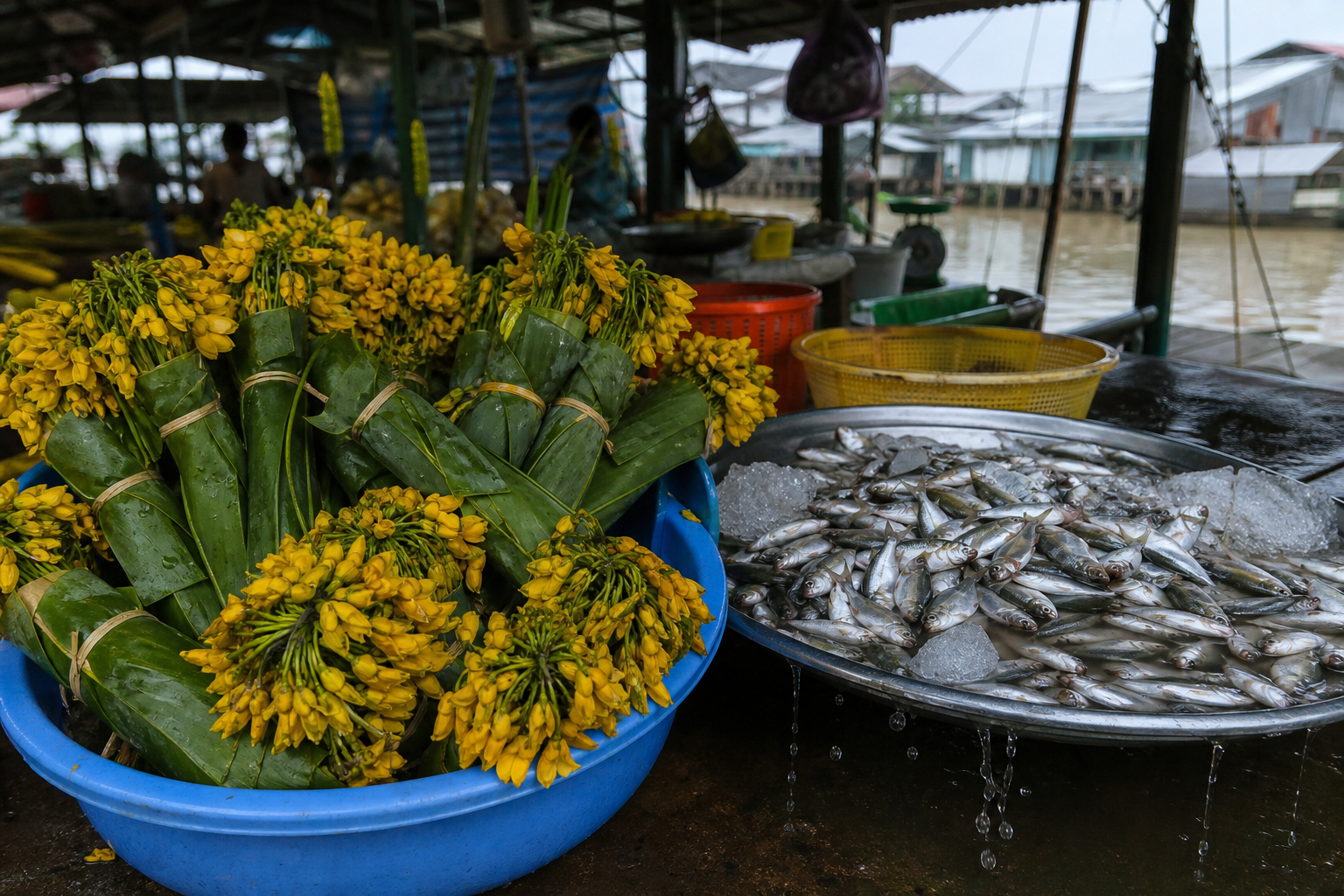
From roughly late August into November the Mekong rises and the delta floods, and two ingredients reshape the menu: cá linh, a small silver river fish that runs with the floodwater, and bông điên điển, the yellow sesbania flower picked from inundated fields. Together they make canh chua cá linh bông điên điển and its hot-pot version — the signature Vietnamese sour soup of An Giang province around Châu Đốc.
Châu Đốc is about 250 km from Ho Chi Minh City, five to six hours by road; Cần Thơ is roughly 170 km, three to four hours. Both are cheapest at the height of the flood and either vanish or turn up frozen and expensive outside it, and the window shifts with how high the Mekong runs — a range, not a date. Măng chua follows the same rhythm. If you are timing a trip around food rather than weather, this is the window to check against a month-by-month view of the country.
Nine things a Vietnamese sour soup menu never prints
- The dip is for the fish, not the broth. Fish sauce with sliced chilli and sometimes lime arrives with the order; dip the fish, spoon the broth over rice.
- Rice is the pairing, noodles are the exception. With bún, the dish is usually the hot-pot version.
- Sourness is set in the kitchen. Ask for ít me (less tamarind) when you order; the stall vocabulary for adjusting a bowl is short. Once the pulp is in the pot it cannot come back out.
- It is not a spicy dish by default. Heat lives in the chilli slices and the dip; say không cay for none.
- Heads are a feature, not a bargain cut. The đầu cá line costs more and is the boniest of all.
- A vegetarian version exists on most menus. Canh chua chay swaps fish for tofu and mushroom, fish sauce for soy or mushroom seasoning, and costs less.
- Herbs are free and refillable. Asking for thêm rau costs nothing.
- The pot sits in the middle. In a family meal everyone refills their own bowl; nobody serves you.
- Tea and ice are usually free. Trà đá arrives unasked at most quán; bottled water runs 5,000–10,000 VND.
FAQ
Is Vietnamese sour soup spicy? No, not by default. The sourness comes from tamarind or fermented rice, and the heat comes from fresh chilli slices and the fish-sauce dip on the side, both of which you control. Say không cay when ordering if you want the bowl plain.
Can you eat it as a full meal? Yes, with rice. A shared bowl plus rice and one grilled or braised dish is a standard meal for two or three people; the soup on its own leaves most people hungry.
Does the fish have bones? Cá lóc and other whole-fish versions do, especially toward the head. If that is a problem, order cá trê or cá basa steaks or the vegetarian version, and read the menu line carefully: a bowl described by fish head will be the boniest.
What do you do if you don’t eat fish at all? Order canh chua chay, the tofu and mushroom version. Ask whether the broth uses fish sauce, since many kitchens season the vegetarian pot with the same base and will swap it on request.
Where did Vietnamese sour soup originate? The Mekong Delta of southern Vietnam, where it is built around river fish and tamarind. Central Vietnam has its own sour soups with different souring agents, and northern versions lean on seasonal sour fruit instead.