
I burned my mouth on bún bò Huế the first time I ordered it, in a plastic-chair stall two streets back from the Perfume River in Huế, because I did what every first-timer does: I stirred in the little dish of raw chili paste sitting on the table without asking what it was. The vendor, an older man with a towel over his shoulder, watched me take one spoonful, saw my face change, and just said “cay lắm đó” — very spicy — about four seconds too late to be useful. I finished the bowl anyway, sweating, and went back the next day for more.
Bún bò Huế gets lumped in with phở by people who haven’t had it, but they’re barely related. It’s thicker, spicier, funkier from fermented shrimp paste, and built from completely different technique. Instead of walking you through a day of eating it (I did plenty of that too), I want to actually take the bowl apart — broth, noodle, protein, garnish, condiment — because understanding what’s in front of you changes how you order it, how you eat it, and honestly how much you enjoy it. This is the dish explained piece by piece, based on eating it six times across four days in Huế and comparing notes with three different vendors.
Component 1: The Broth — Where the Whole Dish Lives or Dies
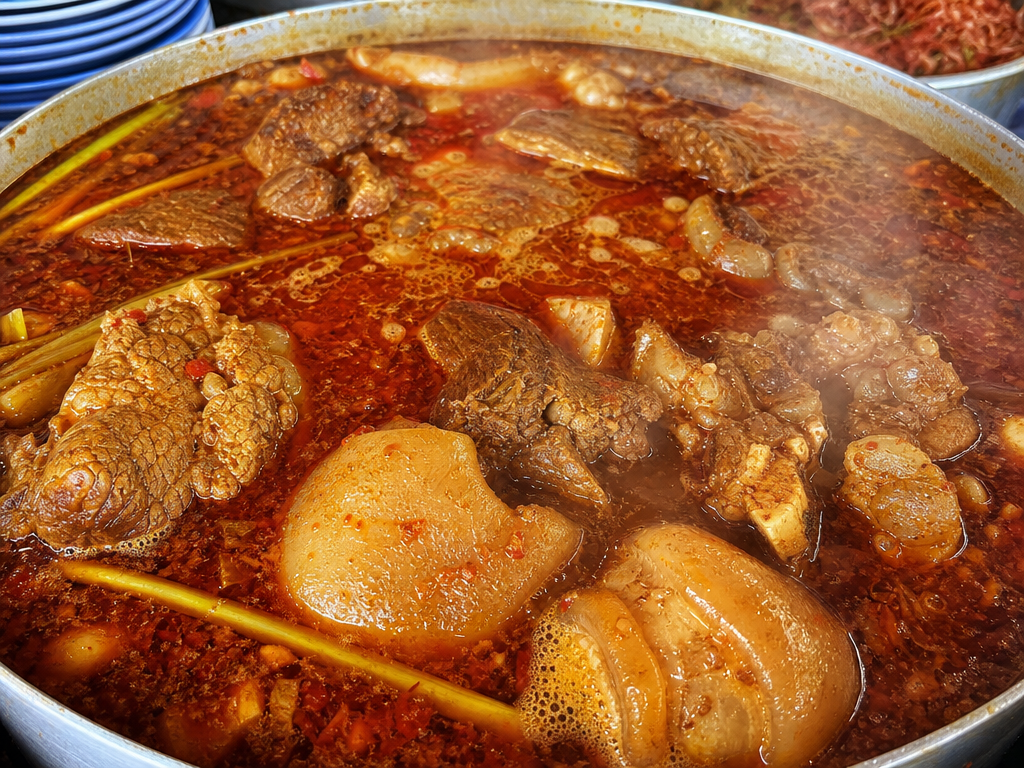
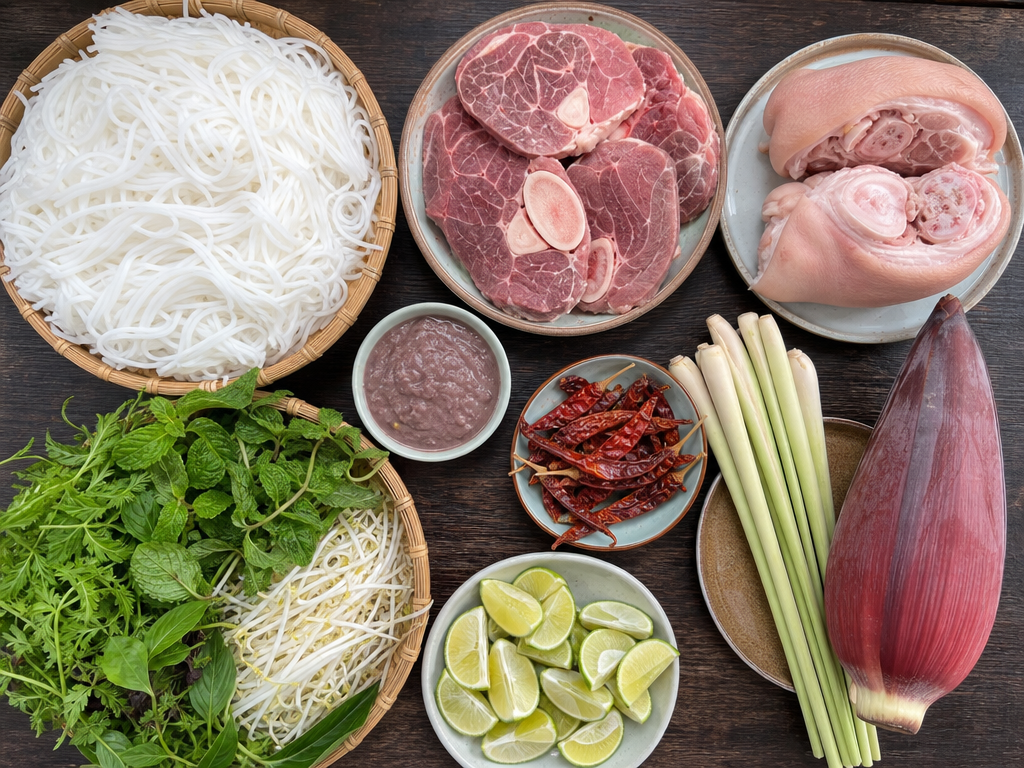
This is the part that actually defines the dish, and it’s built from three things most people don’t expect: beef bones simmered for hours, lemongrass stalks bruised and added in bundles, and mắm ruốc — fermented shrimp paste — stirred in near the end. That last ingredient is the one that throws newcomers off. It smells sharp and a little funky raw, but once it dissolves into a broth this rich, it adds a savory depth that plain beef stock can’t get to on its own. The color comes from chili oil, usually made by frying chili flakes in annatto-tinted oil, floated on top rather than mixed all the way through — which is why the first spoonful can look deceptively calm and the fourth spoonful, once you’ve stirred it, suddenly isn’t.
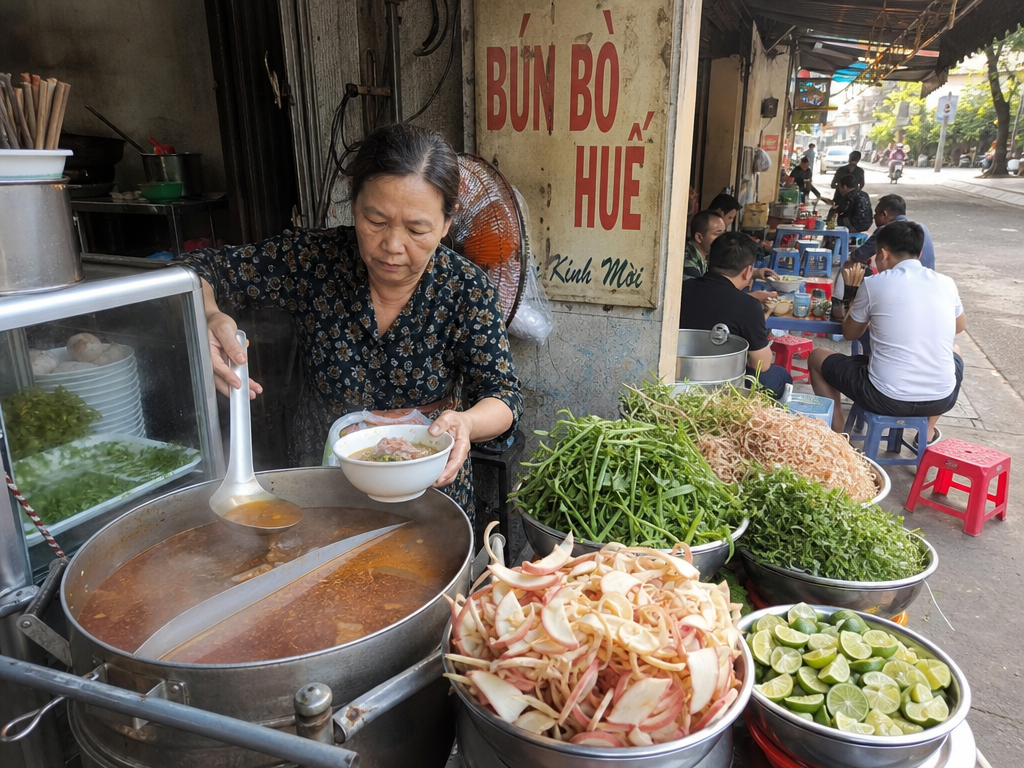
I asked a vendor named Anh Tuấn near An Cựu how long his broth actually simmers, and he said he starts it around 4am for lunch service — a six-to-seven hour process he does daily, not in batches that last multiple days. That freshness is part of why the good bowls taste layered instead of flat.
Component 2: The Noodle — Thicker Than You Think
Bún bò Huế noodles (bún) are round like the vermicelli used in bún chả or bún đậu, but noticeably thicker — closer to the diameter of a thin spaghetti than the hair-thin noodles in a lot of other Vietnamese bún dishes. This matters because thin noodles would get lost in a broth this heavy; the thicker noodle holds up to the punch of the broth without turning to mush by the time you finish the bowl. If you’ve had phở and expect flat rice noodles (bánh phở), don’t — bún bò Huế is always round noodles, never flat ones. Mixing that up is one of the more common misunderstandings I’ve seen tourists have when ordering.
Component 3: The Protein — More Variety Than a Single Word Suggests
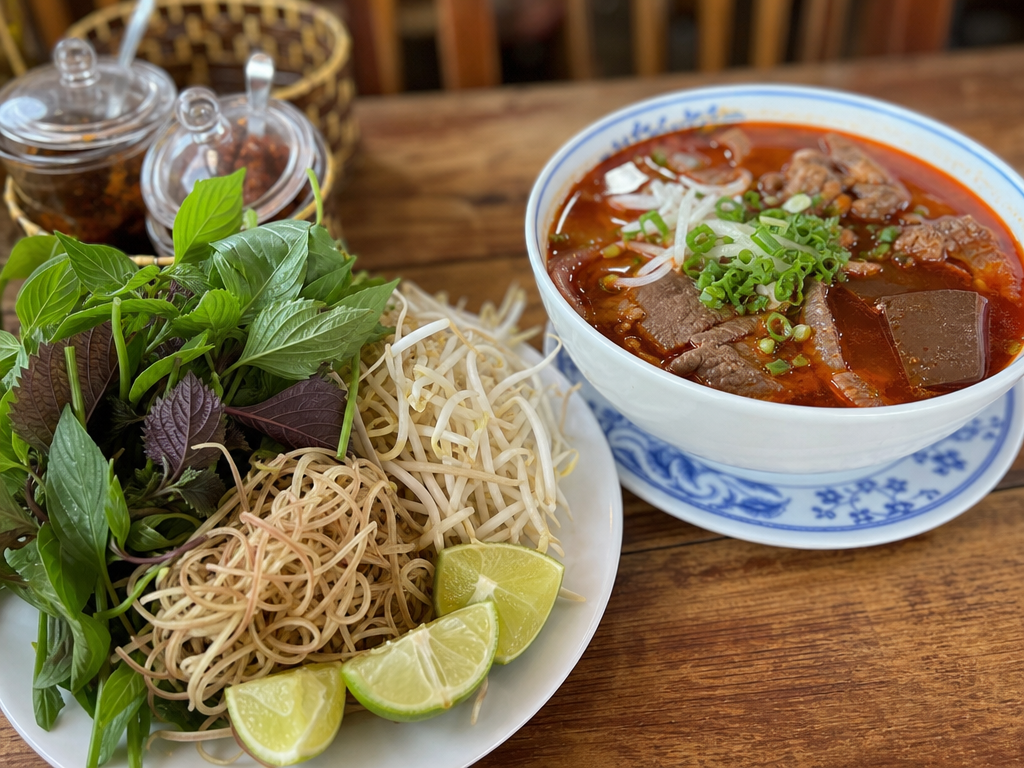
“Beef noodle soup” undersells what’s actually in the bowl. A standard serving typically includes sliced beef shank (bắp bò), a chunk of pork knuckle or pig’s trotter (giò heo), and often a cube of congealed pork or beef blood (huyết), which has almost no flavor of its own but takes on the broth and adds a soft, custardy texture. Some stalls also offer chả cua (crab paste cake) as an add-on for about 10,000 VND extra. I ordered the full combination — beef, pork knuckle, and blood — on my second visit specifically to understand the range, and honestly the pork knuckle was my favorite: slow-braised until the collagen turned soft and almost sticky, very different from the leaner beef shank slices.
Component 4: The Garnish Plate — Not Optional, Not Decoration
You’ll get a side plate with shredded banana blossom (bắp chuối), bean sprouts, Vietnamese mint (rau răm), perilla or basil depending on the stall, and a lime wedge. This isn’t a garnish you can skip the way you might skip parsley on a Western dish — the banana blossom especially adds a slightly bitter, crunchy contrast that balances the richness of the broth, and without it the bowl feels one-note by the halfway point. I made the mistake on my first bowl of eating around the garnish plate instead of mixing it in, treating it like a side salad, and the broth just felt heavier and more one-dimensional than it needed to. Once I started tearing the banana blossom in and squeezing the full lime wedge over the top, the whole bowl opened up.
Component 5: The Condiment Dish — Handle With Respect
Almost every stall gives you a small side dish of raw chili — sometimes sliced fresh, sometimes a thick reddish paste — separate from the chili oil already floating in the broth. This is the part that got me on day one. The broth itself is already spicier than phở by default, so adding the side chili is stacking heat on top of heat. My advice, learned the hard way: taste the broth completely unmodified first. If you want more heat after that, add the chili in small amounts, stir, taste, repeat. Don’t dump it in like you would sriracha into a bowl of instant noodles — mắm ruốc–based broths carry heat differently, and it builds after you swallow rather than hitting immediately, so you won’t feel how spicy it’s about to get until it’s too late to undo it.
What a Bowl Actually Costs
Prices in Huế itself, where the dish originates, were noticeably lower than what I later paid for bún bò Huế-style bowls in Hanoi and Saigon. Near Dong Ba Market I paid between 30,000 and 40,000 VND ($1.20–$1.60) for a standard bowl with beef and pork knuckle. Adding the crab paste cake or extra meat pushed a couple of bowls to 50,000 VND ($2). At a more restaurant-style sit-down spot closer to the Citadel, the same bowl with table service ran 55,000–65,000 VND ($2.20–$2.60). Outside Huế, in touristy areas of Hanoi, I saw menus pricing a similar bowl at 65,000–85,000 VND, a noticeable markup for a dish that travels less well once it’s outside its home city — the broth I had in Hanoi was thinner and missed the funk of the mắm ruốc entirely.
How It Fits Into a Huế Food Day
If you’re building a food-focused day around Huế, I’d anchor breakfast on bún bò Huế specifically because most stalls are strongest early — by early afternoon, a lot of the good spots near the market have already sold out of pork knuckle and are running on reheated broth. I usually paired that with an afternoon walk through the Hue Imperial City, which is where I ended up talking to Anh Tuấn about his broth timing in the first place. If you’re comparing regional noodle soups across your trip, it’s worth tasting this next to mì Quảng from Quảng Nam or cao lầu from Hội An — three dishes from three cities within a few hours of each other, and each one tells you something different about how central Vietnam builds a noodle bowl.
Bún bò Huế has documented roots specifically tied to Huế as the former imperial capital, and its combination of lemongrass, chili, and fermented shrimp paste is considered one of the more technically demanding broths in Vietnamese cooking. You can read more general background on the dish on Wikipedia’s entry for bún bò Huế, and on the city’s broader culinary identity via Wikipedia’s entry on Huế.
Final Take
Taking the bowl apart like this changed how I order it now — I ask for the pork knuckle specifically because I know what it’s doing in the broth, I taste before I touch the chili dish, and I actually use the garnish plate instead of nudging it to the side. It’s a dish that rewards understanding its components rather than just diving in, and it’s also, unlike a lot of iconic Vietnamese dishes, genuinely hard to find done well outside its home city. If you’re only eating one noodle soup during a Huế stop, make it this one, order it where the broth’s been going since before sunrise, and go in already knowing what’s in the bowl.
FAQ
Is bún bò Huế always this spicy?
By default, yes — spicier than phở. You can ask for it “không cay” (not spicy) or “ít cay” (a little spicy) at most stalls, and they’ll leave out the chili oil, though the broth itself still carries some heat from the base recipe.
What’s the difference between bún bò Huế and phở?
Different noodles (round and thick vs. flat rice noodles), different broth base (beef bone plus lemongrass and fermented shrimp paste vs. a clearer, more delicately spiced beef or chicken broth), and very different heat levels. They’re both noodle soups but not interchangeable.
Can I get it without the pork blood cube?
Yes, just ask for it “không có huyết.” It’s a common request and vendors are used to it.
Is bún bò Huế available outside Huế?
Widely, yes — it’s one of the most popular noodle soups nationwide. But the closer you are to Huế, the more likely you’ll get the funkier, more traditional mắm ruốc-forward version rather than a milder adaptation.
What time of day is best to eat it?
Morning to early afternoon. Like a lot of Vietnamese noodle soups, the best stalls tend to sell out of key ingredients like pork knuckle by mid-afternoon.